

Key Takeaways
Fuel Economy Rating (MPG)
A fuel economy rating, expressed in miles per gallon (MPG), tells you how far a vehicle can travel on one gallon of fuel under standardized test conditions. The U.S. Environmental Protection Agency (EPA) sets and publishes these ratings for every new vehicle sold in America. Higher MPG means the vehicle uses less fuel to travel the same distance, which generally translates to lower fuel costs.
EPA ratings are generated from laboratory simulations of city and highway driving cycles, not from real road tests. Actual on-road MPG varies based on driver behavior, load, terrain, weather, and vehicle condition.
What the Window Sticker Is Actually Telling You
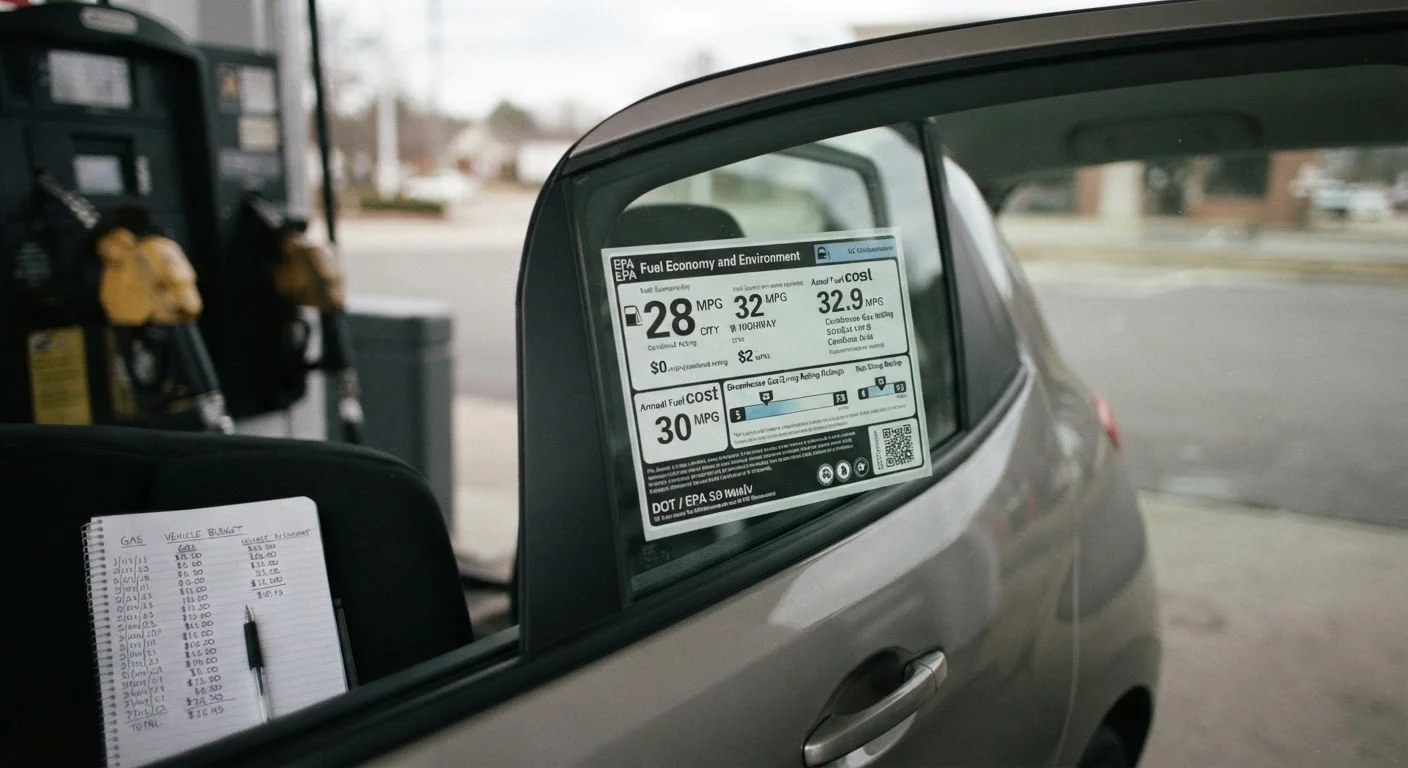
Every new car sold in the U.S. carries an EPA fuel economy label — a yellow-and-black sticker showing city, highway, and combined MPG figures. Many shoppers glance at these numbers and move on. But understanding what these figures actually represent can change how you evaluate a vehicle's long-term cost.
The EPA derives its ratings from laboratory simulations, not real highway driving. Test engineers run vehicles through standardized driving cycles in a climate-controlled setting. The results are useful for comparing vehicles to each other, but they don't account for how you drive — your commute terrain, your highway speed habits, or your local climate.
That gap between lab and reality matters. According to the EPA, most drivers can expect real-world MPG to fall somewhere below the sticker figure, often by 10–20% depending on conditions. For a vehicle rated at 30 MPG combined, real-world performance might land closer to 24–27 MPG for many drivers.
10–20%
Typical gap between EPA rating and real-world MPG
The U.S. Department of Energy notes that real-world fuel economy frequently falls below the EPA sticker figure due to driving habits, weather, and load.
~$1,500–$2,500
Estimated annual fuel cost for average U.S. drivers
Based on national average mileage (12,000–15,000 miles/year) and typical gas prices; actual costs vary significantly by vehicle efficiency and local fuel prices.
10–15%
Fuel economy loss from driving 75 vs. 65 mph
According to the U.S. Department of Energy, fuel efficiency drops noticeably as highway speed increases above 50 mph.
Turning MPG Into an Actual Dollar Figure
A fuel economy rating only becomes financially meaningful when you attach it to your driving habits and your local gas price. Here's a straightforward way to estimate your annual fuel cost:
- Estimate your annual miles. The national average is roughly 12,000–15,000 miles per year, but your number may differ based on your commute and lifestyle.
- Divide your miles by the vehicle's realistic MPG. Use the combined EPA figure as a starting point, then mentally discount it by 10–15% for real-world conditions.
- Multiply gallons needed by your local gas price. Gas prices vary significantly by state and season, so use a current local figure rather than a national average.
As an example: if you drive 13,000 miles annually in a vehicle that realistically delivers 28 MPG, you'll use about 464 gallons of gas. At $3.50 per gallon, that's roughly $1,625 per year in fuel alone.
Run the same calculation for a vehicle rated at 22 MPG: 13,000 ÷ 22 = 591 gallons × $3.50 = approximately $2,068 per year. That 6 MPG gap costs you over $440 annually — and around $2,200 over five years.
Tools like the EPA's fueleconomy.gov let you compare vehicles side-by-side with customizable mileage and fuel price inputs, which gives a more tailored estimate than the sticker alone. For a complete picture of what a vehicle costs beyond fuel, see our guide to reading a car's total cost of ownership.
The Variables That Move the Needle Most
MPG is not a fixed property of a vehicle — it's a range influenced by several controllable and uncontrollable factors.
Driving behavior
Hard acceleration, frequent braking, and sustained high highway speeds are among the biggest drains on fuel efficiency. Driving at 75 mph instead of 65 mph can reduce fuel economy by roughly 10–15%, according to the U.S. Department of Energy. Smooth, anticipatory driving consistently outperforms aggressive habits.
Vehicle load and accessories
Extra weight — passengers, cargo, roof racks — increases fuel demand. Running the air conditioner at full blast in summer or using heated seats in winter also draws engine power and reduces MPG.
Tire condition and inflation
Underinflated tires increase rolling resistance. Keeping tires at the manufacturer's recommended pressure (found on the door jamb sticker, not the tire sidewall) helps preserve fuel economy. Our car maintenance hub covers tire care and other habits that protect long-term efficiency.
Temperature and terrain
Cold weather thickens engine oil and increases warm-up time, reducing efficiency. Hilly terrain demands more from the engine than flat roads. If you live in Minnesota and commute over hills, your real-world MPG will diverge from a California flat-road test more than the sticker suggests.
These variables are why two drivers in identical vehicles can have meaningfully different annual fuel bills — sometimes by hundreds of dollars. For a broader view of where driving costs accumulate, see our look at where drivers waste the most money.
Putting Fuel Economy in the Full Ownership Picture
Fuel is one of the largest recurring ownership costs, but it doesn't exist in isolation. A vehicle with excellent fuel economy might carry a higher purchase price, or require premium-grade gasoline that offsets some savings. A less efficient vehicle might have lower insurance costs or depreciate more slowly in your specific market.
The right approach is to treat fuel economy as one line item in a broader cost-of-ownership calculation, not the headline number that decides everything. Our article on the true annual cost of owning a car in America walks through all the categories — insurance, depreciation, maintenance, and fees — that round out the real financial picture.
If you're weighing vehicle options, comparing new and used vehicles on total cost can also surface tradeoffs that MPG alone won't reveal.
The goal isn't to find the highest MPG number — it's to understand what that number will realistically cost or save you, given how you actually drive.