

Key Takeaways
Option A
Batch Cooking
The cook-once, eat-all-week strategy.
Best for: People who want to minimize daily cooking by preparing complete or near-complete meals in large quantities on one dedicated day.
Option B
Meal Prepping
The flexible component-first approach.
Best for: People who want building-block ingredients ready to mix and match throughout the week without committing to set meals in advance.
If you want dinner on the table in under 10 minutes on busy weeknights
Batch Cooking
Fully cooked meals just need reheating, making them the fastest path from fridge to table on hectic evenings.
If you get bored eating the same meal multiple days in a row
Meal Prepping
Having prepped components lets you assemble different combinations each day, keeping meals feeling fresh without extra daily effort.
If you're cooking for a full household with varied tastes
Meal Prepping
Prepped components allow household members to build their own plates, accommodating different preferences with a single prep session.
If you're cooking solo and want to control portions and food costs
Batch Cooking
Making a large pot of soup, stew, or grain dish and portioning it into individual servings is one of the most cost-efficient strategies for single-person households.
If you want maximum flexibility to decide meals day by day
Meal Prepping
Prepped ingredients can pivot easily — the same roasted vegetables work in grain bowls, wraps, omelets, or as a side dish depending on what sounds good.
What's the Actual Difference?
The terms "batch cooking" and "meal prepping" get used interchangeably in food blogs and social media, but they describe meaningfully different workflows. Knowing which is which helps you choose the one that actually fits how you live — rather than copying a system that works for someone with a completely different schedule.
Batch cooking means preparing a large quantity of one complete dish or recipe at a time. You make a full pot of chili, a tray of baked chicken thighs, or a slow-cooker soup — then portion it out and eat it across several days. The meal is essentially finished once it's cooked.
Meal prepping, by contrast, means preparing individual components — cooked grains, washed greens, roasted vegetables, marinated proteins — that you combine into different meals throughout the week. Nothing is fully assembled in advance; instead, you build each meal at the time you eat it, using ready-to-go parts.
Both save time. Both reduce the friction of weeknight cooking. But they do it through opposite logic: batch cooking front-loads the assembly, while meal prepping front-loads the ingredients.
| Criterion | Batch Cooking | Meal Prepping |
|---|---|---|
| Output | Complete or near-complete meals | Ready-to-use ingredients and components |
| Daily flexibility | Low — meals are predetermined | High — mix and match each day |
| Weeknight effort | Minimal — just reheat | Light — quick assembly required |
| Variety | Limited — same dish repeated | High — many combinations possible |
| Skill level needed | Beginner-friendly | Moderate — juggling multiple preps |
| Best household size | Solo or consistent eaters | Mixed preferences or larger households |
| Budget efficiency | High — single-recipe bulk buying | Moderate — more ingredients to manage |
| Food safety window | 3–4 days refrigerated (most dishes) | Varies by component; some last longer |
When Batch Cooking Makes More Sense
Batch cooking works best when predictability is your friend. If you're comfortable eating the same lunch three days in a row, or if you have a handful of go-to recipes your household actually wants on repeat, batch cooking delivers the highest return on your time investment.
It's also the more beginner-friendly approach. You're working within a single recipe — scaling up a familiar dish rather than managing multiple simultaneous preps. A large pot of lentil soup, a sheet pan of roasted chicken and potatoes, or a casserole portioned into individual containers can cover several days of meals with one focused cooking session.
Budget-conscious cooks often favor batch cooking because buying ingredients in larger quantities for one dish is easier to plan and typically reduces per-serving cost. It also pairs naturally with strategies like cooking from what you already have, since a batch recipe can often absorb pantry staples that need to be used up.
One limitation: batch cooking can feel monotonous if variety is important to you or your household. Food safety is also a real consideration — most cooked dishes should be consumed within three to four days when refrigerated, so plan batches with that window in mind.
When Meal Prepping Makes More Sense
Meal prepping shines when flexibility matters more than simplicity. If different people in your household have different preferences, or if your appetite shifts from day to day, having a bank of ready components lets you assemble exactly what you want without committing to a specific meal in advance.
A typical meal prep session might include: a cooked grain (brown rice or farro), a roasted vegetable (broccoli and sweet potatoes), a cooked protein (ground turkey or hard-boiled eggs), and a washed, dried salad green. From those four components, you can build grain bowls, wraps, omelets, or quick stir-fries throughout the week — each meal feeling distinct despite sharing a prep session.
This approach rewards cooks who have developed some basic knife skills and kitchen comfort, since managing multiple components simultaneously takes more coordination than following a single recipe. The mise en place habit — organizing ingredients before cooking starts — becomes especially useful here.
Meal prepping also scales well. As explored in our guide to scaling meal plans by household size, a component-based system adapts naturally to one person or five, since each person can portion their own plate from the same set of ingredients.
~68%
Americans who say weeknight dinners feel stressful
Survey data from the American Time Use Survey and related food research consistently show that time pressure around evening meals is one of the most commonly reported household stressors.
30–45 min
Typical weekly time saved per prep session
Nutrition and meal planning researchers generally estimate that structured weekly prep reduces daily active cooking time by roughly 30 to 45 minutes on average across weekdays.
Up to 25%
Potential reduction in weekly food waste
Planning meals — whether through batch cooking or prepping — has been associated with reduced food waste by limiting impulse purchases and ensuring ingredients are used before spoiling, according to food waste reduction research.
Combining Both Approaches
You don't have to choose one method exclusively. Many experienced home cooks layer both strategies: they batch-cook one or two high-effort items (a protein, a soup, a grain that takes 45 minutes) while simultaneously prepping components (chopping vegetables, washing herbs, portioning snacks) that add variety to the rest of the week.
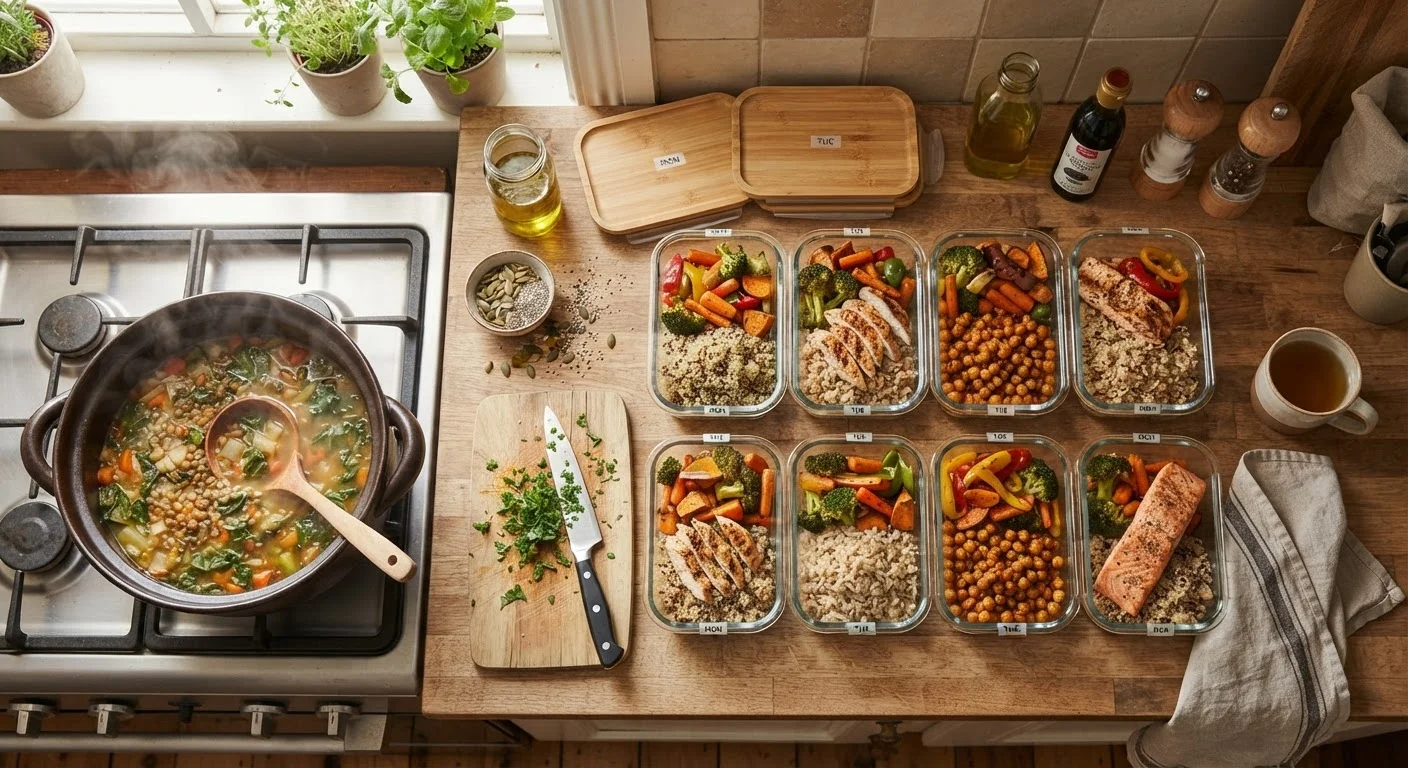
For example, a single two-hour session might produce a full batch of turkey meatballs stored in the freezer, a pot of cooked farro, and a sheet pan of roasted mixed vegetables. The meatballs serve as a ready-made dinner option; the farro and vegetables serve as flexible components for lunches and quick weeknight meals.
If you're newer to either approach, it helps to start small and specific rather than overhauling your entire routine at once. Our guide to meal planning myths addresses the common belief that these systems require hours of elaborate weekend effort — in practice, even 30–45 minutes of focused prep can meaningfully reduce weeknight stress.
Use the before-you-cook checklist to organize your session before you start, so your prep time is spent cooking rather than searching for equipment or ingredients.