

Key Takeaways
Option A
Brake Pads
The consumable friction material that stops your car.
Best for: Drivers experiencing squealing or reduced stopping response who need the most common brake service.
Option B
Brake Rotors
The metal disc that pads clamp against to slow the wheel.
Best for: Drivers noticing vibration, pulsing, or grinding who may have moved beyond a simple pad replacement.
If you hear a high-pitched squeal when braking but stopping feels normal
Brake Pads
Most modern pads include a metal wear indicator that squeals deliberately when friction material runs low. This is typically a pad-only issue caught early.
If you feel a pulsing or shuddering through the pedal when slowing down
Brake Rotors
Pedal pulsation usually means the rotor surface is uneven or warped. Resurfacing or replacing the rotors — along with fresh pads — is generally needed.
If you hear a deep metallic grinding with every brake application
Brake Rotors
Metal-on-metal grinding means pads are fully worn and the backing plate is cutting into the rotor. Both components almost certainly need replacement at this stage.
If your brake warning light comes on and the car is less than a year past its last service
Brake Pads
Many vehicles have electronic pad-wear sensors that trigger a dashboard warning before damage occurs. Rotors are likely still serviceable at this stage.
What Each Component Actually Does
Your braking system works by converting the kinetic energy of a moving vehicle into heat through friction. Two parts do most of the work: the brake pad and the brake rotor.
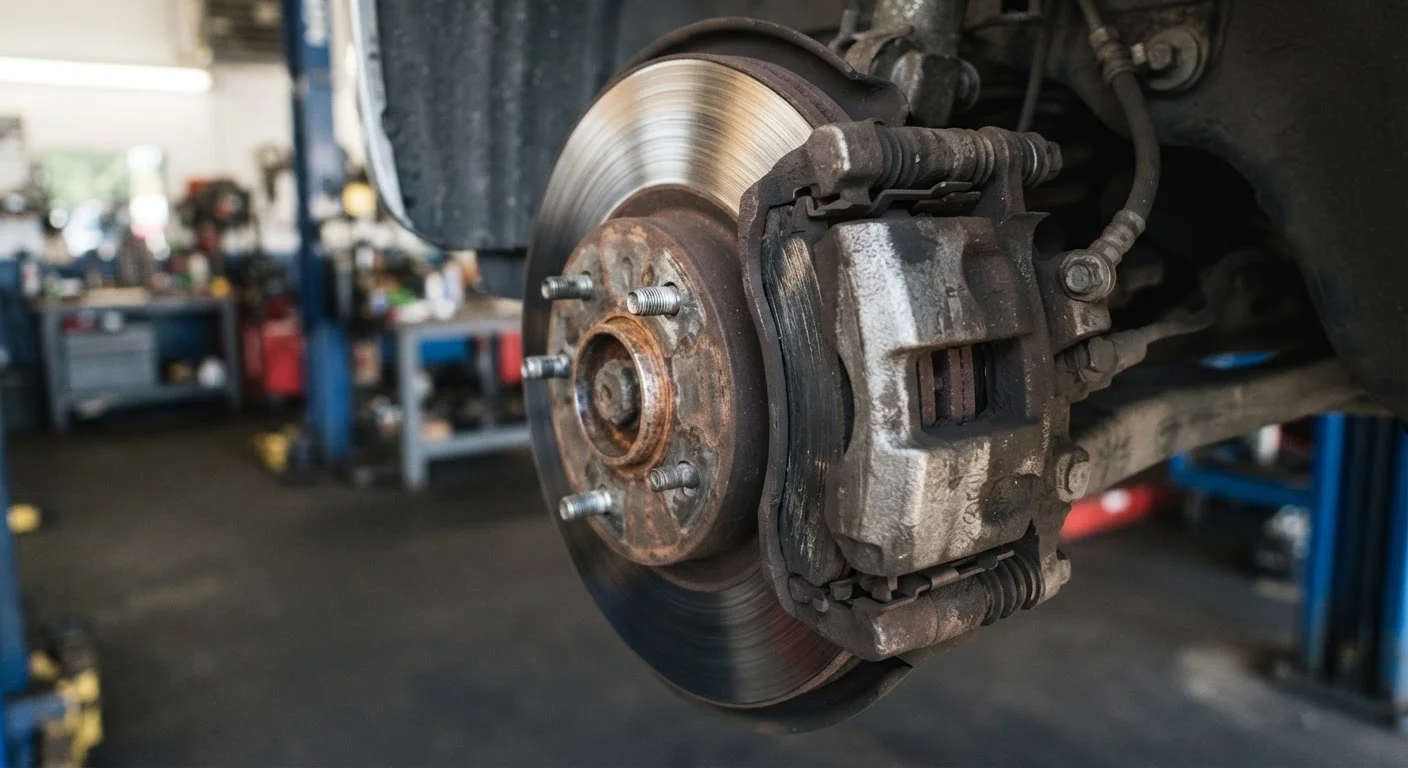
The rotor (also called a disc) is a round metal plate bolted to the wheel hub that spins with your tire. The pad is a friction material — bonded to a steel backing plate — that a hydraulic caliper squeezes against both sides of the rotor when you press the brake pedal. That clamping friction is what slows the wheel.
Because pads are made from softer friction material designed to wear sacrificially, they degrade far faster than rotors. Think of rotors as a long-lived surface and pads as the consumable element pressed against it — similar to how a record player needle wears before the record does.
For more on how brake fluid pressure connects to this whole system, see our guide to your car's fluid system.
Reading the Warning Signs: Pads vs. Rotors
The sounds and sensations your car produces while braking are reliable clues — if you know what to listen and feel for.
Signs pointing to brake pads
- High-pitched squealing: A deliberate wear indicator — a small metal tab — makes this noise when pads thin to roughly 2–3mm of usable material remaining.
- Soft or spongy pedal feel: Sometimes accompanies severe pad wear, though this can also signal a brake fluid issue.
- Reduced braking response: The car takes slightly longer to stop than it used to, especially noticeable on highway ramps.
Signs pointing to brake rotors
- Pulsing or vibration in the pedal: A classic symptom of rotor runout — where the disc surface is no longer perfectly flat or concentric.
- Steering wheel shudder during braking: Often means a front rotor has developed thickness variation across its surface.
- Deep metallic grinding: At this stage pads are gone and the steel backing is contacting the rotor directly, scoring its surface.
- Visible grooves or rust channels on the rotor face: Light surface rust after rain is normal and brushes off; deep grooves mean the surface is compromised.
| Criterion | Brake Pads | Brake Rotors |
|---|---|---|
| Primary function | Friction material that grips the rotor | Metal disc the pads clamp against |
| Typical replacement interval | 25,000–70,000 miles (varies by driving style) | 50,000–70,000+ miles if pads replaced on time |
| Common warning sign | High-pitched squealing | Pedal pulsation or deep grinding |
| Can be resurfaced? | No — must be replaced | Sometimes, if above minimum thickness |
| Relative replacement cost | Lower (parts and labor) | Higher (parts and labor) |
| DIY difficulty | Moderate — accessible for confident DIYers | Higher — measurement tools recommended |
Why Neglecting Pads Destroys Rotors
This is the most important cost relationship to understand. Brake pads are the less expensive part of the equation — rotor replacement costs significantly more, and the labor to access rotors is generally the same whether you're replacing pads or the whole assembly.
When pads wear completely through, the metal backing plate contacts the rotor directly. Every brake application then machines grooves into the rotor face. What started as a pad-only job becomes a full brake job — pads and rotors — simply because the service was delayed.
Rotors that show light scoring or minor thickness loss can sometimes be resurfaced (machined flat on a brake lathe) rather than fully replaced, but only if sufficient material remains. Each rotor has a minimum discard thickness stamped on its edge or hat — once machined below that number, it must be replaced. A qualified mechanic can measure this with a micrometer during inspection.
Braking performance also ties directly into overall stopping distance. Everything that shapes your stopping distance explains how pad and rotor condition interact with speed, tires, and road surface to determine how quickly your vehicle actually halts.
When to Handle It Yourself vs. Call a Mechanic
Brake pad replacement is one of the more approachable DIY maintenance tasks for a mechanically confident driver with basic tools — a jack, jack stands, a lug wrench, and a C-clamp or caliper piston tool. Most passenger car pads can be swapped in an hour or two per axle.
Rotor work adds complexity. Removing a rotor sometimes requires loosening a retaining screw or dealing with corrosion that has essentially welded the rotor to the hub. If you're also assessing whether a rotor is within spec for resurfacing, that requires measurement tools most home garages don't have.
As a practical rule: if your only symptom is squealing with normal pedal feel, a pad replacement is a reasonable DIY project for someone comfortable working under a car safely on level ground. If there's vibration, grinding, or any doubt about rotor condition, having a professional measure and inspect before you commit to parts is money well spent.
Also worth remembering: brakes are a safety-critical system. If you're unsure at any step of a DIY brake job, stop and consult a qualified mechanic. There's no shame in drawing that line — brake failure has serious consequences.
For another example of how routine service items that sound alike differ in important ways, see our piece on tire rotation, balancing, and alignment.