

Key Takeaways
What Stopping Distance Actually Means
Stopping distance is the total distance your vehicle travels from the moment you perceive a hazard to the moment the car comes to a complete stop. It is not just about how hard your brakes work — it is the sum of two distinct phases that most drivers never separate in their thinking.
Reaction distance is how far you travel while your brain processes the hazard and your foot moves to the brake pedal. Braking distance is how far the car continues moving after the brakes are fully applied. Add them together and you get your total stopping distance — and that number can surprise even experienced drivers.
Understanding each component separately is the first step toward actually managing them. See our guide to defensive driving mental habits for how experienced drivers frame these split-second decisions.
How Speed Multiplies Your Stopping Distance
Speed is the single most powerful variable in the stopping distance equation. The relationship is not linear — it is exponential. Because kinetic energy increases with the square of velocity, doubling your speed does not double your braking distance; it roughly quadruples it.
~4x
Increase in braking distance when speed doubles
Because kinetic energy grows with the square of velocity, doubling speed quadruples the energy brakes must absorb.
132 ft
Distance traveled during reaction time at 60 mph
At 60 mph with a 1.5-second reaction time, a vehicle covers approximately 132 feet before braking begins.
Up to 10x
Stopping distance increase on ice vs. dry pavement
Ice dramatically reduces tire-road friction, extending stopping distances far beyond what most drivers expect.
A vehicle traveling at 30 mph might need around 75 feet to stop under ideal conditions. At 60 mph, that same vehicle may need close to 300 feet — four times the distance. At highway speeds of 70 mph or more, the numbers grow even more dramatically. This is why speed limits near schools, intersections, and pedestrian zones exist where they do.
The practical takeaway: small reductions in speed yield meaningful reductions in stopping distance. Dropping from 70 mph to 60 mph is not just a 14% reduction in speed — it is a significant reduction in the energy your brakes must absorb.
Reaction Time: The Hidden First Phase
The average driver reaction time — from perceiving a hazard to pressing the brake — is commonly cited as approximately 1.5 seconds under normal, alert conditions. That number sounds small. At 60 mph, 1.5 seconds equals roughly 132 feet of travel before braking even begins.
Several factors stretch that number considerably: driver fatigue, distraction (including hands-free phone use), alcohol or medication, and unfamiliar road conditions all increase reaction time. Nighttime driving adds the challenge of reduced visibility, meaning hazards appear later in your sightline.
Look well ahead — not just at the car in front of you. Scanning 12 to 15 seconds ahead gives your brain more time to process hazards before they become emergencies.
Earlier hazard detection directly reduces reaction distance, which is the phase of stopping distance most within a driver's control.
If you drive a truck or SUV and regularly carry heavy loads, add extra following distance beyond what you'd keep in an unloaded car. Weight changes your stopping equation every time.
Loaded vehicles carry significantly more kinetic energy and require greater braking force and distance to stop safely.
Improving reaction distance is less about reflexes and more about attention management. Scanning the road 12 to 15 seconds ahead, keeping eyes moving rather than fixed, and eliminating in-cabin distractions are all evidence-backed habits. This is explored more in our defensive driving habits article.
Road Surface and Weather Conditions
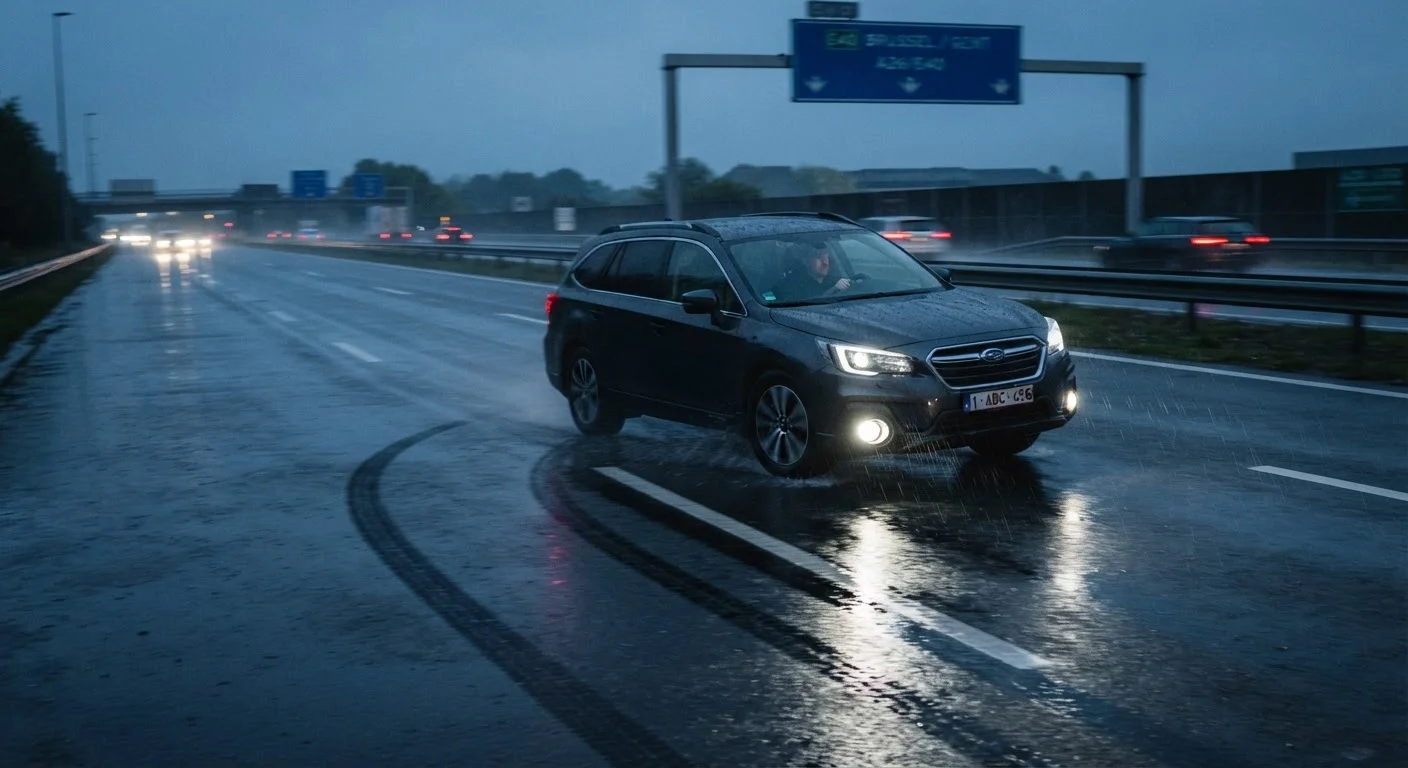
Braking distance depends heavily on the friction between your tires and the road surface. Friction is measured as a coefficient of friction — higher means more grip, shorter stopping distance. Dry asphalt offers a high coefficient. Wet pavement significantly reduces it. Ice or packed snow can drop it to a fraction of dry conditions.
General estimates for how surface conditions affect stopping distance compared to dry pavement:
- Wet road: roughly 2x the braking distance
- Loose gravel or dirt: 1.5x to 2x
- Snow-packed road: 3x to 4x
- Ice: up to 10x the dry stopping distance
These are general illustrations, not precise guarantees — actual results vary by tire type, vehicle weight, speed, and brake condition. The key insight is that surface changes require immediate adjustments to following distance and speed, not reactive ones after a skid begins.
Tire Condition and Its Outsized Impact
Tires are the only point of contact between your vehicle and the road. Their condition directly controls how effectively friction — and therefore braking — can occur. Two tire factors matter most: tread depth and inflation pressure.
Tread channels water away from the contact patch. As tread wears down, wet-weather braking performance degrades substantially. Tires at the minimum legal tread depth of 2/32 of an inch can take significantly longer to stop on wet roads than tires at 4/32 or deeper. Under-inflated tires deform unevenly, reducing the effective contact patch and generating excess heat that accelerates wear. Over-inflation shrinks the contact patch and reduces grip.
Checking tire condition before long trips is a basic step that pays real safety dividends. Our pre-trip safety walkthrough covers tire checks alongside other essential inspections.
Vehicle Weight, Brakes, and Safety Systems
Heavier vehicles carry more kinetic energy at any given speed and therefore require more braking force to stop. A loaded pickup truck or SUV will generally need more stopping distance than a compact car under the same conditions, assuming equivalent tires and brake systems. This is especially relevant for drivers who regularly haul cargo or tow trailers — braking behavior changes meaningfully under load.
Brake system condition also matters. Worn brake pads, glazed rotors, or low brake fluid can reduce clamping force and extend stopping distance. Regular brake inspections — typically recommended every 12,000 miles or annually — are a straightforward safeguard.
Modern safety systems like ABS (Anti-lock Braking System) and traction control improve vehicle control during emergency stops but do not eliminate the physics of weight and speed. ABS prevents wheel lockup so steering is maintained, but it does not shorten stopping distance on dry pavement compared to a skilled driver with well-maintained brakes. Our explanation of ABS and traction control goes deeper on what these systems actually do.
Practical Habits That Keep Your Margins Safe
The most effective way to manage stopping distance is to build habits that create buffer room before an emergency arises. None of these require special skills — only consistency.
- Increase following distance: The 3-second rule (staying 3 seconds behind the vehicle ahead) is a baseline for dry conditions. Add at least 2 more seconds in wet or reduced-visibility conditions, and double the gap on snow or ice.
- Slow down earlier: Anticipating stops and reducing speed gradually reduces brake heat and extends pad life. This also connects to fuel and maintenance savings — hard braking wears components faster.
- Check tires monthly: Pressure changes with temperature. A tire that was properly inflated in summer may be noticeably low by winter.
- Stay alert: Distraction is the most controllable reaction-time factor. Put the phone away, limit passenger conversations in complex traffic, and pull over if fatigued.
Stopping distance is ultimately a product of physics, vehicle condition, and driver behavior. The physics are fixed — but the other two are squarely within your control.
This article is for general informational and educational purposes. Always follow the safety guidance of a qualified mechanic for vehicle maintenance decisions, and consult your vehicle's owner manual for manufacturer-specific recommendations.