

Key Takeaways
Start here
Why Fluids Are the Lifeblood of Your Car
Build knowledge
The Six Essential Fluids and What They Do
Get hands-on
How to Check Each Fluid Yourself
Spot trouble early
Warning Signs You Should Never Ignore
Make smart decisions
When to DIY and When to Call a Mechanic
Why Fluids Are the Lifeblood of Your Car
Modern cars contain hundreds of moving parts that generate friction, heat, and pressure. Fluids are what allow those parts to work together without destroying each other. They lubricate, cool, transfer force, and clean — and when any one of them runs low or breaks down, the consequences can range from a minor inconvenience to an expensive repair or a safety hazard.
The good news: monitoring your car's fluid health is one of the most accessible things you can do as an owner. No special tools, no mechanical expertise required for the basics. Understanding what each fluid does and where to find it puts you in a far better position to catch problems early — before a dashboard light does it for you. For a broader look at how warnings escalate, see your car's dashboard warning lights, decoded.
Viscosity
A measure of how thick or thin a fluid is. Engine oil viscosity ratings (like 5W-30) indicate how the oil flows at different temperatures.
Hydraulic fluid
A fluid that transmits mechanical force through a closed system. Brake fluid is a hydraulic fluid — pressing the pedal pushes fluid through lines to activate the brakes.
Hygroscopic
A substance that absorbs moisture from the surrounding air. Brake fluid is hygroscopic, which is why it degrades over time even if you haven't used it much.
Dipstick
A long metal rod you pull out of the engine to check the level and condition of engine oil or transmission fluid.
Coolant flush
A service that drains old coolant from the radiator and cooling system and replaces it with fresh fluid, removing corrosion and buildup in the process.
MIN/MAX markings
Lines printed or molded onto a reservoir or dipstick indicating the safe operating range for a fluid. The level should always fall between these two points.
The Six Essential Fluids and What They Do
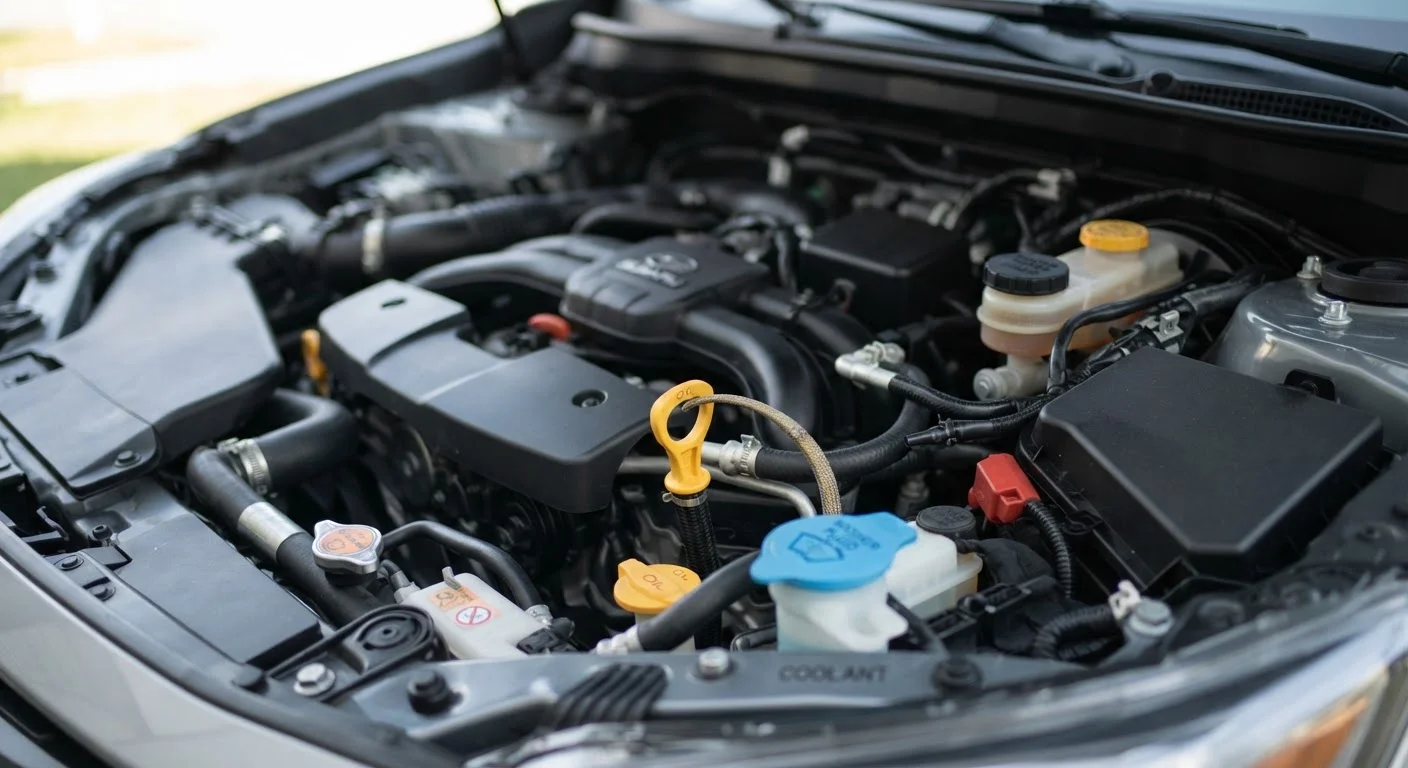
Every passenger vehicle relies on the same core set of fluids, each handling a specific job:
- Engine Oil
- Lubricates moving engine parts, reduces heat from friction, and carries microscopic debris away from sensitive surfaces. Without it, metal components wear against each other rapidly. For details on how often to change it, see what your owner's manual is actually telling you about oil change intervals.
- Coolant (Antifreeze)
- Regulates engine temperature by absorbing heat and releasing it through the radiator. It also prevents freezing in winter and corrosion inside the cooling system year-round.
- Brake Fluid
- Transfers the force of your foot pressing the brake pedal through hydraulic lines to the brake calipers and pads. It's hygroscopic, meaning it absorbs moisture over time, which lowers its boiling point and can reduce braking effectiveness.
- Transmission Fluid
- Lubricates the gears and internal components of the transmission. In automatic transmissions, it also acts as a hydraulic fluid that enables gear changes.
- Power Steering Fluid
- Powers the hydraulic assist that makes turning your steering wheel feel effortless. Many newer vehicles use electric power steering and don't have this reservoir at all.
- Windshield Washer Fluid
- Cleans your windshield on the go. Unlike water, it's formulated to resist freezing and to cut through road grime and insects.
How to Check Each Fluid Yourself
For most fluids, the process is straightforward: park on level ground, let the engine cool (especially for oil and coolant), locate the reservoir or dipstick, and compare the level against the marked MIN and MAX lines.
- Engine oil: Pull the dipstick, wipe it clean, reinsert fully, then pull again. Oil should fall between MIN and MAX and look amber to dark brown — not milky or gritty.
- Coolant: Check the translucent overflow reservoir (never open the radiator cap on a hot engine). Level should sit between the LOW and FULL marks.
- Brake fluid: Locate the small reservoir near the firewall on the driver's side. The level should be between MIN and MAX. Note that a low level can sometimes indicate worn brake pads, not just fluid loss.
- Transmission fluid: Many vehicles have a dipstick similar to the oil dipstick; others are sealed and require a lift and a mechanic. Consult your owner's manual.
- Power steering fluid: Found in a small reservoir near the power steering pump. Some caps have a built-in dipstick; others use MIN/MAX markings on the side.
- Windshield washer fluid: The only reservoir you can fill cold and full with no special precautions — just don't substitute plain water in freezing climates.
Warning Signs You Should Never Ignore
Fluid problems rarely appear without warning signals. Learning to read them early can save significant money and keep you safer on the road.
Check Fluids When the Engine Is Cold
Hot engines can give misleading fluid readings and pose a burn risk if you open the wrong cap. Make fluid checks part of a pre-trip routine before you start the engine — morning is ideal. The one exception is transmission fluid on vehicles that specify checking it at operating temperature; your owner's manual will note this.
- Oil pressure warning light: Stop driving as soon as it's safe to do so. Running an engine with critically low oil pressure can cause permanent damage within minutes.
- Spongy or sinking brake pedal: Could indicate air in the brake lines or a brake fluid leak — have this inspected immediately. See also brake pads vs. brake rotors.
- Engine overheating: Often tied to low coolant or a failing thermostat. Pull over safely if the temperature gauge climbs into the red.
- Slipping or rough gear changes: Can point to low or degraded transmission fluid.
- Puddles under the car: Identify the fluid by color and location, then address the source — not just the symptom.
Many of these warnings also trigger dashboard indicators. What your dashboard warning lights are actually telling you walks through which symbols demand immediate action versus which can wait for a scheduled appointment.
When to DIY and When to Call a Mechanic
Checking fluid levels and topping off windshield washer fluid or coolant (with the correct product) are tasks most drivers can handle safely at home. Changing engine oil is also manageable with the right preparation — and understanding whether conventional or synthetic motor oil is right for your engine helps you choose the correct product before you start.
However, some fluid jobs carry real safety or complexity risks that make professional service the right call:
- Brake fluid flush: Involves opening hydraulic lines. Incorrect bleeding can introduce air into the system, compromising braking. Have a qualified mechanic perform this.
- Transmission fluid change: Especially on sealed transmissions, this requires specialized equipment. Using the wrong fluid type can damage the transmission.
- Coolant flush: Disposing of used coolant requires following local regulations — it's toxic to animals. If you're not set up to handle this responsibly, a shop is the better option.
There are also plenty of fluid-related myths that lead drivers to spend unnecessarily or skip genuinely important services. Car maintenance myths that could be costing you money separates fact from fiction. And for a full picture of often-forgotten fluid services, maintenance items even diligent drivers tend to overlook is worth a read.