

| Check Engine Light Response | Steady = schedule service soon; Flashing = pull over promptly |
| TPMS Trigger Threshold | 25% below recommended PSI (U.S. TPMS federal standard (FMVSS 138)) |
| Overheating Cool-Down Time | At least 30 minutes before opening hood |
| Red Light Action | Stop or act immediately |
| Amber Light Action | Schedule service within a few days |
| Owner's Manual Location | Glove box or manufacturer's app/website |
Why Warning Lights Exist (and Why You Shouldn't Ignore Them)
Modern vehicles are equipped with an OBD system that continuously monitors dozens of sensors — from engine temperature to wheel speed. When something falls outside its expected range, the system triggers a dashboard warning light. Think of these icons as your car's way of flagging a problem before it becomes a breakdown.
The challenge is that many drivers either panic at every light or dismiss them entirely. Neither response serves you well. Some lights demand immediate action; others simply remind you that routine maintenance is due. Knowing the difference keeps you safer and saves you money.
For a deeper look at separating real concerns from overblown ones, see our breakdown of common car care myths.
OBD (On-Board Diagnostics)
A standardized system built into vehicles since the mid-1990s that monitors engine and emissions-related components. When a fault is detected, it stores a diagnostic trouble code (DTC) and typically triggers a warning light.
TPMS
Tire Pressure Monitoring System — a sensor-based system that alerts you when a tire's air pressure drops significantly below the manufacturer's recommended level.
Catalytic Converter
An emissions-control device in the exhaust system that converts harmful combustion byproducts into less harmful gases. Engine misfires can overheat and permanently damage it.
Alternator
A generator driven by the engine that recharges the battery and powers the vehicle's electrical systems while the engine is running. A failed alternator will drain the battery quickly.
Diagnostic Trouble Code (DTC)
A standardized code stored by a vehicle's OBD system when a sensor reading falls outside acceptable parameters. Mechanics and scan tools use these codes to pinpoint the source of a fault.
The Most Common Warning Lights, Explained
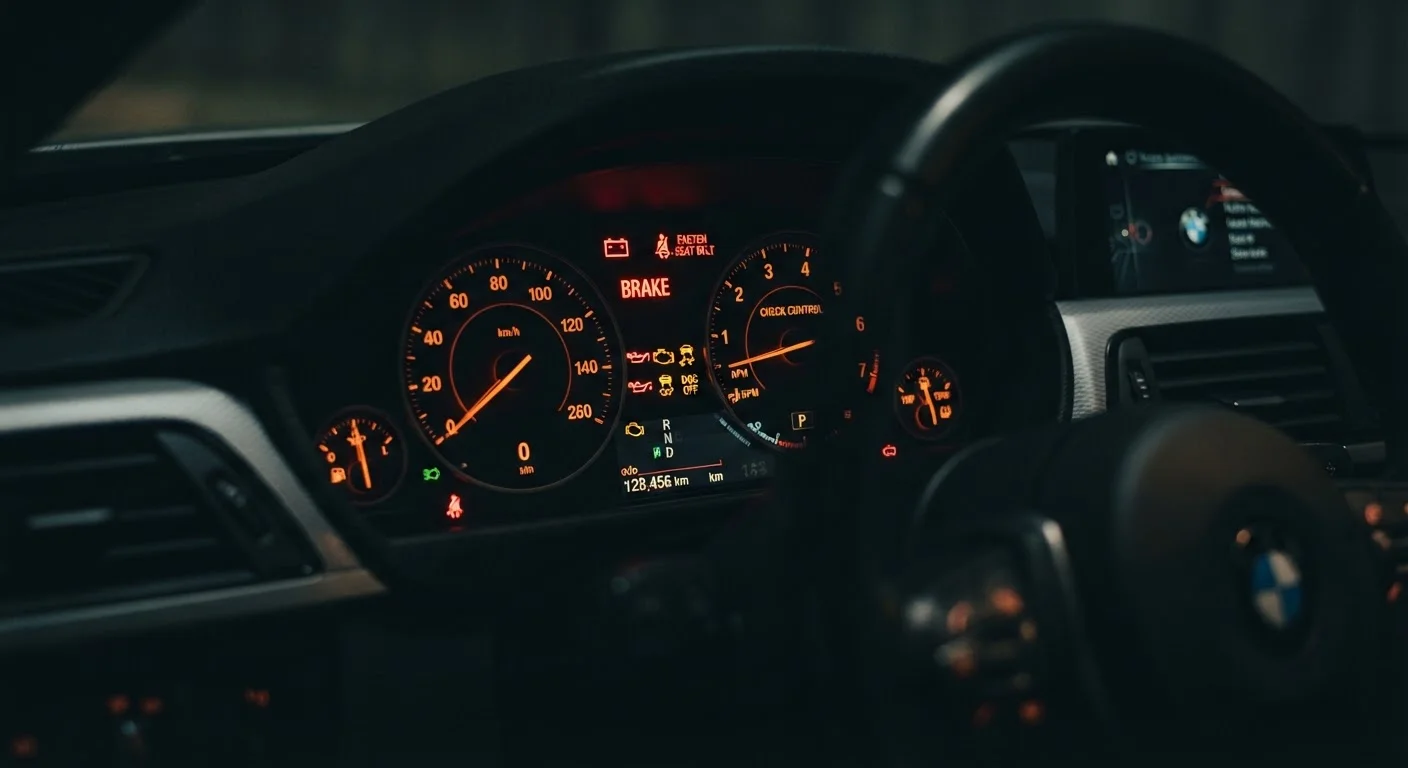
Below are the dashboard symbols drivers encounter most often, what they mean, and how urgently you should respond.
| Check Engine Light Response | Steady = schedule service soon; Flashing = pull over promptly |
| TPMS Trigger Threshold | 25% below recommended PSI (U.S. TPMS federal standard (FMVSS 138)) |
| Overheating Cool-Down Time | At least 30 minutes before opening hood |
| Red Light Action | Stop or act immediately |
| Amber Light Action | Schedule service within a few days |
| Owner's Manual Location | Glove box or manufacturer's app/website |
Check Engine Light (CEL)
This amber engine-shaped icon is the most misunderstood light on any dashboard. It can signal anything from a loose gas cap to a misfiring cylinder. A steady CEL usually means a non-emergency fault — you can drive to a shop soon, but don't delay more than a day or two. A flashing CEL indicates an active misfire that can damage your catalytic converter; pull over safely and avoid heavy acceleration until it's diagnosed.
Oil Pressure Warning
This red oil-can icon means your engine has low oil pressure — not simply low oil level. If it illuminates while driving, pull over as soon as it's safe and shut off the engine. Running an engine with low oil pressure can cause irreversible internal damage within minutes. Check the oil level with the dipstick; if it's full, do not restart and call for assistance. Learn more about what engine oil actually does in our guide to your car's fluid system.
TPMS (Tire Pressure Monitoring System)
An exclamation point inside a flattened tire shape signals that one or more tires are significantly under-inflated — typically 25% below the recommended pressure. Check all four tires with a gauge and inflate to the PSI listed on the sticker inside your driver's door jamb, not on the tire sidewall. Cold weather commonly triggers this light as air contracts.
Battery / Charging System
A red battery icon usually means the charging system isn't keeping the battery topped up — often a failing alternator or a worn serpentine belt. Your car may continue running briefly on battery power alone, but you should head directly to a shop. Turn off non-essential electronics (heated seats, rear defroster) to extend your driving range.
Coolant Temperature Warning
A red thermometer symbol means your engine is overheating. Pull over immediately, turn off the engine, and allow it to cool for at least 30 minutes before opening the hood. Never remove the radiator cap while the engine is hot — pressurized coolant can cause serious burns. Check coolant level only after the engine is fully cool.
Brake System Warning
This light can mean the parking brake is engaged, brake fluid is low, or there's a fault in the hydraulic brake circuit. If the light comes on while driving with the parking brake released, treat it seriously: check your brake fluid level and have the system inspected promptly. Do not ignore a brake warning.
Color Codes: What Red, Amber, and Green Mean
Warning light color is a reliable first indicator of severity across virtually all modern vehicles:
- Red — Stop or act immediately. These indicate conditions that can cause injury, stranding, or serious mechanical damage.
- Amber / Yellow — Caution required. Something needs attention soon, but the situation is generally not an emergency at that precise moment.
- Green or Blue — Informational. A system is active (high beams, turn signal, cruise control). No action needed beyond awareness.
Keep in mind that some manufacturers use slightly different icon designs. When in doubt, your owner's manual has a complete reference specific to your vehicle — it's worth bookmarking that section. You can also explore the Driving & Safety hub for additional guidance on staying informed behind the wheel.
And don't stop at dashboard alerts — our article on overlooked maintenance items covers the things no warning light will ever tell you about.