

Key Takeaways
Why Tire Pressure Is Worth Your Attention
Tire pressure is one of the easiest maintenance items to check and one of the most commonly neglected. The U.S. Department of Energy has noted that underinflated tires can reduce fuel economy — even modest pressure shortfalls add up over thousands of miles. Beyond fuel costs, low pressure forces more of the tire's surface to contact the road, wearing the outer edges faster and shortening tire life.
If you drive with tires that are consistently low, you're quietly spending more money at the pump and replacing tires sooner than you should. For a fuller picture of where car costs accumulate, see our look at where drivers waste money without realizing it.
The good news: checking and adjusting your own tire pressure requires no mechanical skill, minimal tools, and about five minutes of your time.
Check Pressure Monthly, Not Just Seasonally
Tires lose air gradually even without a leak — roughly 1 PSI per month is normal. A quick monthly check takes less time than it takes to fill a coffee cup. Pair it with a visual inspection for any obvious bulges, cuts, or embedded objects. This small habit supports broader maintenance items drivers often overlook.
What You'll Need Before You Start
Gather these items before you begin. Having everything on hand makes the process faster and more accurate.
What you will need
Tire pressure gauge
Measures the air pressure inside each tire in PSI so you know whether to add or release air.
Air compressor or gas station air pump
Supplies air to inflate any tires that are below the recommended PSI.
Valve stem cap (set)
Protects valve stems from dirt and moisture that can cause slow leaks over time.
Step-by-Step: Checking and Adjusting Tire Pressure
Work through each tire in the same order every time — front-left, front-right, rear-left, rear-right — so you don't skip one. Don't forget the spare if your vehicle has a full-size or compact spare mounted underneath or in the trunk.
Find your vehicle's recommended PSI
Open the driver's door and look for a sticker on the door jamb — it lists the recommended front and rear tire pressure in PSI. Write it down or take a photo. Note that the front and rear recommendations are sometimes different.
Remove the valve stem cap
Locate the valve stem — a short rubber or metal nozzle protruding from the inner edge of the wheel. Twist the small cap counterclockwise to remove it, and set it somewhere you won't lose it.
Press the gauge firmly onto the valve stem
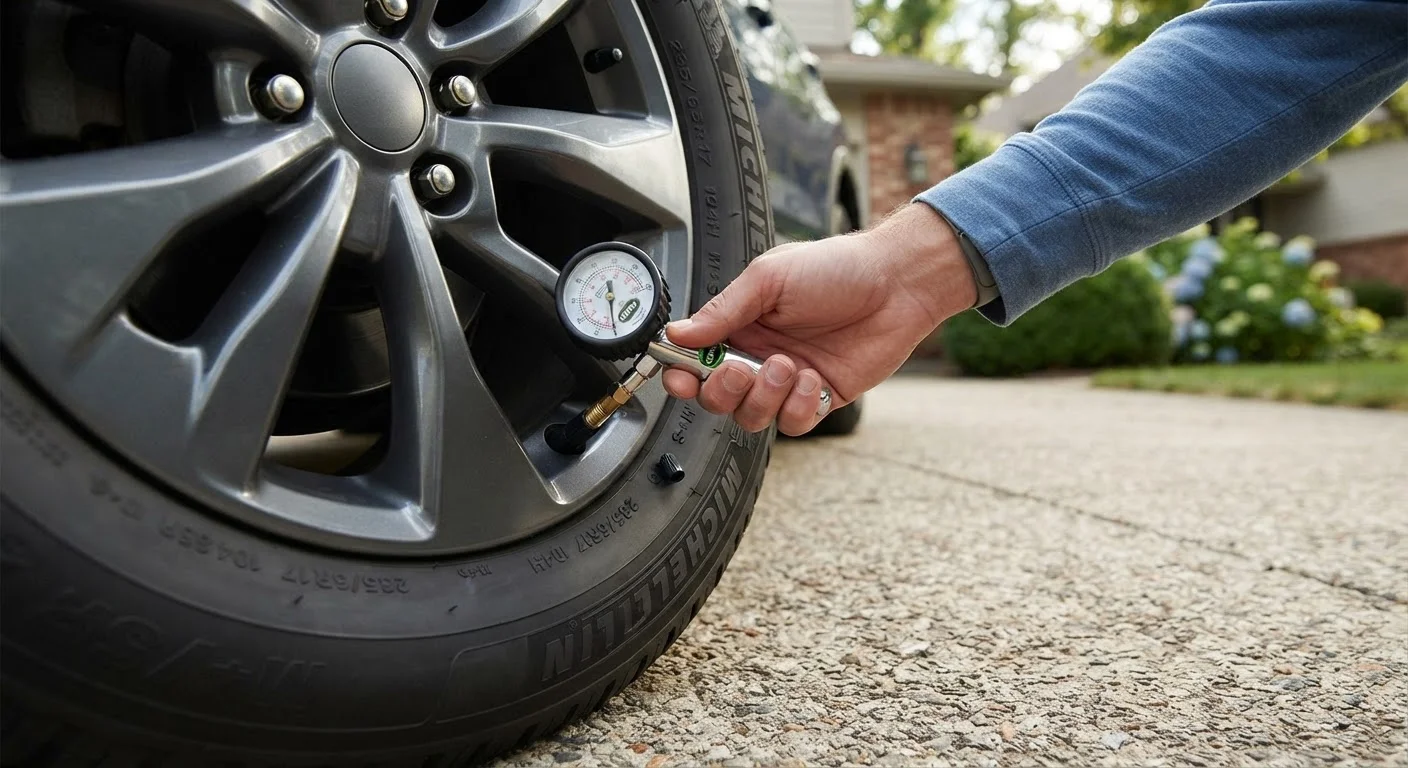
Push the gauge straight onto the valve stem with firm, even pressure. A hissing sound means air is escaping around the gauge — reposition and try again. A good seal gives you a steady reading in about one second.
Read and record the pressure
Note the PSI displayed and compare it to your vehicle's recommended pressure. Write down each tire's reading before moving on — it's easy to forget which ones needed air once you start moving around the car.
Add air if the pressure is low
Attach the air compressor hose to the valve stem. Add air in short bursts of 3–5 seconds, then recheck with your gauge. Repeat until you reach the target PSI. It's easier to add a little, check, and add more than to overshoot and have to release air.
Release air if the pressure is too high
Use a small tool — the back of many gauge caps has a pin for this — to press the center pin inside the valve stem. Release air in brief taps and recheck frequently. It's easy to let out too much at once.
Replace the valve stem cap and repeat
Once the pressure is correct, screw the cap back on finger-tight. Move to each remaining tire and repeat steps 2 through 6. Check the spare tire while you're at it — a flat spare is useless in an emergency.
Keeping your tires properly inflated is one of several habits that quietly extend the life of your car without any trip to the shop.
Common Mistakes and What to Watch For
Even a simple task like this has a few pitfalls. Checking pressure after a long drive inflates your reading — heat expands the air inside the tire, raising the PSI by as much as 4–6 PSI. That's why cold checks are essential for accurate results.
Another common error: using the number printed on the tire sidewall as your target. That number is the tire's maximum allowable pressure — not your vehicle's recommended operating pressure. Always use the number on the door jamb sticker or your owner's manual.
If you find yourself repeatedly topping off the same tire, that's a signal to have it inspected for a slow leak, damaged valve stem, or a nail. A tire that loses more than 2 PSI per month without an obvious cause deserves professional attention. Proper inflation also works hand-in-hand with other tire services — our guide on tire rotation, balancing, and alignment explains how these jobs complement each other.