

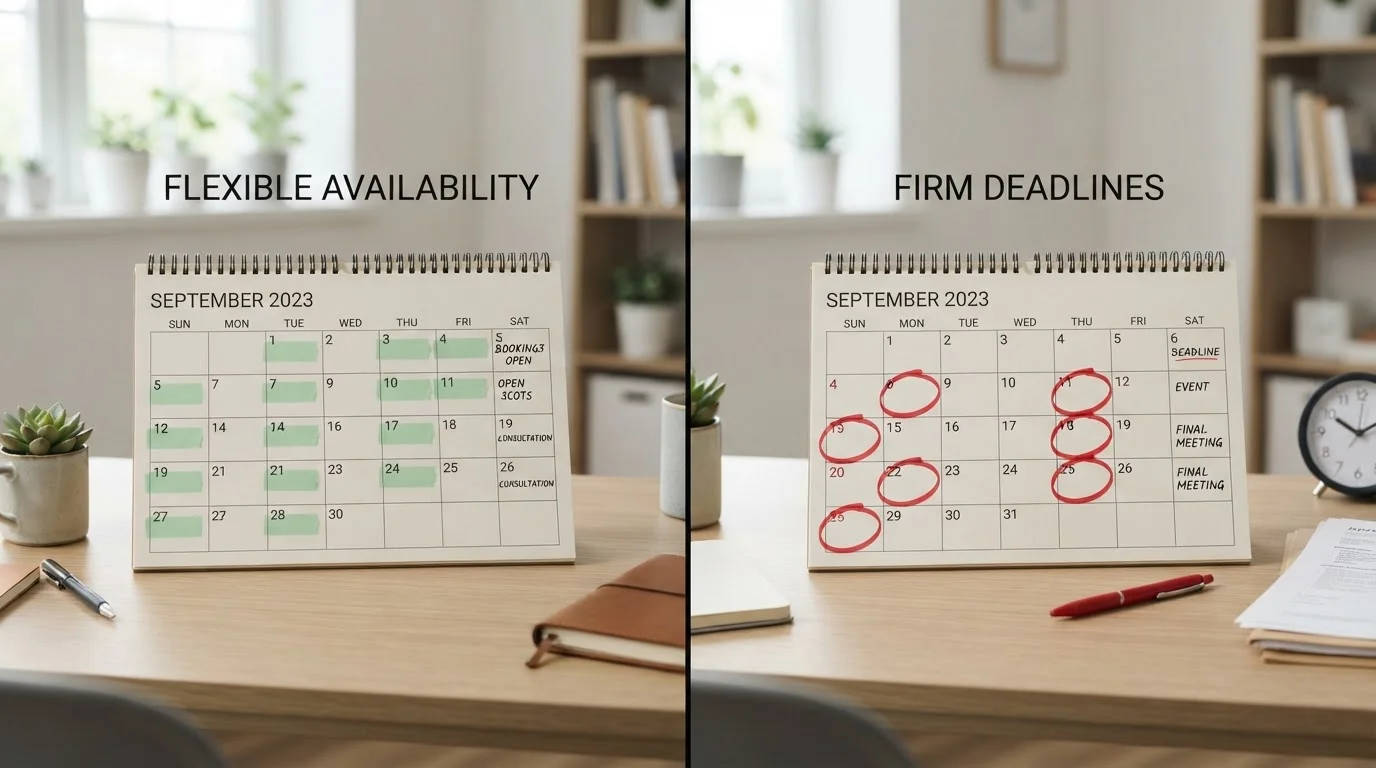
Key Takeaways
Our Verdict
Neither approach is universally better. Flexible-date travelers can capture genuine savings on flights and accommodations — but only when their life actually allows it. Fixed-date travelers trade potential savings for predictability, which often makes more practical sense for most American households. The smarter move is to assess your constraints honestly before deciding, not after you've already started browsing fares.
| Best for | Recommended |
|---|---|
| Solo travelers or couples with no firm time anchors | Flexible Dates |
| Families tied to school calendars or major holidays | Fixed Dates |
| Remote workers able to extend or shift trips freely | Flexible Dates |
| Travelers booking group trips or events with set dates | Fixed Dates |
Why Your Date Strategy Matters More Than You Think
Most travelers spend significant time comparing hotels and flights but settle on their travel dates almost by instinct. That's a missed opportunity. When and how you lock in your dates can affect what you pay across every part of your trip — transportation, lodging, and even activities with surge pricing.
The core question isn't whether flexible or fixed dates are better in theory. It's which one honestly fits your situation. Approaching this as a real decision — rather than an afterthought — is one of the more practical habits in stretching a travel budget.
Two factors determine where you land: how much your schedule can actually bend, and how much uncertainty you're willing to manage in exchange for potential savings.
The Case for Flexible Dates
Date flexibility has a real financial upside — but it's narrower than travel content often suggests. The clearest gains tend to show up in two scenarios:
- Shifting departure by 1–3 days: Midweek flights (Tuesday through Thursday departures) are frequently priced lower than weekend travel on many routes. The gap varies by route and season, but on competitive domestic routes the difference can be meaningful.
- Traveling in shoulder season: Moving a trip a few weeks earlier or later — outside peak holiday windows — often yields lower accommodation rates and smaller crowds, which compounds value beyond just the flight.
Flexible dates also give you a buffer if something goes wrong pre-departure. Rescheduling is far less costly when you haven't already committed to rigid connections on either end.
The caveat: genuine flexibility requires that your work, family, and obligations actually allow it. Many travelers overestimate how movable their schedule is until they're mid-planning and realize a tentative Thursday departure still has to accommodate a Monday meeting.
Check Your Calendar Before Calling Yourself Flexible
Before assuming you're flexible, check commitments 48–72 hours on either side of your tentative window. Real flexibility means you've already cleared those days — not just that they look open right now. Many travelers discover mid-search that their 'flexible' window is actually a 48-hour slot, which limits options considerably.
Before assuming you're flexible, check commitments 48–72 hours on either side of your tentative window. Real flexibility means you've already cleared those days — not just that they look open right now.
The Case for Fixed Dates
Fixed dates get a bad reputation as the "expensive" choice, but that framing ignores what you're actually buying: certainty. And certainty has real value, especially when your trip involves multiple people, employer-approved leave, or non-refundable reservations downstream.
Locking in dates early — and booking around them — lets you:
- Secure accommodation inventory before it shrinks (particularly relevant for popular destinations during busy periods)
- Coordinate logistics across a travel group without constant replanning
- Set a firm budget and stop agonizing over whether to wait for a better price
Fixed-date travelers are also better positioned to use certain rate structures — like advance-purchase hotel rates — that require commitment in exchange for a lower nightly price. It's worth reading up on hotel booking myths before assuming flexible rates are always the safer move.
| Flexible Dates | Fixed Dates | |
|---|---|---|
| Potential cost savings | Higher (if schedule genuinely allows it) | Lower, but more predictable |
| Planning complexity | Higher — requires monitoring multiple windows | Lower — book and move on |
| Best for group travel | Difficult to coordinate | Straightforward to align |
| Works with PTO approval | Only if employer allows open-ended leave | Yes — exact dates submitted upfront |
| Risk of price regret | Higher — you may keep watching fares | Lower — commitment closes the loop |
| Accommodation options | Broader — can avoid peak-rate dates | May be limited during high demand periods |
The practical reality is that most American travelers — especially those traveling with children or on employer-approved PTO — are operating in fixed-date territory whether they acknowledge it or not.
How to Decide Before You Start Booking
Run through these questions before you search for a single fare or rate:
- Do you have a hard deadline on either end? A work meeting, school start date, or pre-paid event locks your dates by default.
- Who's traveling with you? Each additional person narrows flexibility, because aligning multiple schedules multiplies constraints.
- How would you handle a price shift? If you'd spend hours second-guessing after booking, fixed dates save mental energy. If you enjoy optimizing, flexible dates reward that habit.
- Is your destination time-sensitive? Some events, festivals, or seasonal windows only occur on specific dates — flexibility around them is limited regardless of your preference.
Once you've answered honestly, your strategy becomes clearer. This is also a useful checkpoint in any pre-booking planning checklist — knowing your date approach before you search prevents the trap of building an itinerary around a price that wasn't actually available on your real dates.
For a broader look at how timing decisions ripple through travel costs, planning far ahead vs. going last minute walks through the financial tradeoffs at each end of the spectrum.