

Key Takeaways
Prevents missed service intervals
A log gives you a concrete record of what's been done and when, so you're not relying on memory or a faded windshield sticker to stay on schedule.
Supports stronger resale value
Buyers — private or dealer — place real weight on documented service history; it reduces uncertainty and can justify a higher asking price.
Helps mechanics diagnose problems faster
When a technician can see your vehicle's full service history at a glance, they can rule out causes faster and spend less time — and your money — on guesswork.
Catches recurring issues early
Patterns in your log, like repeated replacements of the same part, can alert you to an underlying problem before it becomes a costly failure.
Keeps warranty and recall records organized
If a manufacturer recall or warranty claim arises, having your service history in one place makes the process significantly smoother.
Requires consistent habit to stay useful
A log with gaps is far less valuable than a complete one — if entries are skipped for months, the record loses much of its diagnostic and resale usefulness.
Paper records can be lost or damaged
Physical logs kept in a glove box are vulnerable to spills, wear, and being accidentally discarded; a backup system is wise but adds friction.
Doesn't prevent all breakdowns
A maintenance log reduces neglect-related failures but cannot protect against age-related component wear or unexpected mechanical faults unrelated to service history.
Initial setup takes time and effort
Gathering past receipts and receipts from multiple shops to reconstruct a history can feel like a chore, deterring drivers from starting altogether.
Our Verdict
Keeping a car maintenance log is a low-effort habit with outsized rewards. It keeps your service intervals honest, gives mechanics useful context, and gives buyers confidence when it's time to sell. The main hurdle is building the habit — but once it's routine, the record essentially maintains itself.
Ideal for any driver who wants to protect their vehicle investment, avoid preventable repairs, and get fair value when selling or trading in.
What a Car Maintenance Log Actually Is
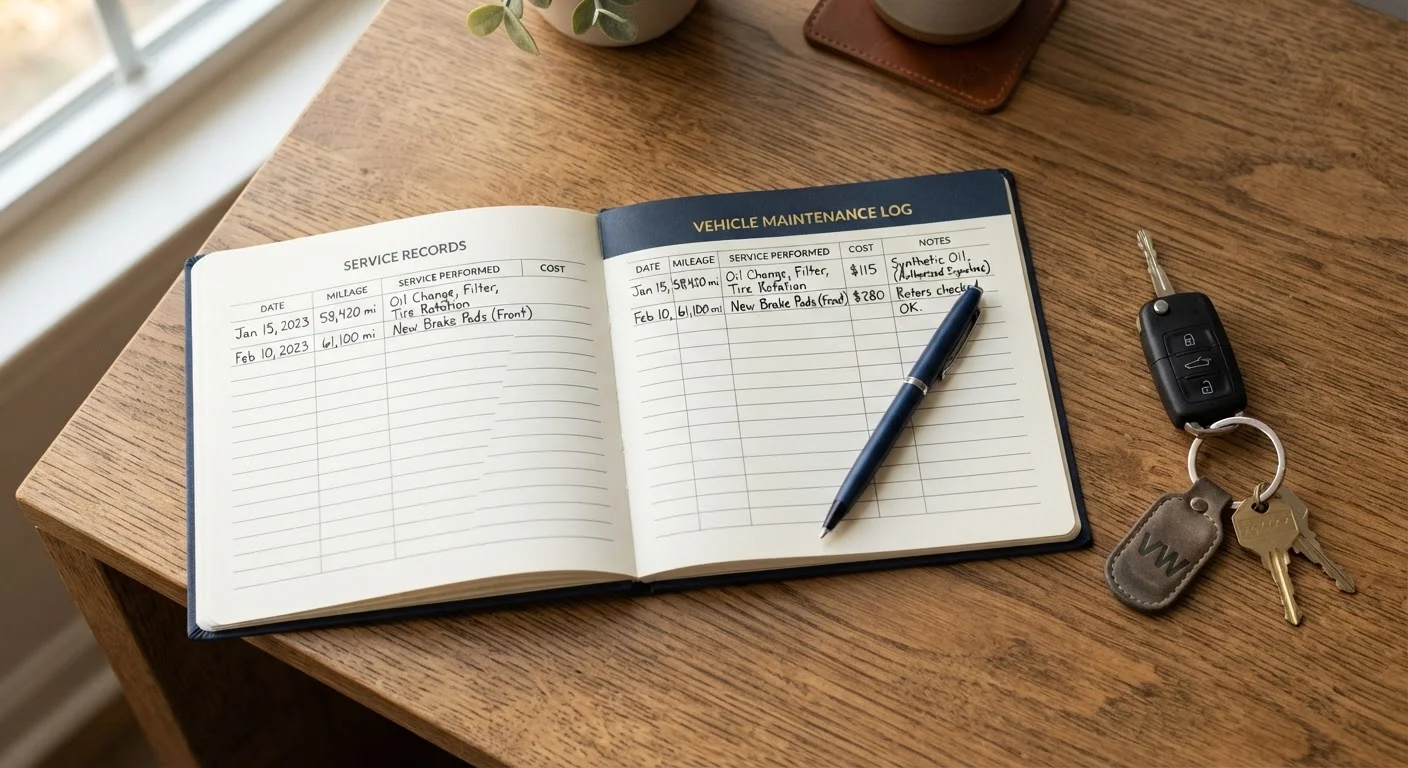
A car maintenance log is a running record of every service your vehicle has received — oil changes, tire rotations, brake work, fluid flushes, filter replacements, and any repairs. It captures the date, mileage, what was done, and ideally the cost. It can be as simple as a spiral notebook kept in the glove box, a spreadsheet on your phone, or a dedicated app.
The log works alongside your owner's manual, not instead of it. Your manual specifies what needs to happen and when; your log proves it actually did. Together, they give you a complete picture of your vehicle's health history — something no dashboard light or gut feeling can replicate.
For drivers trying to stay on top of maintenance without always relying on a shop, a log is one of the most practical tools available. It pairs naturally with resources like a seasonal maintenance checklist to keep nothing slipping through the cracks.
The Real Advantages of Keeping One
Prevents missed service intervals
A log gives you a concrete record of what's been done and when, so you're not relying on memory or a faded windshield sticker to stay on schedule.
Supports stronger resale value
Buyers — private or dealer — place real weight on documented service history; it reduces uncertainty and can justify a higher asking price.
Helps mechanics diagnose problems faster
When a technician can see your vehicle's full service history at a glance, they can rule out causes faster and spend less time — and your money — on guesswork.
Catches recurring issues early
Patterns in your log, like repeated replacements of the same part, can alert you to an underlying problem before it becomes a costly failure.
Keeps warranty and recall records organized
If a manufacturer recall or warranty claim arises, having your service history in one place makes the process significantly smoother.
The benefits compound over time. A log surfaces patterns — if you notice you're replacing the same component repeatedly, that's a signal worth investigating. It also prevents the common mistake of servicing by calendar alone when mileage is a more reliable trigger for many items. Drivers who rely only on memory or sticker reminders often find themselves overdue on services they forgot entirely, from coolant flushes to differential fluid — exactly the kind of overlooked items that quietly cause damage.
At resale time, a documented history signals to buyers that the vehicle was cared for. Private-party buyers and dealerships both respond to paper trails — it reduces uncertainty and can support a stronger asking price.
The Honest Drawbacks
Requires consistent habit to stay useful
A log with gaps is far less valuable than a complete one — if entries are skipped for months, the record loses much of its diagnostic and resale usefulness.
Paper records can be lost or damaged
Physical logs kept in a glove box are vulnerable to spills, wear, and being accidentally discarded; a backup system is wise but adds friction.
Doesn't prevent all breakdowns
A maintenance log reduces neglect-related failures but cannot protect against age-related component wear or unexpected mechanical faults unrelated to service history.
Initial setup takes time and effort
Gathering past receipts and receipts from multiple shops to reconstruct a history can feel like a chore, deterring drivers from starting altogether.
The biggest barrier is habit formation. Most drivers start a log after a big repair bill or a near-miss — not proactively. If entries are inconsistent or the log disappears into the glove box for months, its usefulness degrades quickly.
There's also the question of what to do with shop receipts when someone else performs the work. Paper records get lost; digital records require a system. Neither format solves the problem on its own — it takes a small but real commitment to file receipts and update the log consistently.
It's worth noting that a log won't prevent all mechanical failures. It reduces the risk of neglect-related breakdowns, but some repairs are simply a function of age, miles, or component wear. Understanding which maintenance tasks are truly critical helps you prioritize what belongs in the log most urgently.
How to Set One Up and Actually Stick to It
You Don't Need a Perfect Starting Point
Many drivers delay starting a log because they feel they've already missed too much history to make it worthwhile. This isn't true. A log that begins today — even with incomplete past records — is still far more useful than no log at all. Gather what receipts or records you have, note your current mileage, and move forward from there. Consistency from this point on is what counts.
Start with your current mileage and the most recent service you can confirm — a receipt, a sticker, or a dealer invoice. Work forward from there. You don't need to reconstruct years of history; a log that starts today is still valuable.
Choose a format you'll actually use. If you're on your phone constantly, a notes app or a simple spreadsheet synced to the cloud works well. If you prefer physical records, a small notebook in the glove box is perfectly functional. The habits that extend a car's life are rarely complicated — they're just consistent.
After every service, record the date, odometer reading, what was done, who did it, and the cost. Snap a photo of receipts and save them in a folder labeled by year. Set a calendar reminder to review the log every three months so nothing drifts overdue.
Avoid letting common assumptions replace actual record-keeping. Many drivers skip logging because they believe they'll remember — or because they've heard that certain services matter less than they actually do. Separating those assumptions from facts is worth doing; car maintenance myths can quietly steer you in the wrong direction.