

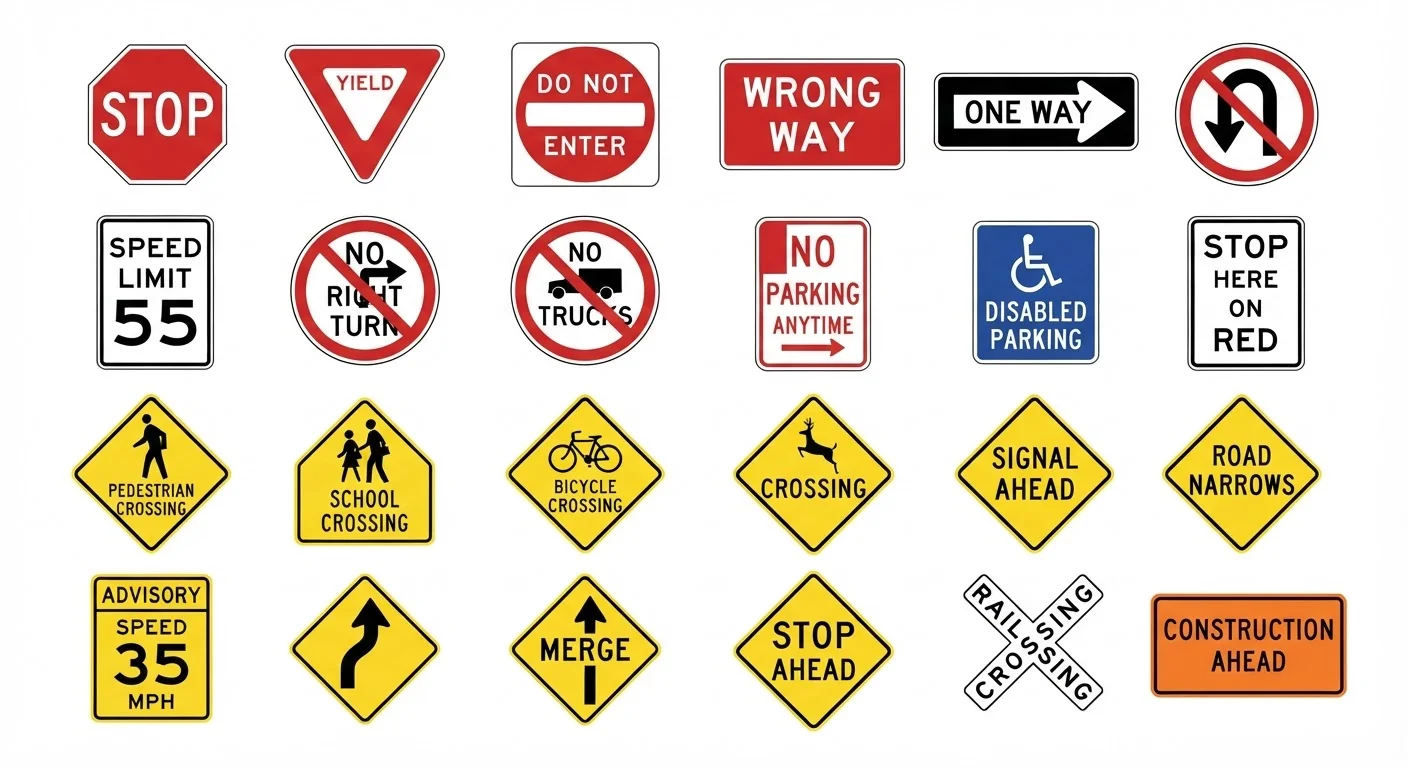
| Sign color: Red | Stop, prohibition, or Do Not Enter — always a legal requirement (Federal Highway Administration (FHWA) MUTCD) |
| Sign color: Yellow | Warning — alerts to a condition or hazard ahead (Federal Highway Administration (FHWA) MUTCD) |
| Sign color: Yellow-Green | Pedestrian, bicycle, and school zone warnings (Federal Highway Administration (FHWA) MUTCD) |
| Sign shape: Diamond | Warning sign — no legal mandate but signals a road condition (Federal Highway Administration (FHWA) MUTCD) |
| Sign shape: Pentagon | School advance warning (points up) (Federal Highway Administration (FHWA) MUTCD) |
| Advisory speed plates | Not a speed limit — recommended safe speed for a specific feature (Federal Highway Administration (FHWA) MUTCD) |
Why Sign Confusion Is More Common Than You Think
Most drivers passed their written license exam years — sometimes decades — ago. The signs covered on that test don't always stick, especially the ones rarely encountered in daily commutes. The result: intersections with ambiguous right-of-way, missed regulatory signs, and misread warnings that create genuine hazards.
This isn't about blaming drivers. Road sign design has evolved, state-specific variations exist, and some signs are simply placed poorly. Still, understanding what a sign means — and what it legally requires — is a core part of safe driving. This refresher focuses on the signs that generate the most real-world confusion.
| Sign color: Red | Stop, prohibition, or Do Not Enter — always a legal requirement (Federal Highway Administration (FHWA) MUTCD) |
| Sign color: Yellow | Warning — alerts to a condition or hazard ahead (Federal Highway Administration (FHWA) MUTCD) |
| Sign color: Yellow-Green | Pedestrian, bicycle, and school zone warnings (Federal Highway Administration (FHWA) MUTCD) |
| Sign shape: Diamond | Warning sign — no legal mandate but signals a road condition (Federal Highway Administration (FHWA) MUTCD) |
| Sign shape: Pentagon | School advance warning (points up) (Federal Highway Administration (FHWA) MUTCD) |
| Advisory speed plates | Not a speed limit — recommended safe speed for a specific feature (Federal Highway Administration (FHWA) MUTCD) |
Regulatory Signs: Legal Requirements, Not Suggestions
Regulatory signs carry the force of law. Ignoring them can result in fines, collisions, or both.
Yield vs. Stop
Drivers regularly confuse these two. A Stop sign requires a complete stop before the limit line — always, even with no traffic present. A Yield sign means slow down, assess cross-traffic, and stop only if a conflict exists. Rolling through a stop sign and treating a yield like a full stop are both errors — one is a traffic violation, the other unnecessarily disrupts traffic flow.
No U-Turn
This sign is frequently missed because drivers look for it only at intersections. It can also appear mid-block or at median openings. When a No U-Turn sign is posted, a U-turn is prohibited at that exact location regardless of traffic conditions. Some states allow U-turns at red lights unless posted otherwise — that rule doesn't override a posted No U-Turn sign.
Wrong Way / Do Not Enter
These two signs work together on divided roads and highway ramps. The Do Not Enter sign (white horizontal bar on red) marks the beginning of a one-way segment you must not enter. The Wrong Way sign (red with white text) confirms you're already heading in the wrong direction. If you see either, stop and reverse safely out of the lane.
For rules that shift as you cross state borders, see our guide to state-by-state driving rules.
Warning Signs: What the Yellow Diamond Is Actually Telling You
Yellow diamond-shaped signs are warning signs — they alert you to a condition ahead, not a legal requirement. The appropriate response depends on conditions, not a fixed rule. Here are the ones most often misread.
Advisory Speed Signs
A small yellow plate reading, say, 25 MPH posted beneath a curve warning is an advisory speed — not a speed limit. It indicates the speed at which engineers consider the curve safely navigable under normal conditions. In rain, ice, or with a loaded vehicle, the safe speed may be lower. This sign does not legally restrict you the way a regulatory speed limit sign does, but it is grounded in real road geometry and should be taken seriously.
Divided Highway Begins / Ends
The Divided Highway Ends sign is one of the most underappreciated warnings on rural roads. It signals that the road ahead transitions from a divided roadway (with a median barrier or grass strip) to an undivided two-lane road with oncoming traffic. Drivers who miss it often stay in a passing lane that no longer exists. Slow down and shift to the right lane immediately upon seeing it.
Pedestrian and School Zone Warnings
School zone warning signs (yellow-green pentagonal shape in many states) alert drivers to an upcoming school zone where reduced speed limits apply during specific hours. The hours are often posted on a secondary sign below — missing that secondary sign leads drivers to either ignore the zone entirely or brake unnecessarily at 11 p.m. The flashing yellow light above many school zone signs indicates the reduced speed is active.
Staying alert to road conditions connects directly to safe following distance — something our article on the real dangers of tailgating covers in depth.
Pavement Markings: The Signs You Drive Over
Road markings are technically signs, too — and they're frequently misread or ignored entirely.
White vs. Yellow Centerlines
A yellow centerline separates traffic flowing in opposite directions. A white line separates lanes moving in the same direction. A solid yellow line on your side means passing is prohibited. A broken yellow line means passing is allowed when safe. A double solid yellow means neither direction may pass. Many drivers treat double yellows as suggestions in light traffic — legally and practically, that's a serious mistake.
White Diagonal Stripes (Gore Areas)
Those chevron or diagonal stripe zones near highway exits, merge points, and turn lane beginnings are called gore areas. They are not travel lanes. Driving through or stopping in a gore area is illegal in most states and creates a significant collision risk. If you miss your exit, do not drive through the gore — continue to the next opportunity.
Merging correctly near these zones is a skill worth refining. See our breakdown of highway merging mistakes and how to fix them.
This article provides general traffic safety information for educational purposes. Always refer to your state's official driver handbook and applicable traffic laws for authoritative guidance on signs and road rules in your area.