

Key Takeaways
Tailgating
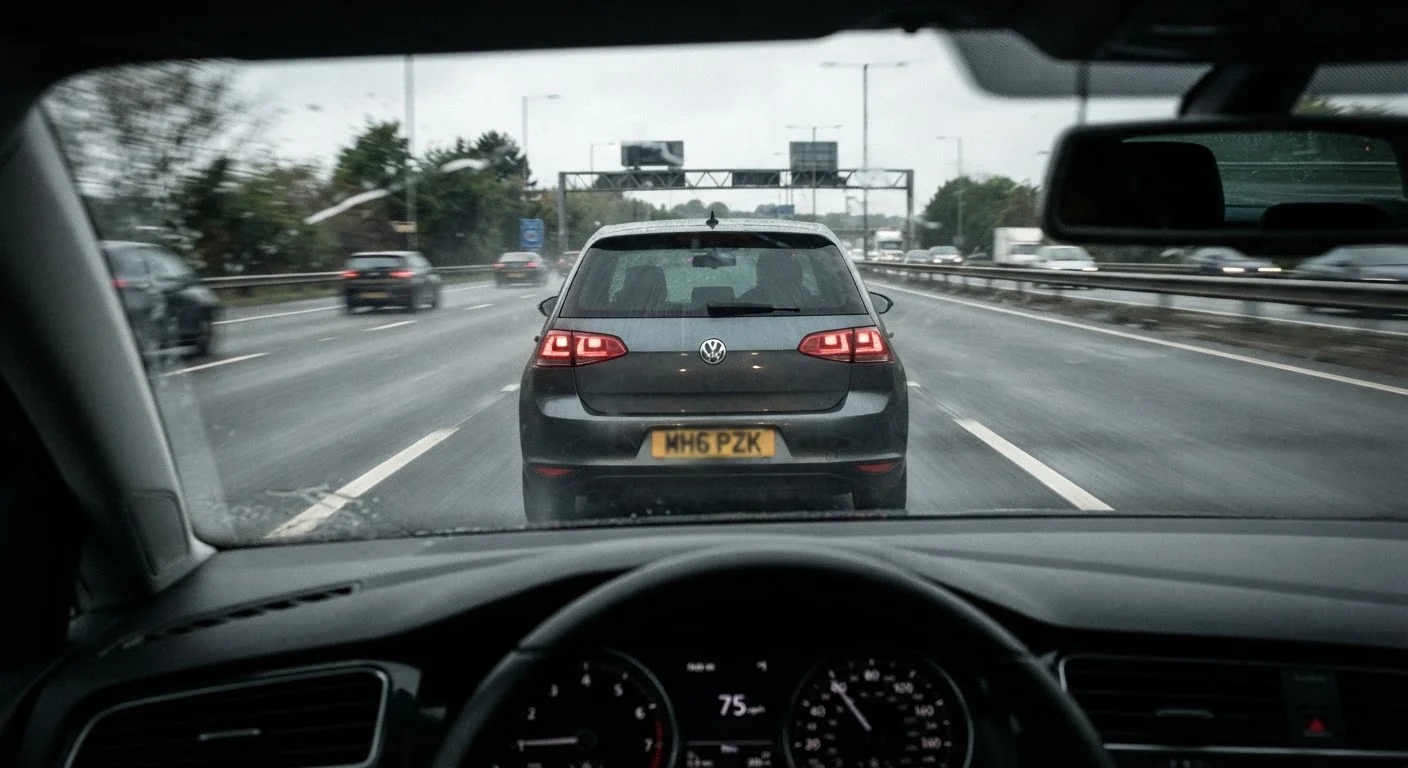
Tailgating means following another vehicle so closely that you would not have enough space to stop safely if that vehicle braked suddenly. It is one of the most common — and most underestimated — causes of rear-end collisions on American roads. Most drivers who tailgate are not aware they are doing it, or underestimate how much stopping distance their vehicle actually needs.
Stopping distance is the sum of reaction distance (how far your car travels while your brain registers the need to brake) plus braking distance (how far it travels once the brakes are applied). At 60 mph, total stopping distance on dry pavement can exceed 240 feet.
The Physics Drivers Keep Getting Wrong
Most drivers know, in an abstract sense, that they should leave space in front of them. What they routinely underestimate is how much space physics actually demands. Your car does not stop the instant you press the brake pedal. Two separate intervals eat up road before you halt.
First is reaction distance: the distance your vehicle travels while your brain perceives a hazard and your foot moves to the brake. At an average reaction time of 1.5 seconds, a car traveling 60 mph covers about 132 feet before braking even begins. Second is braking distance: how far the car slides once brakes are applied. On dry pavement at 60 mph, that can add another 120–180 feet depending on tire condition, vehicle weight, and road surface.
Add those together and you are looking at well over 240 feet — nearly the length of a typical city block — to stop from highway speed. See our full breakdown of stopping distance factors for detail on how tires, surfaces, and load weight shift these numbers significantly.
~29%
Share of U.S. crashes that are rear-end collisions
According to NHTSA data, rear-end crashes consistently represent the largest single category of collision type on American roads.
240+ ft
Approximate stopping distance at 60 mph on dry pavement
This total accounts for both average reaction distance and braking distance under normal conditions with well-maintained tires.
1.5 sec
Average driver reaction time before braking
Research on driver response times finds that most drivers take between 1.0 and 1.5 seconds to perceive a hazard and apply the brake pedal.
Why the Three-Second Rule Works — And When It Falls Short
The three-second rule is the most practical tool most drivers will ever use for spacing. Choose a stationary roadside marker — a sign, overpass, or mile post. When the vehicle ahead passes it, count: one-thousand-one, one-thousand-two, one-thousand-three. If you pass the same marker before you finish counting, you are too close.
At 60 mph, three seconds translates to roughly 264 feet of gap — enough space to have a fighting chance on dry pavement in ideal conditions. But "ideal conditions" is doing a lot of work in that sentence. In rain, stopping distances can increase by 50% or more. In snow or ice, they can multiply several times over. Fatigue, distraction, or any cognitive load — including hands-free phone calls (see why hands-free calling still affects reaction time) — stretches reaction time further.
In those conditions, a five- or six-second gap is a more honest safety buffer. The three-second rule is a floor, not a ceiling.
The Human Factors That Make Tailgating Persistent
Tailgating is not purely a knowledge problem — it is a perception and behavior problem. Drivers who know better still do it, for several identifiable reasons:
- Visual misjudgment: Humans are poor at estimating gap distance at speed. A 150-foot gap looks "fine" to most people, even though it is far too short at 65 mph.
- Normalization: When surrounding traffic is close-packed, drivers unconsciously match the spacing around them, treating it as the social norm even when it is collectively unsafe.
- Frustration: Drivers sometimes follow closely to pressure a slower vehicle to move. This is both dangerous and, in most states, a form of aggressive driving with its own legal consequences.
- Overconfidence in technology: Drivers in vehicles with automatic emergency braking (AEB) sometimes assume the system will handle a close-range emergency. AEB has meaningful limitations — its sensors cannot work miracles when there is no physical room left to stop.
Understanding these tendencies is part of what defensive driving as a mindset asks of every driver: stay aware not just of what other cars are doing, but of your own habits and assumptions.
Real-World Consequences Worth Taking Seriously
Rear-end collisions — the crash type most directly linked to insufficient following distance — are not minor events. They account for a substantial share of all U.S. traffic crashes each year and generate a significant proportion of traffic-related injuries, including whiplash, spinal injuries, and in serious cases, fatalities.
Beyond physical harm, the legal and financial consequences fall squarely on the following driver. Being found at fault in a rear-end collision typically affects insurance premiums for multiple years. Citations for following too closely appear on driving records and, in some states, carry points.
For new drivers especially, the consequences can be formative in the worst way. Teen drivers in their first year are statistically at the highest crash risk, and rear-end collisions are a notable part of that picture — making following distance a habit worth building correctly from day one.
Tailgating is also a form of distracted and aggressive driving in disguise. When you are following closely, your mental bandwidth narrows to the bumper ahead, leaving less capacity to monitor the full traffic picture. That tunnel vision is exactly how chain-reaction pile-ups start.