

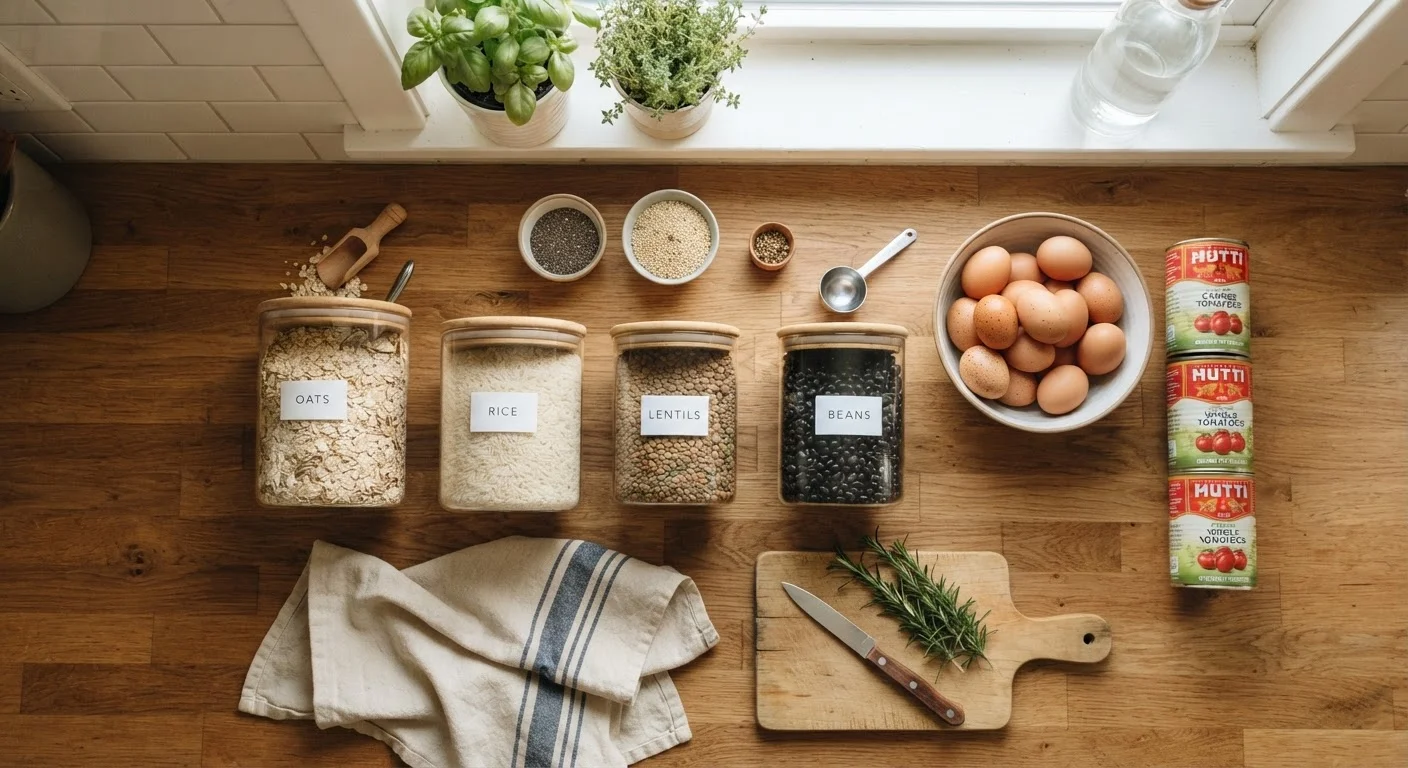
Key Takeaways
Why Anchor Ingredients Change How You Plan
Most weekly meal plans fall apart not because people lack good intentions, but because they're built around too many one-off ingredients. A bag of farro bought for a single recipe, a bunch of fresh herbs used once, a specialty sauce that sits in the fridge — these add up fast and rarely earn their place in your cart.
Anchor ingredients work differently. They're the ones you reach for again and again because they're cheap, shelf-stable or long-lasting, and genuinely flexible across different meals and flavors. When you build your weekly plan around a core set of these ingredients, grocery shopping gets faster, food waste drops, and your budget becomes far easier to manage.
If you're just getting started with meal planning, identifying your anchor ingredients early is one of the highest-leverage moves you can make. The list below covers the ones that show up most reliably in practical, budget-conscious meal plans — and why each earns its spot.
Dried or Canned Legumes (Beans, Lentils, Chickpeas)
Legumes — whether dried or canned — are among the most cost-efficient ingredients available in any American grocery store. A pound of dried lentils or black beans costs a fraction of what an equivalent serving of meat costs, and the protein and fiber content is genuinely substantial.
Canned beans offer convenience for weeknight cooking with no soaking required. Dried beans require more planning but cost less and yield more. Both work across an enormous range of cuisines: lentil soup, black bean tacos, chickpea curry, white bean pasta, refried beans — the applications are nearly endless.
Legumes also keep well. Dried beans last a year or more in a sealed container. Canned beans have shelf lives of two or more years. This means buying in bulk when prices are low carries virtually no waste risk.
Legumes deliver more protein and fiber per dollar than almost any other grocery aisle staple.
Eggs
Eggs remain one of the most versatile proteins in any home kitchen. They work at every meal — scrambled for breakfast, hard-boiled in a lunch salad, poached over dinner grain bowls, or fried alongside rice and vegetables for a quick weeknight meal.
Beyond versatility, eggs are fast. Most egg-based meals take under 15 minutes, which matters enormously on busy weeknights when complicated recipes are the first thing to get abandoned. A carton of eggs as a weekly staple means you always have a fallback meal, which in turn means less takeout spending when plans fall apart.
Eggs also keep for several weeks under refrigeration, so they're a reliable safety net throughout the week rather than an ingredient you need to use immediately.
Eggs are the ultimate weeknight fallback — fast, affordable, and genuinely flexible across every meal of the day.
Rice or Another Whole Grain (Oats, Farro, Barley)
A bulk bag of long-grain white rice or a container of rolled oats is one of the most reliable investments in a budget meal plan. Whole grains provide filling carbohydrates, cook in large batches, and reheat well — making them ideal for meal prep that carries across multiple days.
Rice in particular crosses cuisines with ease: Mexican rice bowls, Asian stir-fries, West African jollof, simple pilaf, fried rice made from leftovers. A batch cooked on Sunday can contribute to three or four different meals without repeating flavors.
Oats, meanwhile, anchor breakfast for the whole week. A pot of steel-cut oats prepared once keeps in the fridge for five days. Rolled oats work for overnight oats, stovetop porridge, or even savory preparations. Oats also cost very little per serving, making them one of the highest-value breakfast options available.
Cooked in bulk on Sunday, a whole grain like rice can quietly anchor four different weeknight meals.
Canned Tomatoes
Canned tomatoes — diced, crushed, or whole — are a pantry anchor that transforms simple ingredients into complete meals. They form the base of pasta sauces, chilis, soups, shakshuka, braised meats, and curries. A single can adds acidity, body, and depth to dishes that would otherwise taste flat.
Unlike fresh tomatoes, which are expensive out of season and quick to go bad, canned tomatoes are shelf-stable, consistently priced year-round, and already cooked to a concentration that improves most long-simmered dishes. They pair naturally with legumes and grains, which makes them an ideal companion to the other anchor ingredients on this list.
Keeping four to six cans on hand at all times means you're rarely more than 30 minutes from a satisfying, filling meal.
Canned tomatoes are shelf-stable, affordable year-round, and capable of turning simple pantry staples into satisfying meals.
Cabbage and Other Hardy Vegetables (Carrots, Onions, Sweet Potatoes)
Produce is where many budget meal plans leak money — delicate greens wilt by day three, and unused vegetables end up in the compost bin. Hardy vegetables solve this problem. Cabbage, carrots, onions, sweet potatoes, and beets keep for one to three weeks under proper storage, meaning you can buy them at the start of the week without worrying about waste.
Cabbage in particular is remarkably underused. It can be braised, stir-fried, eaten raw in slaws, added to soups, or stuffed and baked. A single head of cabbage — usually one of the cheapest items in the produce section — can contribute to meals across the full week.
Onions and carrots function as flavor bases for virtually any savory cooking tradition. Keeping them stocked means you always have the foundation of a real meal, even when other fresh ingredients have run out.
Hardy vegetables like cabbage and carrots outlast the week, eliminating the produce waste that quietly drains grocery budgets.
A Reliable Fat (Olive Oil, Vegetable Oil, or Butter)
Fat is not an anchor ingredient in the dramatic sense, but its presence makes everything else work. Sautéed aromatics, roasted vegetables, pan-fried eggs, and batch-cooked grains all depend on having a reliable fat in the kitchen. Without it, meals taste flat and cooking becomes genuinely harder.
For most home cooks on a budget, a neutral vegetable oil handles high-heat cooking and is the most economical choice bought in larger quantities. Olive oil adds flavor to dressings, pastas, and low-heat preparations. Butter, used in moderation, adds richness that's difficult to replicate cheaply.
The key from a budget standpoint is choosing one or two fats that serve your most common cooking methods, rather than keeping a shelf of specialty oils that each get used twice a year.
A reliable cooking fat isn't glamorous, but it's the structural ingredient that makes every other staple actually cook well.
How to Build Your Weekly Plan Around These Ingredients
The most useful thing about anchor ingredients is that they don't demand a rigid plan — they support a flexible one. You don't need to decide on Monday exactly how you'll use your dried lentils by Friday. Knowing they're there gives you options. That's the foundation of a flexible meal planning approach that actually holds up through a busy week.
A practical starting point: choose two or three anchor ingredients as your weekly foundation, then build 4–5 meals around them. Overlap is a feature, not a flaw. The same batch of cooked rice can anchor a stir-fry on Tuesday, a grain bowl on Thursday, and fried rice on Saturday. For more on structuring that rhythm, see theme nights and anchor meals.
If budget pressure is a real factor in your planning, pairing anchor ingredients with smart shopping habits makes the biggest difference. The meal planning on a tight budget guide offers practical strategies that complement this ingredient-first approach without asking you to follow a rigid rulebook.
Start With Two Anchors, Not All Six
If the idea of overhauling your pantry feels overwhelming, pick just two anchor ingredients from this list — one protein (like eggs or canned beans) and one grain (like rice or oats) — and build your first week around those. Once that rhythm feels natural, layer in a third. Gradual changes are more likely to stick than a complete reset.