

Key Takeaways
The Envelope Method
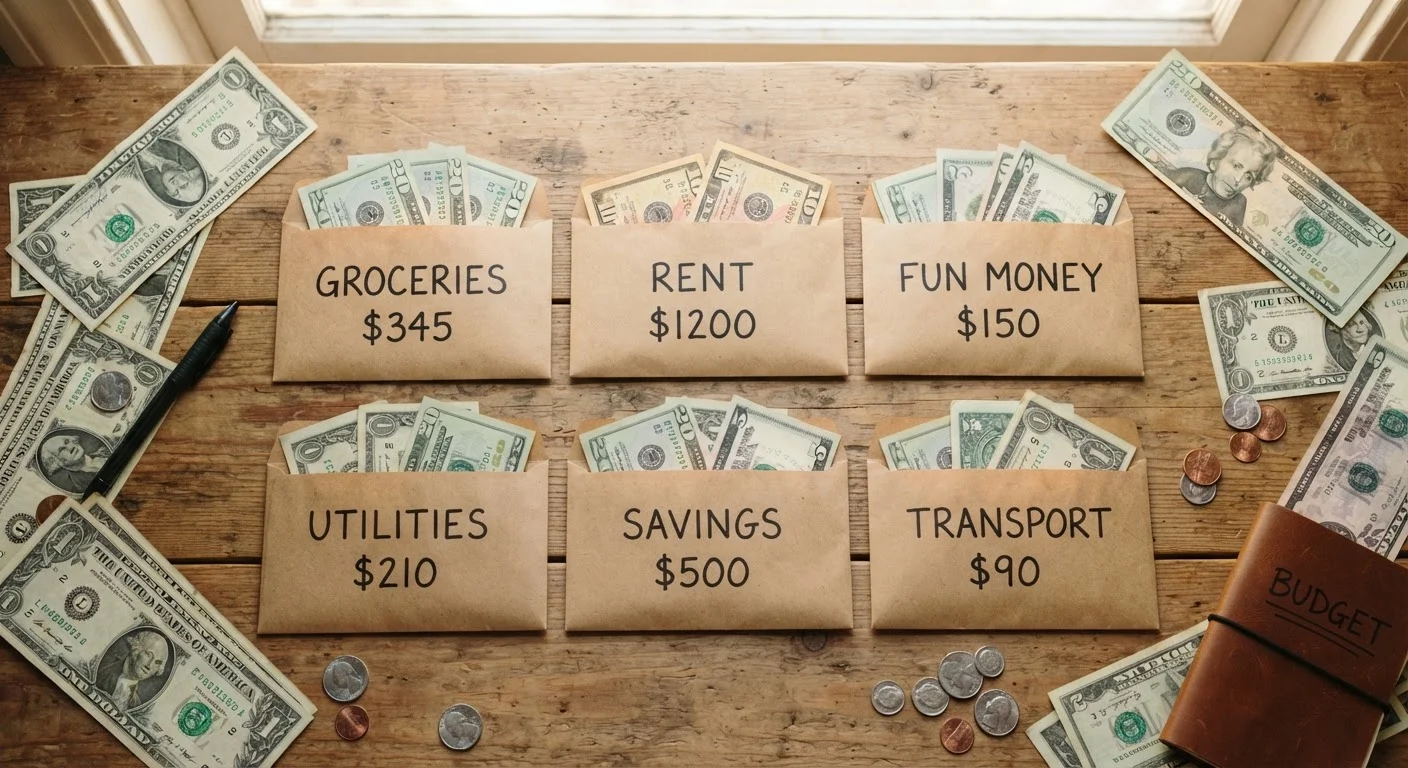
The envelope method is a cash-based budgeting system where you divide your take-home pay into physical envelopes — one per spending category. You label each envelope with a category (groceries, gas, dining out, etc.), fill it with the cash you've decided to spend there, and stop spending in that category when the envelope is empty. It's a hands-on way to make your budget feel real rather than abstract.
Also called envelope budgeting or the cash envelope system, this approach is a subset of zero-based budgeting — a framework in which every dollar of income is assigned a specific purpose before the month begins.
How the Envelope Method Works
The mechanics are simple. On payday, you withdraw cash for every variable spending category in your budget and divide it into labeled envelopes. Want to spend $400 on groceries this month? That $400 goes in the grocery envelope. Once it's gone, it's gone — you either stop spending or consciously move money from another envelope and live with the trade-off.
Fixed, predictable bills (rent, car payment, insurance premiums) stay out of the envelope system entirely. You pay those by check, auto-draft, or card as usual. The envelopes are for the spending that's hardest to control: food, entertainment, clothing, personal care, and similar categories where amounts fluctuate month to month.
At the end of the month, any leftover cash can be rolled into next month's envelope, moved to savings, or used to pay down debt — whichever supports your current financial goal. The system resets with each pay cycle.
For a broader look at how this fits into your overall financial plan, the complete budgeting guide covers foundational frameworks and tracking approaches in one place.
Why the System Still Works — Even Now
Credit cards and tap-to-pay have made spending nearly frictionless. That convenience is also a vulnerability. Research in behavioral economics consistently finds that people spend more when paying digitally than with cash — a pattern sometimes called the "pain of paying." Handing over physical bills registers as a loss in a way that swiping a card simply doesn't.
The envelope method exploits that psychology on purpose. When you open a nearly empty grocery envelope mid-month, the feedback is immediate and visceral. There's no mental accounting required — the remaining cash is right in front of you.
“Budgeting is not about restricting what you love — it's about making sure your money goes toward the things you actually value.”
— Jesse Mecham, Founder of YNAB (You Need a Budget) and author on personal budgeting
That concrete visibility is why the method resonates for people who have tried tracking apps and still overspent. The app tells you what happened after the fact; the envelope tells you what's left right now.
If you're weighing this approach against other structured frameworks, our comparison of zero-based budgeting and the 50/30/20 rule lays out the trade-offs clearly.
Adapting the Envelope Method for a Digital Life
Most Americans rarely carry much cash, and some merchants no longer accept it at all. That doesn't make the envelope system obsolete — it means you adapt the structure without abandoning the principle.
Separate checking accounts as digital envelopes. Open a few free checking accounts (many banks and credit unions offer these) and treat each one as a named envelope. Transfer your budgeted grocery amount to one account, your entertainment amount to another, and use the matching debit card for those purchases only.
Budgeting apps that use envelope logic. Several apps are built explicitly around the envelope framework, allowing you to create virtual envelopes and track spending against each limit in real time. As a category drains, you see it visually — mimicking the physical cue of a thinning envelope.
A hybrid approach. Use physical cash for your highest-risk categories (dining out, personal spending) and digital accounts for lower-risk ones. This concentrates the psychological guardrail where you need it most.
Before committing to any format, it helps to think through how you prefer to track spending day-to-day. Our look at spreadsheet vs. pen-and-paper budgeting can help you find the right tracking style to pair with your envelope setup.
This article is for general informational purposes only and does not constitute personalized financial advice. For guidance specific to your situation, consider consulting a qualified financial professional.