

Key Takeaways
Why the Front of the Bag Tells You Almost Nothing
Pet food packaging is designed to sell. Words like premium, holistic, and natural appear prominently on the front, but the Association of American Feed Control Officials (AAFCO) — the body that sets U.S. pet food labeling standards — either defines these terms loosely or not at all. Natural, for example, simply means the ingredient was not chemically synthesized; it carries no nutritional promise.
The genuinely useful information is on the back or side panel, in three specific places: the ingredient list, the guaranteed analysis, and the nutritional adequacy statement. Understanding each one takes only a few minutes and gives you a clearer picture than any front-of-bag claim ever could. For a broader look at separating genuine pet needs from clever marketing, see what your pet actually needs vs. what the pet aisle is selling you.
How to Read the Label Step by Step
Follow these steps the next time you pick up a bag or can of pet food. You only need the package itself — no app or special tool required.
Find the AAFCO nutritional adequacy statement first
Look for a sentence that begins with something like: "[Product name] is formulated to meet the nutritional levels established by the AAFCO Dog (or Cat) Food Nutrient Profiles for [life stage]." This is the single most important line on the label. It tells you whether the food is considered complete and balanced — meaning it is designed to be a pet's sole diet — and for which life stage (puppy/kitten, adult, all life stages, or senior).
If the statement says "for supplemental or intermittent feeding only," the food is not nutritionally complete on its own. That is not necessarily a problem for treats or toppers, but it matters greatly if you are feeding it as a primary diet.
Read the ingredient list for order and pattern, not just names
Ingredients are listed in descending order by pre-cooking weight, including their moisture. A whole chicken listed first weighs more than a dry ingredient like oatmeal ranked below it — but after cooking, the chicken shrinks considerably. This does not make chicken a bad ingredient; it simply means ingredient rank alone does not tell the whole nutritional story.
Look for a named protein source (chicken, salmon, beef — not a vague term like "poultry" or "meat") in the first few positions. Scan the overall pattern: are the first five to seven ingredients mostly recognizable whole foods and protein concentrates, or mostly grain fractions and fillers? No single ingredient makes or breaks a food, but the pattern across the first third of the list is a reasonable quality signal.
Interpret the guaranteed analysis numbers correctly
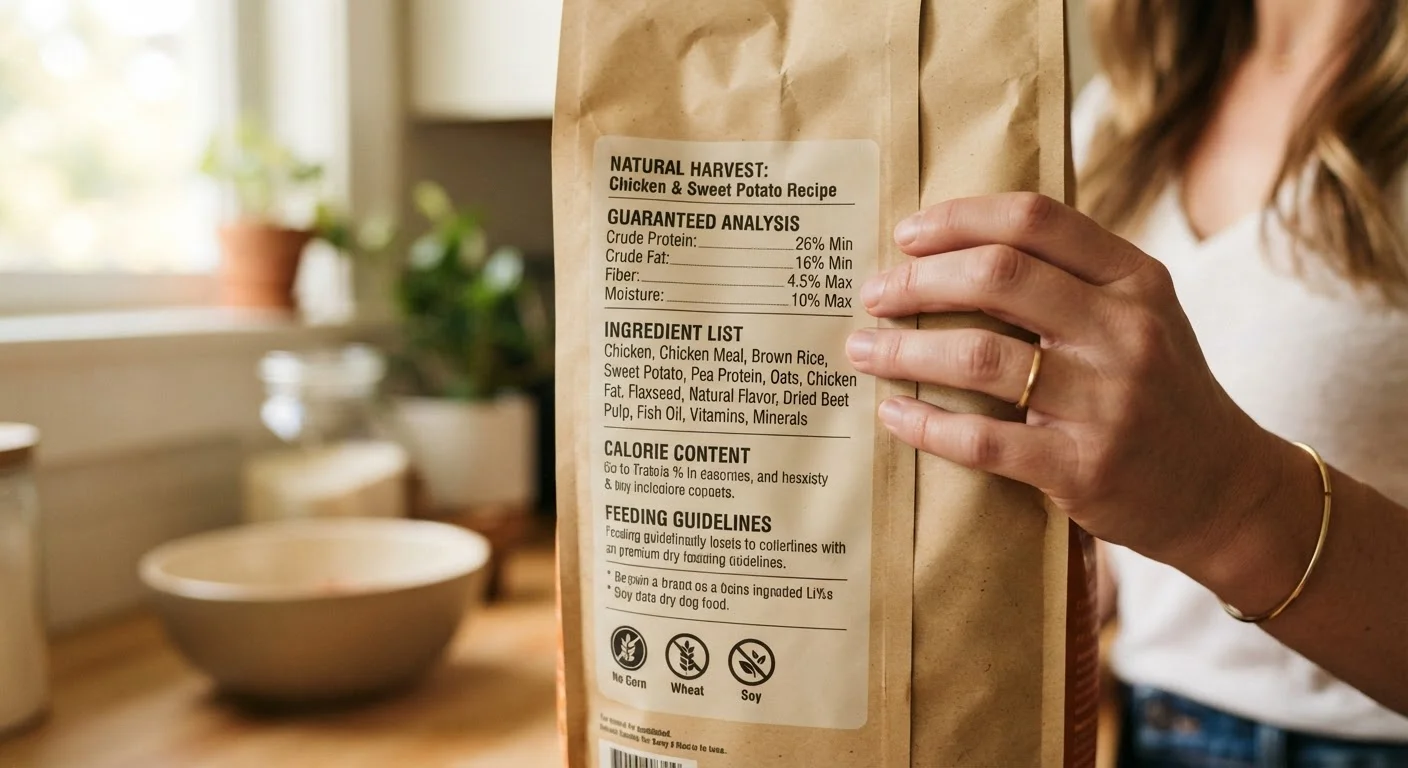
The guaranteed analysis panel lists at minimum four values: crude protein (minimum %), crude fat (minimum %), crude fiber (maximum %), and moisture (maximum %). Some labels add more.
These are not exact measurements — they are regulatory guarantees. A "minimum 26% crude protein" means the food contains at least that much; it could contain more. A "maximum 4% crude fiber" means it contains no more than that. Because these are floors and ceilings rather than averages, they do not replace laboratory analysis, but they give you enough to make reasonable comparisons between products in the same format (wet-to-wet or dry-to-dry).
Check whether the formula was feeding-trial tested or nutrient-profile formulated
The AAFCO adequacy statement will also indicate how the food was validated. One route is feeding trials — animals ate the food over a defined period and the results met AAFCO standards. The other is nutrient profile formulation — the recipe was calculated to hit nutrient targets on paper without live animal testing.
Both routes are legally acceptable, and formulated foods are not automatically inferior. However, feeding-trial validation offers an additional layer of real-world evidence that the food is digested and tolerated as intended. If you see the phrase "animal feeding tests using AAFCO procedures" on the label, that food went through trials.
Ignore unregulated marketing claims on the front panel
Once you have checked the four items above, you have gathered everything the label can reliably tell you. Terms like human-grade, ancestral diet, grain-free, and superfood blend either lack AAFCO definitions or do not correlate with nutritional adequacy. Grain-free formulas, in particular, have been the subject of ongoing FDA inquiry regarding a possible link to certain heart conditions in dogs — your vet is the right person to consult if you are considering one.
For more on filtering genuine pet needs from marketing noise, our companion guide on pet food label fine print covers additional edge cases worth knowing.
Wet vs. Dry: Compare on the Same Basis
Wet foods typically show lower protein percentages on the guaranteed analysis because they contain 75–80% moisture. To compare them fairly with dry foods, convert both to dry matter basis: divide the nutrient % by the % dry matter (100 minus moisture %). Most veterinary nutrition resources include a simple calculator or worksheet for this.
Common Label Confusions — and What They Actually Mean
Even after learning the basics, a few label conventions trip people up repeatedly.
Ingredient splitting
Manufacturers sometimes list variations of one ingredient separately — for example, ground corn, corn gluten meal, and corn bran — so that each appears lower on the list than a single combined corn entry would. This is legal, but worth noting when evaluating how much of a given ingredient is actually present.
"Meal" is not a red flag
Chicken meal, for instance, is chicken with most of its moisture removed. Because the guaranteed analysis measures nutrients on a similar moisture-removed basis, meal ingredients can deliver concentrated protein even when they rank below a whole-meat ingredient on the list. Neither format is automatically superior; context matters.
Guaranteed analysis versus dry matter basis
Comparing a wet food's crude protein (say, 10%) to a dry food's (say, 28%) looks misleading until you account for moisture. Converting both to a dry matter basis — dividing the nutrient percentage by the percentage of dry matter in the food — puts them on equal footing. Most veterinary and nutritional resources walk through this calculation if you want to compare products across formats.
Questions about how nutrition intersects with your pet's specific health status are worth raising at a wellness exam. See our overview of what a routine vet visit actually covers for what to expect and what to ask.
This article is for general informational purposes only and is not a substitute for veterinary nutritional advice tailored to your individual pet.