

Key Takeaways
Permanent identification that can't be removed
Unlike a collar or tag, which can fall off, be cut, or become unreadable, a microchip stays with the animal for life. This is particularly valuable if a pet is stolen or ends up far from home.
Low cost, one-time procedure
The implantation itself is typically comparable in cost to a routine office visit or less, and the chip itself requires no ongoing maintenance, charging, or replacement.
Minimal discomfort and very low risk
The chip is implanted with a needle in a quick procedure requiring no anesthesia. Serious adverse reactions are rare; mild, temporary soreness at the injection site is the most common response.
Proven to improve return-to-owner rates
Research published in veterinary journals has found that microchipped dogs and cats are significantly more likely to be reunited with their owners than unchipped pets arriving at shelters.
Widely readable at shelters and clinics
Universal scanners capable of reading common chip frequencies are standard equipment at most U.S. animal shelters and veterinary practices, meaning the system works across the country.
Not a GPS — cannot locate a lost pet
The chip is passive and emits no signal on its own. It provides no location data and is only detectable when a scanner is held within a few inches of the chip.
Only works if the pet reaches a scanner
If a lost pet is never brought to a shelter or veterinary office, or is kept by a finder who never checks for a chip, the chip provides no benefit at all.
Registry information must be kept current
A chip linked to an old phone number or email address is effectively useless. Many reunification failures happen not because the chip didn't work, but because the registry data was out of date.
Scanner compatibility gaps can occasionally occur
While universal scanners are now standard in most facilities, older or lower-quality scanners may not reliably detect all chip frequencies, particularly some older 125 kHz chips.
Rare but possible chip migration
In some cases, the chip can migrate slightly from the original implantation site, which may require scanning a broader area of the body to detect it.
Our Verdict
Microchipping is a low-cost, low-risk intervention with a meaningful upside: it gives lost pets a verified path back to their owners that a collar alone cannot guarantee. Its limitations are real — it is not a GPS device and is only as useful as the registry data behind it — but those limitations are manageable with a one-time registration and occasional contact updates.
Microchipping is a worthwhile step for virtually any dog or cat owner, but especially for those with pets that spend time outdoors, travel frequently, or live in areas with high stray or theft rates.
What a Microchip Actually Is (and Isn't)
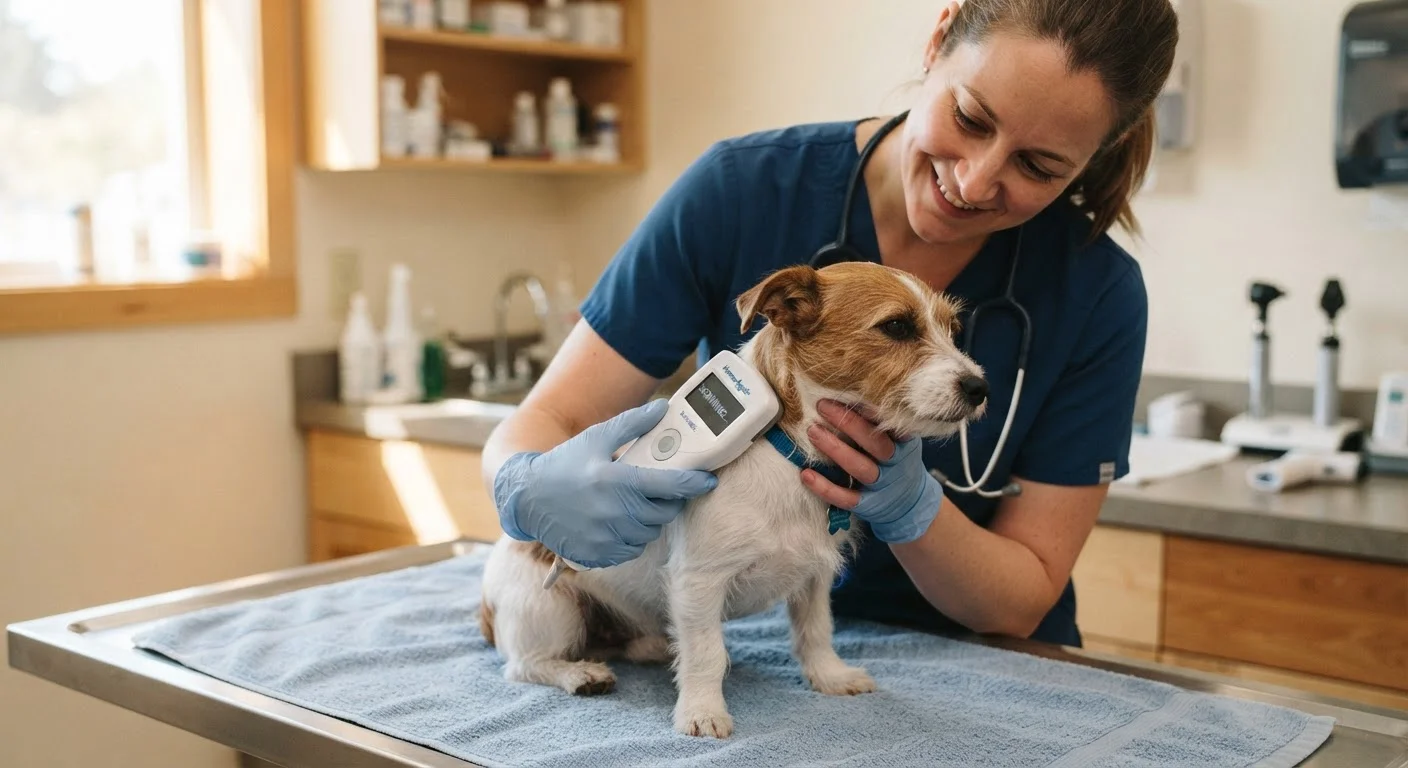
A pet microchip is a tiny passive transponder — roughly the size of a grain of rice — injected under the skin between the shoulder blades. "Passive" is the key word: the chip has no battery, no motor, and no GPS antenna. It does nothing on its own. When a shelter worker or veterinarian passes a compatible RFID scanner over the chip, it emits a unique numeric ID code, which is then cross-referenced against a pet recovery database to find the registered owner's contact information.
This is the most common misconception worth clearing up immediately: a microchip cannot tell you where your pet is. It is a permanent ID tag embedded in the body — not a tracking device. If your dog bolts from the yard, the chip does nothing until that dog physically arrives at a facility with a scanner. Understanding this distinction is essential for setting realistic expectations — and for deciding whether a GPS collar might also be worth considering alongside a chip.
For a broader look at how everyday pet health decisions stack up against common assumptions, see common pet health myths vets want debunked.
The Case For Microchipping: Real Advantages
The veterinary consensus in favor of microchipping rests on several practical strengths that are hard to argue with.
Permanent identification that can't be removed
Unlike a collar or tag, which can fall off, be cut, or become unreadable, a microchip stays with the animal for life. This is particularly valuable if a pet is stolen or ends up far from home.
Low cost, one-time procedure
The implantation itself is typically comparable in cost to a routine office visit or less, and the chip itself requires no ongoing maintenance, charging, or replacement.
Minimal discomfort and very low risk
The chip is implanted with a needle in a quick procedure requiring no anesthesia. Serious adverse reactions are rare; mild, temporary soreness at the injection site is the most common response.
Proven to improve return-to-owner rates
Research published in veterinary journals has found that microchipped dogs and cats are significantly more likely to be reunited with their owners than unchipped pets arriving at shelters.
Widely readable at shelters and clinics
Universal scanners capable of reading common chip frequencies are standard equipment at most U.S. animal shelters and veterinary practices, meaning the system works across the country.
Microchipping is also increasingly routine as part of annual wellness care. If your pet hasn't been chipped yet, it's a straightforward item to add during a regular exam — see what actually happens at a routine vet visit to understand how these preventive steps fit together.
~2.5x
Return-to-owner rate for microchipped dogs vs. unchipped
A study published in the Journal of the American Veterinary Medical Association found microchipped dogs were approximately 2.5 times more likely to be reunited with their owners.
~21%
Microchipped cats returned to owners without chip
The same JAVMA research found return rates for unchipped cats at shelters were dramatically lower than for those with registered microchips.
The Honest Limitations You Should Know
A balanced view requires acknowledging what microchips genuinely cannot do.
Not a GPS — cannot locate a lost pet
The chip is passive and emits no signal on its own. It provides no location data and is only detectable when a scanner is held within a few inches of the chip.
Only works if the pet reaches a scanner
If a lost pet is never brought to a shelter or veterinary office, or is kept by a finder who never checks for a chip, the chip provides no benefit at all.
Registry information must be kept current
A chip linked to an old phone number or email address is effectively useless. Many reunification failures happen not because the chip didn't work, but because the registry data was out of date.
Scanner compatibility gaps can occasionally occur
While universal scanners are now standard in most facilities, older or lower-quality scanners may not reliably detect all chip frequencies, particularly some older 125 kHz chips.
Rare but possible chip migration
In some cases, the chip can migrate slightly from the original implantation site, which may require scanning a broader area of the body to detect it.
None of these limitations make microchipping a bad idea — they make it an incomplete idea if used as a single strategy. Layering in a secure ID tag, a well-fitted collar, and for high-risk situations a GPS tracker, gives your pet the strongest coverage. Microchipping is one layer of that system, not the whole system.
ISO Standard Chips Are Now the Norm
Most chips implanted in the U.S. today conform to the ISO 11784/11785 standard and operate at 134.2 kHz, the international frequency used across much of the world. If your pet travels internationally or was adopted from abroad, it's worth confirming which frequency their chip uses. Ask your veterinarian to scan and document the chip number so you have it on record — this is especially useful if your pet ever needs to be identified in an emergency.
The Registry Problem: The Step Most Owners Skip
The single biggest failure point in microchipping isn't the chip — it's the paperwork. A chip that isn't registered in a searchable database, or that carries old contact details, is functionally useless. Studies of microchipped pets arriving at shelters have consistently found that a significant portion have either unregistered chips or outdated registry information.
When you have your pet microchipped, the clinic will typically prompt you to register the chip number with a national pet recovery registry. This requires creating an account, entering your contact details, and linking them to the chip's unique ID. If you move, change your phone number, or change your email, that registry entry needs to be updated — manually, by you. Most registries charge a small one-time or annual fee, though some are free.
The practical habit: update your pet's registry information any time your own contact details change, the same way you'd update an emergency contact at a school or a beneficiary on an account. It takes minutes and is the difference between a chip that works and one that doesn't.
Preventive steps like this — small efforts that pay off disproportionately — are also central to the broader argument for routine care covered in preventive care versus reactive treatment.