

Key Takeaways
Why 'Stay' Is Harder Than It Looks
"Stay" asks a dog to do something inherently unnatural: remain still while the world moves around them. Unlike sit or down, which are brief action cues, stay is a sustained behavior — the dog must resist impulse, ignore distractions, and trust that holding position is worthwhile. This is why so many dogs learn a shaky version that falls apart the moment something interesting happens nearby.
Trainers and behaviorists commonly frame stay as three separate skills combined: duration (how long), distance (how far away you move), and distraction (what competes for the dog's attention). Each variable adds cognitive load. Trying to train all three at once is like teaching someone to juggle while riding a bicycle on the first lesson. For a broader foundation in reward-based obedience, see our guide to basic obedience training.
Never Train All Three Variables at Once
Adding duration, distance, and distraction simultaneously is the most common reason stay training stalls or regresses. Dogs need to feel successful in order to build confidence in a behavior. Isolate one variable per session until your dog is reliably holding the stay, then combine gradually.
What You'll Need Before Starting
Effective stay training requires very little equipment, but a few items make sessions cleaner and more efficient.
High-value training treats
Reward the dog immediately upon a successful stay or release, reinforcing the desired behavior.
Treat pouch or bait bag
Keeps rewards accessible so you can deliver them quickly without fumbling in pockets.
Six-foot leash
Provides a safety backup during early distance work so the dog cannot self-reward by wandering off.
Clicker (or verbal marker word)
Marks the exact moment the correct behavior occurs, improving precision of reinforcement.
You'll also want to confirm your dog meets these starting points before beginning the step-by-step progression below.
What you will need
Step-by-Step: Training the Stay Command
Follow these steps in order. Each builds on the last, and skipping ahead is the most reliable way to create an unreliable stay. Most dogs can reach a solid 30-second stay at close range within one to two weeks of consistent daily practice.
Establish a Clear Stay Cue and Release Word
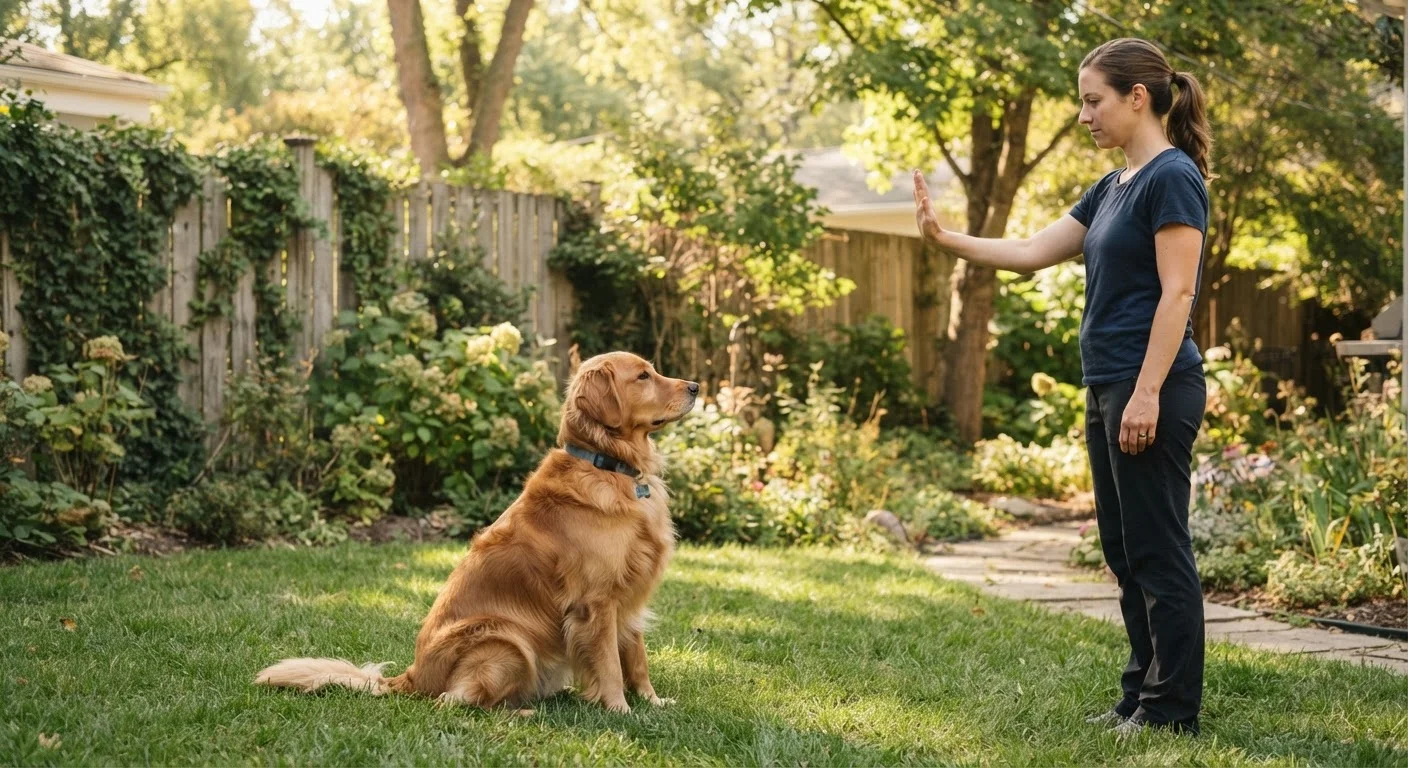
Ask your dog to sit or lie down. Once settled, say "stay" in a calm, neutral tone — one time only. Wait just one to two seconds, then say your chosen release word ("okay" or "free") and immediately reward. The release word tells your dog the behavior is finished; without it, the dog has no clear endpoint and will start making its own decisions about when to move.
Build Duration First — Seconds Before Minutes
With your dog in position and you standing directly in front, gradually extend the time between your stay cue and your release. Increase in small increments: 2 seconds, then 5, then 10, building toward 30 seconds over multiple sessions. Return to your dog to deliver the reward before you release — this teaches that you coming back is a good thing, not a sign the exercise is over. Aim for a 30-second reliable stay before moving to distance.
Introduce Distance Gradually
Once your dog holds a 30-second stay reliably with you standing close, begin adding distance. Take one step back, pause, step back in, reward, then release. Over multiple sessions, work up to moving 6 feet away, then across the room. A leash attached to a fixed anchor point (not held taut) can act as a safety net early on. Reset duration to just a few seconds when you first add distance — you are asking the dog to manage a new challenge.
Add Distraction as the Final Layer
Distraction is the hardest variable and should come last. Start with mild disruptions: toss a treat on the ground to the side, clap once softly, or walk in a small circle around your dog. Reward heavily when the dog holds position. Progress to more realistic distractions — a family member walking by, doorbell sounds, or training near other dogs — only after the dog is solid at easier levels. Keep duration and distance short when adding new distractions.
Combine Variables and Proof in Real-Life Contexts
Once your dog handles each variable separately, begin combining them: longer duration and greater distance, then add mild distraction on top. Practice in varied locations — the front yard, a park, a friend's house — because dogs learn behaviors in context and need to generalize across environments. A stay that works only in the living room is a good start, not a finished skill.
Avoid Repeating the Cue Mid-Stay
Saying 'stay, stay, stay' repeatedly teaches your dog that a single 'stay' means nothing. Give the cue once, clearly, and let the dog work through it. If the stay breaks, calmly reset without scolding — frustration during training undermines trust and slows progress.
Troubleshooting Common Problems
Dog breaks the stay immediately: Your starting duration is too long. Drop back to one second and rebuild. Every successful repetition matters more than reaching a time goal quickly.
Dog follows you when you step back: You may be moving too fast or leaning back in a way that triggers the dog's instinct to follow. Return to one small shuffle-step, reward generously, and progress more slowly. A leash anchored to a sturdy object (not held in your hand) can prevent the dog from completing the mistake.
Stay works at home but nowhere else: This is a generalization problem, not a failure of training. Dogs don't automatically transfer learned behaviors across environments. Practice the skill from scratch — at an easy level — in each new location. It will progress faster than the original training since the concept is already understood.
If your dog struggles with being left alone more broadly, the stay skill complements the gradual desensitization approach outlined in our separation anxiety training guide. You may also want to review common training myths that could be shaping your approach in unhelpful ways.
Use High-Value Rewards for Harder Challenges
When increasing distraction — such as training near other dogs or in a busy park — switch to a higher-value treat than you use for easy practice. Real meat, cheese, or your dog's favorite reward signals that the harder task is worth extra effort. Reserve these special rewards exclusively for the most challenging scenarios so they stay motivating.