

Key Takeaways
Why a Whole-Home Approach Matters
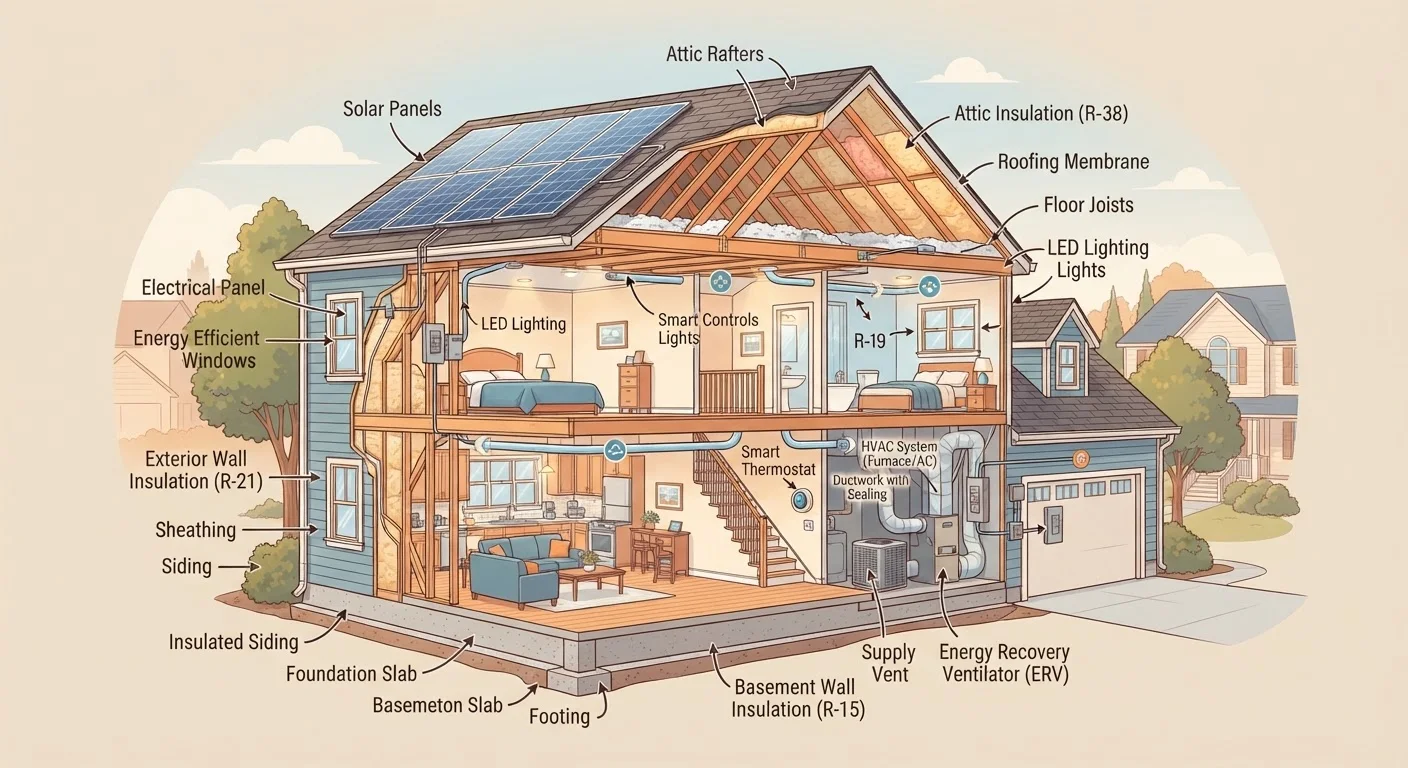
Most homeowners tackle energy efficiency one item at a time — swapping a light bulb here, turning down the thermostat there. While every action helps, this piecemeal approach leaves significant savings on the table. A whole-home strategy treats your house as an interconnected system, where improvements in one area ripple through the rest.
For example, adding a more powerful furnace without first sealing air leaks is likely to waste money — you're paying to heat air that escapes through the walls. Conversely, tightening the building envelope and upgrading insulation can allow a smaller, less expensive HVAC unit to keep your home comfortable year-round.
According to the U.S. Department of Energy, the average American household spends more than $2,000 per year on energy bills, and a substantial portion of that can be reduced through informed upgrades. This guide walks through every major system — in a logical sequence — so you can prioritize intelligently and avoid costly missteps.
Start With an Energy Audit
Before spending a dollar on upgrades, get a clear picture of where your home currently stands. A professional home energy audit — sometimes called a home performance assessment — uses diagnostic tools like a blower door test and thermal imaging camera to locate air leaks, under-insulated cavities, and duct problems that are invisible to the naked eye.
Many utility companies offer subsidized or even free audits to residential customers. You can also hire a certified energy auditor independently; look for credentials from organizations such as BPI (Building Performance Institute) or RESNET. The audit report will typically rank improvements by cost-effectiveness, giving you a prioritized action plan rather than guesswork.
When scheduling an energy audit, do it during a heating or cooling season — not mild weather — so the auditor can run a blower door test under realistic pressure conditions and spot active infiltration more accurately.
Temperature differentials between indoors and outdoors make air movement through leaks more detectable with thermal imaging and pressure testing, producing more actionable audit results.
Before adding attic insulation, have a professional check for and seal attic bypasses — the gaps where interior partition walls, plumbing chases, and recessed lights penetrate the ceiling plane — or new insulation will simply sit on top of your existing air leakage problem.
Bypasses allow warm interior air to flow directly into the attic regardless of insulation depth, dramatically reducing the effectiveness of insulation added above them.
If a full audit isn't immediately accessible, a DIY visual inspection is a reasonable starting point. Check for daylight around door frames, feel for drafts near electrical outlets on exterior walls, and look for uneven room temperatures — all are signs of air sealing or insulation gaps worth addressing.
The Building Envelope: Insulation, Air Sealing, and Windows
Your building envelope — the roof, walls, floors, windows, and doors that separate conditioned indoor air from the outside — is the single most influential factor in home energy performance. Gaps and thin insulation force your heating and cooling equipment to work overtime every day of the year.
Air Sealing
Air sealing is often the highest-return improvement available. Common leakage points include attic hatch covers, recessed lighting fixtures, plumbing and wiring penetrations, and the sill plate where your home's frame meets the foundation. Caulk, weatherstripping, and spray foam are the primary materials, and most sealing tasks are accessible to careful DIYers — though penetrations near combustion appliances should be handled by a professional to avoid carbon monoxide risks.
Insulation
Insulation levels are measured in R-values — the higher the number, the greater the resistance to heat flow. The U.S. Department of Energy publishes recommended R-values by climate zone; attics in cold climates may warrant R-49 to R-60, while milder regions may need less. Attic insulation is typically the most cost-effective place to start, since heat rises and attic bypasses are a major loss point.
Windows and Doors
Window replacement is expensive relative to its energy payback. Prioritize sealing and weatherstripping existing windows before replacing them. When replacement is warranted — due to age, damage, or single-pane glass — look for ENERGY STAR-certified products rated for your climate zone. Low-emissivity (low-e) coatings and double or triple panes make a meaningful difference in heat transfer.
Heating and Cooling: Your Biggest Energy Draw
Space conditioning — keeping your home warm in winter and cool in summer — accounts for roughly 43% of household energy use in the United States, according to the U.S. Energy Information Administration. This makes your HVAC system the highest-impact target for efficiency improvements.
~43%
Share of home energy used for space conditioning
According to the U.S. Energy Information Administration's Residential Energy Consumption Survey.
20–30%
Conditioned air lost through leaky duct systems
Estimated by the EPA's ENERGY STAR program for homes with forced-air systems routed through unconditioned spaces.
75%
Less energy used by LEDs vs. incandescent bulbs
Per the U.S. Department of Energy's lighting efficiency data.
HVAC Equipment Efficiency
If your furnace or central air conditioner is more than 15–20 years old, a modern replacement is likely to use significantly less energy for the same comfort output. Efficiency ratings to understand: SEER2 (Seasonal Energy Efficiency Ratio) for central air conditioners and AFUE (Annual Fuel Utilization Efficiency) for gas furnaces. Higher numbers indicate greater efficiency.
Heat pumps have emerged as a versatile option in many US climates — they provide both heating and cooling from a single system, using electricity rather than combustion fuel. Cold-climate heat pumps now operate efficiently at temperatures well below freezing, making them viable in more northern states than in previous generations of the technology.
Duct Systems
In homes with forced-air systems, leaky or uninsulated ducts can waste 20–30% of conditioned air before it reaches living spaces, according to Energy Star program estimates. Have ducts tested and sealed by an HVAC professional, especially in unconditioned spaces like attics and crawlspaces. This is not a safe DIY task where gas appliances are involved.
Maintenance
Replace air filters on schedule (typically every 1–3 months depending on filter type and household conditions), keep outdoor condenser coils clear of debris, and schedule annual professional tune-ups. Well-maintained equipment runs more efficiently and lasts longer.
Water Heating, Lighting, and Appliances
After space conditioning, water heating is typically the second-largest energy expense in American homes. Conventional tank water heaters keep a large volume of water hot around the clock. Heat pump water heaters — which move heat from surrounding air into the water — use roughly half the electricity of a standard electric resistance heater and are now widely available in the US market. They work best in spaces that stay above 40°F and have adequate square footage for air circulation.
Tankless (on-demand) water heaters eliminate standby heat loss by heating water only when needed. They require adequate gas line or electrical capacity, so consult a licensed plumber before switching.
Lighting
LED lighting now dominates the US market for good reason: LEDs use approximately 75% less energy than traditional incandescent bulbs and last many times longer, according to the Department of Energy. If your home still has significant incandescent or halogen fixtures, converting to LEDs is among the fastest-payback improvements available.
Appliances
When replacing major appliances — refrigerators, dishwashers, washing machines — look for ENERGY STAR certification, which signals that the product meets efficiency standards set by the EPA. Running full loads in dishwashers and washing machines, and using cold water wash cycles, further reduces energy and water use without any capital investment.
Smart Controls and Home Automation
Physical improvements to insulation and equipment set the foundation; smart controls help you extract maximum value from those improvements day to day. A programmable or smart thermostat, for example, can reduce heating and cooling energy use by adjusting temperatures automatically when the home is unoccupied or occupants are asleep.
Smart thermostats go further than programmable models by learning household patterns, integrating with weather data, and allowing remote adjustments via smartphone. The EPA's ENERGY STAR program estimates that a certified smart thermostat can save around 8% on heating and cooling bills on average — though actual results vary by home, climate, and prior thermostat habits.
Beyond thermostats, smart power strips eliminate phantom load (standby power draw) from electronics, smart plugs allow scheduling of devices, and whole-home energy monitors give real-time visibility into where electricity is being consumed. For a broader look at building a connected home ecosystem, see our complete guide to smart home living.
It's also worth checking our energy efficiency myths article before finalizing your upgrade plan — some common assumptions about what saves the most energy don't hold up under scrutiny.
Financial Incentives and Next Steps
The cost of energy efficiency upgrades can be substantially offset by available incentives. The federal Inflation Reduction Act (IRA), enacted in 2022, created or extended tax credits for a range of home improvements including insulation, air sealing, heat pumps, heat pump water heaters, and electric panel upgrades. These credits are generally available to homeowners filing US federal taxes, subject to eligibility rules and annual limits — consult a qualified tax professional for guidance on your specific situation.
In addition to federal credits, many state governments and local utility companies offer rebate programs, low-interest financing, or on-bill financing for qualifying upgrades. The Database of State Incentives for Renewables & Efficiency (DSIRE), maintained by NC State University, is a publicly accessible resource for researching programs available in your area.
As a practical sequencing guide: start with an energy audit, then prioritize air sealing and insulation, address HVAC maintenance or replacement if warranted, update water heating and lighting, and layer in smart controls last. This order generally delivers the greatest return on investment and avoids the mistake of over-sizing new equipment in a still-leaky home.
For homeowners interested in security alongside efficiency, our home security hub covers how modern connected devices can address both goals simultaneously. Explore the full range of options through our smart devices hub as well.
This article is intended for general educational purposes only and does not constitute financial, tax, legal, or professional home improvement advice. Always consult qualified professionals — including licensed contractors, certified energy auditors, and tax advisers — before undertaking significant home improvements or making financial decisions based on incentive programs.