

Key Takeaways
Motion Sensor
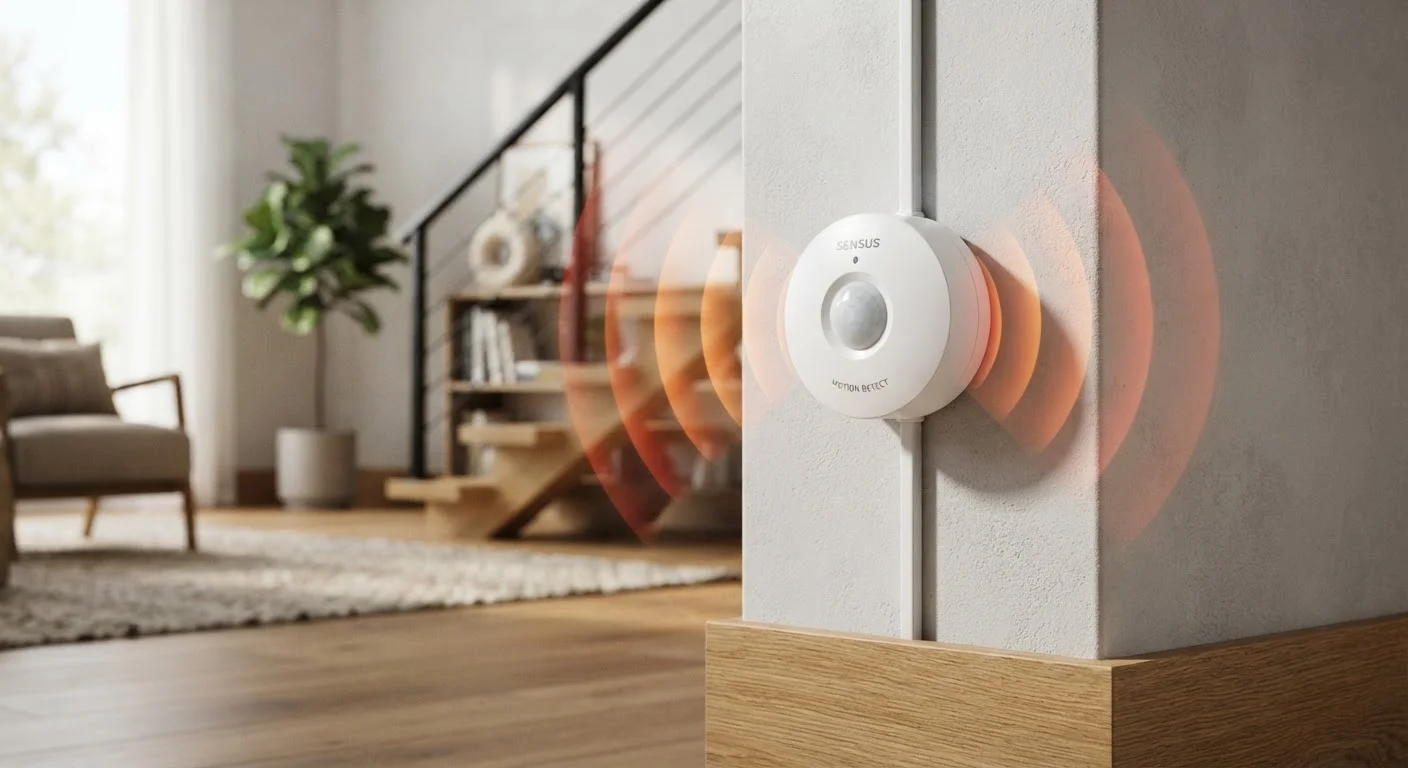
A motion sensor is a device that detects movement within a defined area and triggers a response — such as sounding an alarm, turning on a light, or sending a smartphone alert. Most home security motion sensors work by monitoring changes in infrared heat, radio waves, or a combination of both. When the sensor registers a change that matches its detection threshold, it activates.
Detection sensitivity is typically measured in terms of the temperature differential a sensor can register (for PIR) or the Doppler frequency shift it can resolve (for microwave). Dual-technology sensors require both signals to trigger simultaneously, reducing false alarms at the cost of slightly reduced sensitivity.
The Three Main Types of Home Motion Sensors
Most homeowners assume a motion sensor simply "sees" movement. In reality, different sensor types detect entirely different physical phenomena — and that distinction explains nearly every reliability problem people experience. See how sensors fit into the broader picture in our overview of home security system components.
Passive Infrared (PIR)
PIR sensors are by far the most common type found in residential security systems. They work by measuring infrared radiation — essentially body heat — and detecting when a warm object moves across the sensor's field of view. The word "passive" means they emit nothing; they only receive. A PIR sensor divides its detection zone into segments using a multi-faceted lens. When a heat source moves from one segment to another, the sensor registers the contrast and triggers.
Microwave Sensors
Microwave sensors emit continuous radio waves and measure how those waves bounce back. If a moving object changes the frequency of the reflected signal — a phenomenon called the Doppler effect — the sensor triggers. These sensors are more sensitive to subtle motion than PIR units and can detect through non-metallic barriers like glass or drywall.
Dual-Technology Sensors
Dual-tech sensors combine both PIR and microwave detection in one housing. They only trigger when both technologies register activity at the same time. This design dramatically reduces false alarms in challenging environments — busy offices, garages with temperature swings — though it adds some cost and complexity.
94%
Residential sensors that are PIR-based
Industry estimates suggest passive infrared technology dominates the residential sensor market due to low cost and low power consumption.
6.5–8 ft
Recommended mounting height for PIR sensors
Sensor manufacturers broadly recommend this height range to balance detection zone coverage and angular projection across the floor.
~50 lbs
Pet weight threshold for pet-immune sensors
Most pet-immune PIR sensors are calibrated to ignore heat signatures consistent with animals below approximately 50–80 lbs, depending on the model.
Why False Alarms Happen
False alarms are the most common complaint about motion sensors, and they almost always trace back to a specific, fixable cause rather than a defective product. Understanding the trigger mechanism makes the fix obvious.
Heat Sources and HVAC Systems
Because PIR sensors detect heat contrast, anything that changes the thermal landscape of a room can fool them. A heating vent blowing warm air across the sensor's detection zone, a fireplace cycling on, or a refrigerator motor running nearby can all generate enough infrared change to trigger an alert. The fix is usually repositioning the sensor away from direct airflow.
Sunlight and Window Exposure
Direct sunlight moving across the detection zone as the sun's angle changes throughout the day is a well-known PIR trigger. Similarly, a car's headlights sweeping across a wall at night can produce the same effect. Mounting sensors on interior walls, angled away from windows, solves most of these cases.
Microwave Bleed-Through
Because microwave sensors can penetrate walls, placing one on an exterior wall may cause it to pick up activity from outside — a passing car, a neighbor's pet, wind-blown foliage. This is a placement problem, not a sensor defect. The same root causes that make smart home systems feel unreliable often apply here: the device is working as designed, but in a context it wasn't optimized for.
Why Sensors Miss Real Movement
Missed detections are less discussed than false alarms but equally important to understand. A sensor that fails to trigger when someone is actually present is a fundamental security gap.
Parallel Movement and Slow Approach
PIR sensors are much better at detecting motion that crosses their detection zone — moving side to side — than motion that approaches directly toward them. Someone walking straight at a PIR sensor produces very little change across the segmented lens. Slow movement also produces less heat contrast change per unit time, sometimes falling below the sensor's trigger threshold entirely.
Temperature Masking
On a very hot day, when ambient room temperature approaches body temperature, the contrast a PIR sensor relies on shrinks. Detection range and reliability can drop noticeably in rooms that aren't climate-controlled, such as garages or sunrooms in summer.
Placement and Coverage Gaps
Sensors mounted too high lose the ability to detect people near the floor. Sensors aimed at a narrow corridor cover far less area than sensors placed at a corner covering a wide room. Most sensors are designed to be mounted at 6.5–8 feet — above that height, the detection angle may project the zone too far across the floor rather than through it. Addressing these blind spots is part of building a layered security approach, as explored in our article on common home security myths.
Practical Placement Principles
Sensor placement decisions resolve most reliability complaints before they start. A few consistent principles apply regardless of sensor type.
- Corner placement covers more area. Mounting a sensor in a room corner, angled across the space, maximizes the detection zone and ensures movement must cross the sensor's field of view rather than approach it head-on.
- Avoid thermal interference zones. Keep PIR sensors away from HVAC vents, windows with direct sun exposure, stoves, and space heaters.
- Layer sensor types for critical areas. For entry points where reliability is non-negotiable, pairing a PIR sensor with a door or window contact sensor adds a redundant detection layer that doesn't rely on motion at all.
- Check lens cleanliness. Dust or grease on the Fresnel lens (the ridged plastic dome on most PIR units) scatters infrared signals and reduces detection accuracy. Cleaning with a dry microfiber cloth is a quick fix often overlooked during troubleshooting.
Motion sensors are one piece of a broader detection strategy, not a standalone solution. Recognizing what they can and cannot do — and matching sensor type to environment — is the most practical path to a reliable, low-nuisance system. For a deeper look at realistic expectations for automated home systems, see our piece on home automation myths new owners commonly encounter.