

Key Takeaways
Home Security System
A home security system is a network of interconnected devices designed to detect unauthorized entry, alert occupants, and — in monitored setups — notify emergency responders. Each component plays a specific role in detecting, communicating, or responding to a threat. Understanding what each part does helps you evaluate whether a system is genuinely protecting your home or leaving gaps.
Most modern systems communicate between components using radio frequencies (Z-Wave, Zigbee, or Wi-Fi), while the central hub coordinates all signals and triggers appropriate responses.
The Control Panel: Command Center of Your System
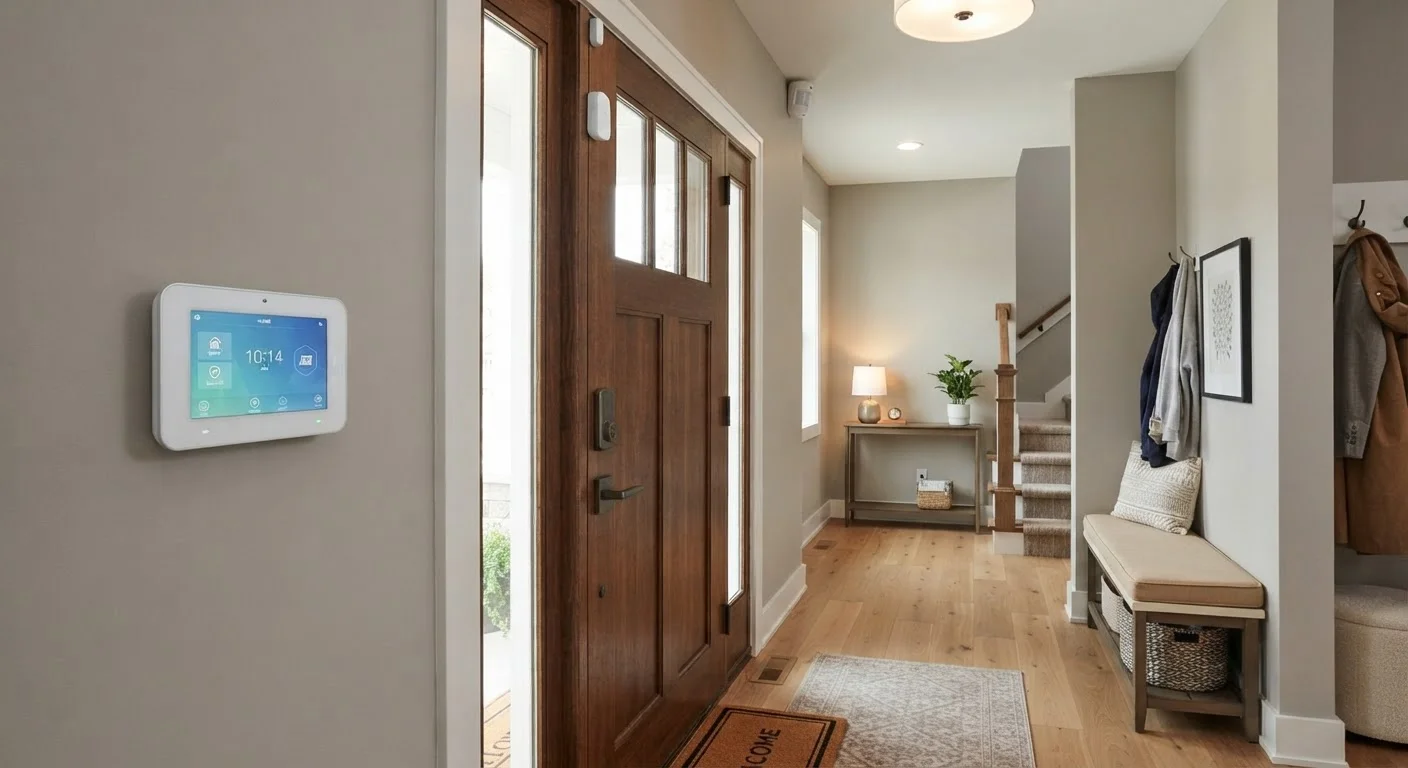
Every home security system centers on a control panel, sometimes called the hub or the brain of the system. This device receives signals from every sensor and detector in your home and decides what action to take — sounding an alarm, sending you a phone notification, or alerting a monitoring center.
The control panel also manages your system's arming and disarming status. When you leave for work and arm your system, the panel begins actively listening to all connected sensors. When you return and disarm at the keypad, the panel stops that listening cycle so normal activity doesn't trigger an alert.
Modern panels communicate wirelessly with components throughout the home. For a deeper look at how smart home hubs coordinate multiple devices, see our smart devices explainer.
Sensors: Your System's Eyes and Ears
Contact sensors are the most widely used component in home security. Installed in pairs — one piece on a door or window frame, one on the moving part itself — they detect separation. When a door opens while the system is armed, the two magnetic pieces pull apart and the panel is immediately notified.
Contact sensors are passive and highly reliable because they don't need to interpret anything. Either the door is closed or it isn't.
Motion detectors take a different approach. Placed in interior spaces, they monitor for movement using passive infrared (PIR) technology, which senses heat signatures as a person moves across a room. A second line of defense, motion sensors catch intruders who may have bypassed a door or window entry point — for example, through a broken pane of glass.
Glass break sensors round out this layer. Rather than detecting movement or contact, they listen for the specific acoustic frequency of shattering glass and trigger an alert when detected. They are especially useful on ground-floor windows where direct sensor installation is difficult.
34%
Break-ins through front door
According to FBI crime statistics, roughly one-third of home burglaries occur through the front door, reinforcing the value of contact sensors at primary entry points.
60 sec
Average time to complete a burglary
Studies on residential burglary patterns suggest most intruders complete an entry and exit within 60 seconds to a few minutes, making immediate alarm response critical.
85–120 dB
Residential siren decibel range
Most residential security sirens fall within this range — comparable to a lawn mower at the low end and a rock concert at the high end.
Keypads, Key Fobs, and Entry Methods
A keypad is the primary interface most homeowners use daily. Mounted near the main entry, it lets you arm or disarm the system using a PIN. Many systems support multiple user codes, so you can give family members or trusted visitors their own code without sharing the primary one.
Some systems also support key fobs — small remotes that let you arm and disarm with a button press from a distance, useful when your hands are full. Smartphone apps serve the same function in most modern systems, letting you control your system remotely.
Entry delay settings on keypads give you a brief window — typically 30 to 60 seconds — to disarm the system after entering, preventing false alarms while still maintaining protection.
Sirens and Notifications: Making Noise and Getting Attention
When a sensor is triggered and the system is armed, the siren activates. Its purpose is twofold: alerting occupants inside the home and drawing attention from neighbors or passersby. Research on burglary behavior suggests noise is a significant deterrent — see what actually deters break-ins for context on what the evidence shows.
Sirens are typically rated in decibels — most residential units range from 85 to 120 dB. The louder the siren, the more discomfort it creates for an intruder and the more likely neighbors are to take notice.
Beyond the physical siren, push notifications and SMS alerts sent to your smartphone extend real-time awareness when you're away from home. In monitored systems, alerts also reach a 24/7 dispatch center staffed with operators who can confirm an emergency and contact local authorities.
Test Your System Regularly
Most security professionals recommend testing each sensor and the siren at least once every three to six months. Walk your perimeter, open each protected door and window while the system is in test mode, and confirm the panel registers each trigger. Battery-powered sensors will also need periodic battery replacements — check manufacturer guidance for expected battery life.
Cameras and Environmental Detectors: Beyond Intrusion
Security cameras add a visual layer to what sensors detect numerically. They serve two functions: deterrence (a visible camera may discourage an attempt) and documentation (footage can aid in identifying individuals after an incident). Cameras may be indoor, outdoor, wired, or battery-powered, and many now integrate directly with a system's app or hub.
A complete system often includes environmental detectors that go beyond intrusion. Smoke detectors, carbon monoxide (CO) detectors, and water/flood sensors can be integrated into a security system so that one monitoring center or app covers multiple home hazards — not just unauthorized entry.
To identify where your home may have coverage gaps before investing in new equipment, running a home security audit is a practical first step. For a broader overview of everything these systems involve, see our complete homeowner guide to security systems.