

Key Takeaways
Burglary Deterrence
Burglary deterrence refers to physical, behavioral, and environmental measures that reduce the likelihood a would-be intruder will target your home. Rather than stopping a break-in in progress, deterrents work by making your home look riskier, harder, or less rewarding to attempt. Research on offender behavior consistently shows that perceived risk and effort matter more than most homeowners expect.
Criminologists use the term 'situational crime prevention' to describe how modifying the environment — raising effort, increasing risk of detection, reducing reward — shapes offender decision-making.
What Research Actually Says About Burglar Behavior
Understanding what deters break-ins starts with understanding how most burglars actually make decisions. Criminological research — including interview studies with convicted offenders — consistently shows that residential burglars are predominantly opportunistic. They assess risk quickly: Is someone home? Will I be seen? Can I get in fast? How long before someone notices?
This matters because it shapes which deterrents work. Measures that raise the perceived risk of getting caught or that slow down entry are more effective than those that simply look intimidating without creating real obstacles. See our overview of common security myths for a deeper look at beliefs that don't hold up under scrutiny.
~60%
Burglaries involving forcible door or window entry
U.S. Bureau of Justice Statistics data consistently shows doors and windows as the dominant entry method, underscoring the value of physical hardening.
< 60 seconds
Time many burglars spend attempting forced entry before moving on
Offender interview research, including studies cited by the U.S. Department of Justice, suggests that resistance slowing entry beyond about a minute significantly increases abandonment.
~30%
Burglaries occurring through an unlocked door or window
FBI and victimization survey data indicate that a substantial share of residential break-ins require no forced entry at all, highlighting the value of basic locking habits.
Door and Entry Point Hardening: The Highest-Leverage Investment
The majority of break-ins happen through doors — often not because the lock failed, but because the door frame gave way under a single kick. A quality deadbolt installed in a weak frame offers far less protection than it appears to. Door frame reinforcement kits, which strengthen the strike plate and hinge area with longer screws and steel inserts, are among the most cost-effective security upgrades available.
Beyond the frame, sliding glass doors and first-floor windows deserve attention. A cut-to-length wooden dowel or adjustable bar in the track of a sliding door prevents it from being forced open even when the latch is defeated. Window pin locks — simple hardware-store items — make double-hung windows far more resistant to being lifted from outside.
For a comprehensive breakdown of how locks, deadbolts, and frame reinforcement interact, see our practical door security comparison.
Lighting, Visibility, and the Appearance of Occupancy
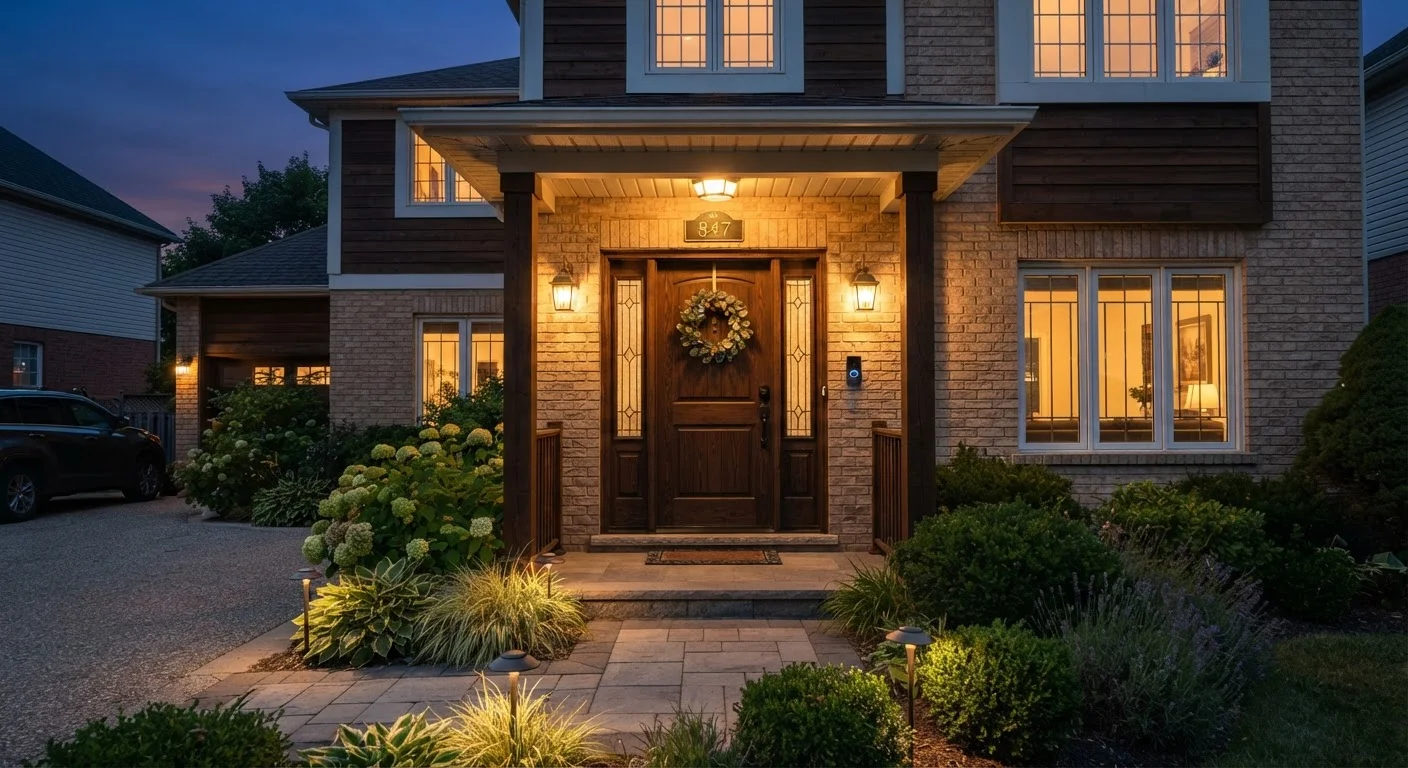
Exterior lighting is one of the lowest-cost, highest-impact deterrents supported by research. Motion-activated lights startle and illuminate, increasing the risk that a neighbor, passerby, or the occupant will notice activity. Well-lit entryways also eliminate the concealment that makes a forced entry attempt lower-risk for an intruder.
Occupancy cues matter just as much. Homes that look empty — uncollected mail, dark windows on a schedule, no vehicle in the driveway — are disproportionately targeted. Smart plugs that vary interior lighting on a timer, or a trusted neighbor who collects deliveries during travel, address this vulnerability inexpensively.
Landscaping also plays a role. Overgrown shrubs near entry points provide concealment. Keeping hedges and plantings trimmed around doors and ground-floor windows removes that cover without any ongoing cost.
Cameras, Alarms, and What Makes Them Work
Visible security cameras raise perceived detection risk — a key factor in offender avoidance decisions. The camera's presence signals that evidence will be recorded, which increases the perceived cost of attempting entry. Doorbell cameras are particularly effective because they cover the most common entry point and are highly visible to anyone approaching.
Audible alarms — systems that produce a loud siren on breach — serve a different function. They cut the window of time an intruder has to act once inside. A monitored system that contacts emergency services adds a response layer, but even an unmonitored audible alarm creates urgency and attracts attention. Our guide to home security system components explains how sensors, hubs, and sirens work together.
If you're renting and face installation restrictions, our renter's security guide covers approaches that work within most lease agreements.
Layering Measures for Compounding Effect
No single deterrent is foolproof, but combining several creates a compounding effect. A home with reinforced doors, motion-activated lighting, a visible camera, and audible alarm presents multiple obstacles and risks to weigh — and research on offender decision-making suggests that even modest combinations shift attention to easier targets.
The practical approach is to start with entry point hardening (the highest-leverage step), add exterior lighting, then layer in cameras and alarm capability as budget allows. Each step builds on the last. For homeowners interested in connecting these measures to a broader smart home setup, our guide on integrating home security into a smart home covers what to consider before committing to any platform.
The goal isn't a perfect fortress — it's a home that consistently looks like more trouble than it's worth.