

Key Takeaways
Our Verdict
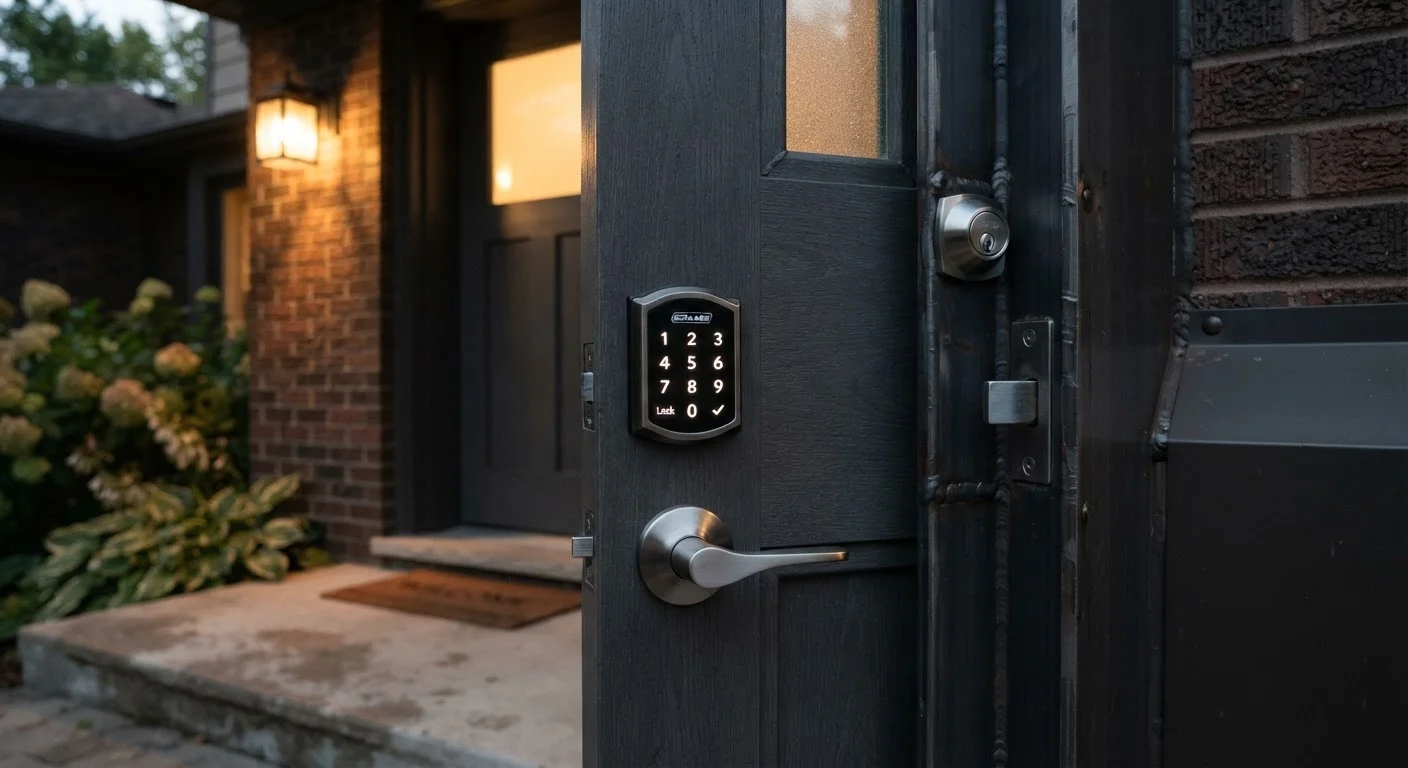
No single product secures a door on its own. A Grade 1 deadbolt resists physical force, frame reinforcement prevents kick-in failures, and a smart lock adds access management and visibility. Used together, these three layers address fundamentally different vulnerabilities and deliver meaningful, well-rounded entry protection.
| Best for | Recommended |
|---|---|
| Homeowners wanting strong physical resistance against forced entry | Deadbolt + Frame Reinforcement |
| Tech-forward households managing multiple users or remote access | Smart Lock |
| Anyone seeking maximum overall door security | All Three Layers Combined |
| Renters or those on a tight budget | Strike Plate Upgrade + Deadbolt |
Why Door Security Is a System, Not a Single Product
Most forced entries don't happen because someone picked a lock — they happen because a door, frame, or strike plate gave way under brute force. The FBI's Uniform Crime Report has consistently found that the majority of residential burglaries involve direct forced entry rather than technical lock bypass. That distinction matters enormously when deciding where to invest in security.
Understanding door security means thinking about three distinct layers: the locking mechanism (what holds the door shut), the door itself (what the mechanism is anchored to), and the frame and strike plate (what the door is held against). Weakness in any one layer can undermine the strength of the others. For a broader look at how door security fits into a full home security setup, see our breakdown of home security system components.
Deadbolts: The Physical Foundation
A deadbolt is still the baseline standard for residential door security. Unlike spring-latch locks (the kind on most doorknobs), a deadbolt throws a solid metal bolt into the door frame when engaged and cannot be retracted without the correct key or thumb-turn.
Deadbolts are graded by ANSI/BHMA standards — Grade 1 (highest residential security), Grade 2 (standard residential), and Grade 3 (minimal). Grade 1 deadbolts are tested to withstand significant kick and strike force, making them a meaningful physical deterrent. Key considerations when evaluating a deadbolt include bolt throw length (a minimum 1-inch throw is standard), cylinder anti-pick and anti-drill protection, and the quality of the strike plate hardware included.
One limitation: even a Grade 1 deadbolt installed with weak screws into a soft wood frame will fail under a determined kick. That's where frame reinforcement becomes essential.
| Deadbolt | Smart Lock | Frame Reinforcement | |
|---|---|---|---|
| Primary protection type | Physical bolt resistance | Access management & monitoring | Structural kick-in resistance |
| Addresses key duplication risk | No | Yes (keyless options) | No |
| Resists forced entry (kick-in) | Partially (depends on frame) | Partially (depends on frame) | Yes — directly addresses this |
| Requires power or batteries | No | Yes (batteries/Wi-Fi) | No |
| Typical installation complexity | Moderate (door prep needed) | Moderate (replaces existing lock) | Low to moderate (screws/hardware) |
| Renter-friendly options available | Limited | Some (portable models) | Some (removable kits) |
| Relative upfront cost | Low to moderate | Moderate to high | Low |
Smart Locks: Access Control and Visibility
Smart locks replace or augment the traditional key cylinder with electronic access — typically via keypad PIN, smartphone app, or key fob. They do not necessarily make a door harder to kick in, but they address a different set of vulnerabilities: lost keys, unauthorized key duplication, and the inability to monitor or control entry remotely.
Practical advantages of smart locks include auto-locking schedules, temporary access codes for houseguests or service workers, and activity logs showing who entered and when. Many models integrate with smart home platforms, which is worth evaluating carefully — see our guide on integrating security into a smart home for what that process actually involves.
Smart locks introduce their own considerations: battery dependence (most require replacement every 3–12 months depending on usage), potential Wi-Fi or Bluetooth connectivity gaps, and software update requirements. They are generally not rated differently than standard deadbolts on physical resistance — the underlying bolt mechanism still determines how well a door holds against force.
Door Frame and Strike Plate Reinforcement
This is the most overlooked layer of door security, and arguably the highest-impact upgrade per dollar spent. Standard residential doors ship with strike plates secured by short screws (often just 3/4 inch) that anchor into the door casing rather than the structural framing behind it. A single solid kick can rip those screws out and defeat even a Grade 1 deadbolt.
Upgrading involves replacing the standard strike plate with a heavy-gauge steel reinforcement plate (sometimes called a door jamb reinforcement kit or door armor) secured with 3-inch screws that reach the structural stud behind the casing. Door frame reinforcement kits extend steel protection along the entire door edge, guarding against jamb splitting. These upgrades are generally low-cost and installable with basic tools, though anyone unsure about locating structural framing should consult a professional.
For those in rental situations, some reinforcement options are removable — a topic covered in detail in The Renter's Playbook for Home Security.
Putting It Together: Which Layer Does What
Each security layer addresses a distinct threat. Deadbolts resist manual manipulation and provide physical holding force. Smart locks manage who has access and when, reducing vulnerabilities from key management and human error. Frame reinforcement determines whether the door system as a whole holds under brute force — the most statistically common attack method.
Homeowners who are cost-conscious and want the highest physical security return should prioritize a Grade 1 deadbolt and a reinforced strike plate first, then consider smart lock features as a secondary layer. Those managing multiple household members or rental units may find smart lock access logs and remote control worth prioritizing. For a grounded look at which security measures research suggests actually deter break-ins, Home Security on a Budget offers useful evidence-based context.
No lock or door product can guarantee against every threat, and door security is just one part of a layered home security approach. Evaluate your own entry points, budget, and usage patterns before making changes — and for any installation work involving structural modifications, consider consulting a licensed contractor or locksmith.