

Key Takeaways
Start here
Understanding the Renter's Security Challenge
Next
Securing Doors Without Altering Hardware
Then
Window and Sliding Door Protection
When you're ready
Portable Cameras and Wireless Alarms
Finish strong
Building Habits That Actually Reduce Risk
Understanding the Renter's Security Challenge
Renters face a specific security dilemma: the unit you live in isn't yours to alter, yet you're responsible for protecting everything inside it. Lease agreements routinely prohibit drilling, replacing locks without permission, or making structural changes — restrictions that rule out most traditional security upgrades at a stroke.
The good news is that modern portable and wireless security tools have largely closed that gap. The challenge isn't finding options; it's knowing which ones are genuinely useful rather than just marketed as renter-friendly. This guide walks through practical, reversible approaches organized by the vulnerability they address. For a broader look at what the security research actually says about deterrence, our home security on a budget guide is a useful companion read.
Reversible installation
A mounting method that can be fully undone without leaving damage — such as adhesive strips or tension bars — important for renters who must restore a unit to its original condition.
Door security bar
A telescoping bar braced between a door handle and the floor to physically prevent the door from opening, requiring no screws or permanent attachment.
Magnetic contact sensor
A two-piece sensor placed on a door or window frame that triggers an alert when the door or window is opened, separating the magnet from the detector.
Local storage
Video or data saved directly to a device (like an SD card) rather than uploaded to a cloud server — useful when internet access is interrupted.
Sash lock
A device that limits how far a window can slide open, acting as a secondary latch without replacing the original window hardware.
Securing Doors Without Altering Hardware
The front door is the entry point most often targeted, and it's also the area where renters feel most constrained. You likely can't replace the deadbolt or reinforce the frame with hardware screws — but you have several strong options that require no permanent changes.
- Door security bars: A telescoping bar braced between the door handle and the floor prevents the door from opening even if the lock is defeated. No installation needed — it's entirely removable.
- Portable door alarms: These wedge-shaped devices slide under the door and trigger a loud alarm if the door is pushed open. Battery-powered, no adhesive required.
- Door reinforcement plates (with landlord approval): Strike plate upgrades significantly improve kick-in resistance, but they require screws into the door frame. This falls in the grey zone — worth a conversation with your landlord, as it's a genuine safety improvement for the property.
Understanding the difference between the lock itself and the frame around it is important. Our smart locks and door reinforcement comparison explains how these layers interact.
Window and Sliding Door Protection
Windows on ground floors and easily accessible upper floors are common secondary entry points, and sliding glass doors are among the weakest links in many apartments. Both are straightforward to address without any tools.
- Window stop pins or sash locks: These drop into the sash channel to prevent a window from being opened beyond a few inches. No adhesive, no screws.
- Glass break alarms: Adhesive-mounted sensors detect the vibration pattern of breaking glass and sound a local alarm. Many use peel-off mounting that leaves no residue.
- Sliding door bars: A cut-to-length dowel or a commercial security bar laid in the door track prevents the panel from being slid open. Inexpensive and completely removable.
- Sliding door loop locks: These small devices latch the panel to the frame and require no screws.
For a structured way to evaluate every window and entry point in your unit, our home security audit walkthrough provides a room-by-room checklist.
Portable Cameras and Wireless Alarms
Wireless security technology has matured to the point where a fully functional camera and alarm setup requires no professional installation and no wall penetrations.
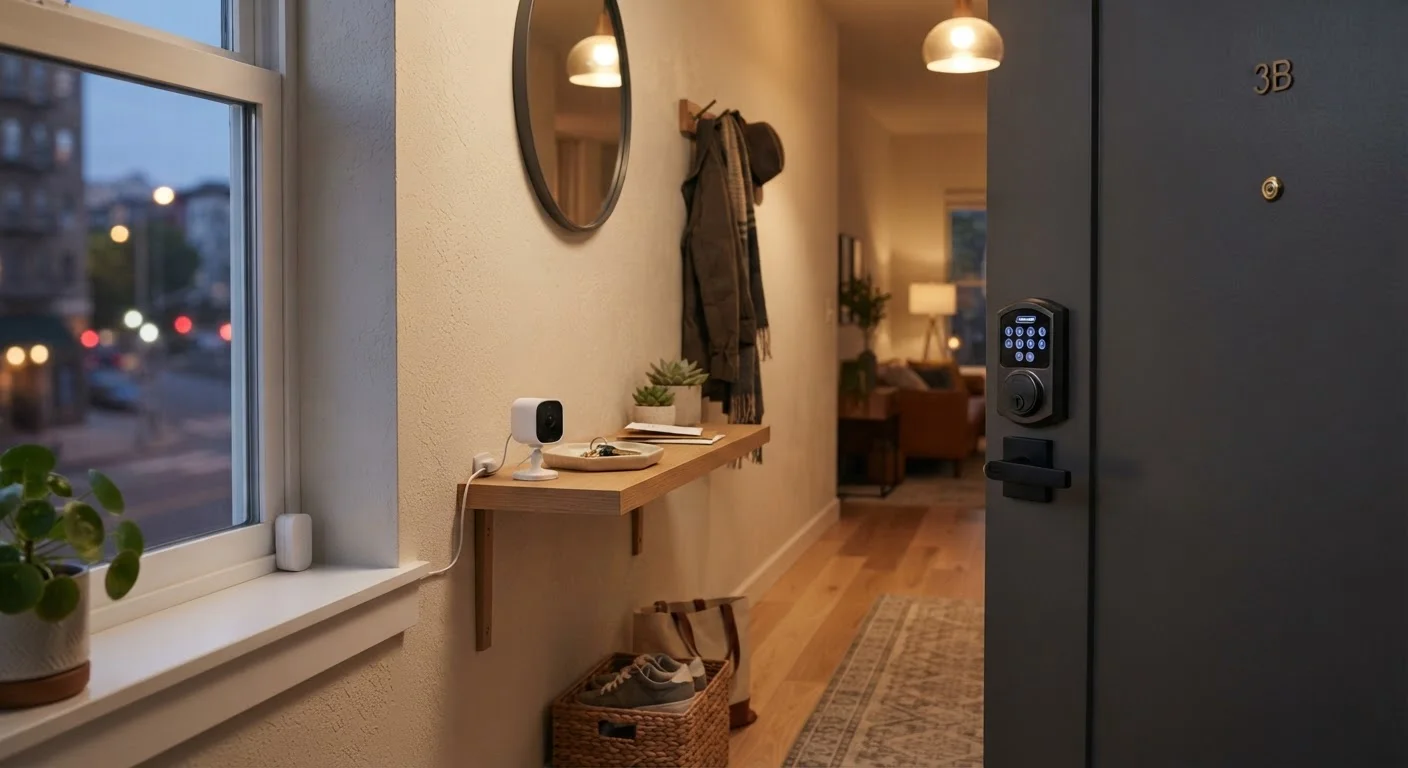
Camera placement for renters: Battery-powered or plug-in cameras can sit on bookshelves, window ledges, or be mounted with removable adhesive strips. Position them to cover entry doors and main living areas. Before placing a camera, consider privacy — pointing a camera toward shared hallways or a neighbor's space may raise legal and ethical questions depending on your state.
Wireless door and window sensors: These small magnetic sensors pair with a hub or a smartphone app to alert you when a door or window opens. They typically attach with peel-and-stick backing. Many systems are self-contained and require no professional monitoring subscription, though that option is usually available.
What to look for in a portable system:
- Local storage (SD card) as a backup to cloud storage, in case your internet goes down
- Simple pairing — the fewer steps to set up, the fewer failure points
- Battery life transparency — know how often you'll need to recharge or replace
Document Your Setup Before You Move Out
Take dated photos of every device you install and where it was placed before you move in and just before you move out. If a landlord disputes whether you caused any wall or surface damage, this photographic record is your clearest evidence. Keep the photos in cloud storage so they're accessible even after you've returned the keys.
For renters interested in connecting these devices to a broader smart home setup, our smart home security integration guide explains compatibility and potential friction points worth knowing before you commit.
Building Habits That Actually Reduce Risk
Hardware and technology only work if paired with consistent habits. Most opportunistic break-ins succeed because a door was unlocked, not because a lock was picked or a sensor failed.
- Lock every time, even when home: Ground-floor units are particularly vulnerable. Make locking the door on entry automatic, not something you remember when you're already settled on the couch.
- Don't signal absence: Avoid posting travel plans publicly before a trip. Use plug-in timers or smart plugs to cycle lights when you're away.
- Know your neighbors: Familiarity with who belongs in your building is one of the most effective passive deterrents — people notice unfamiliar faces when they know each other.
- Secure packages promptly: Porch theft is a gateway for more serious crime. Use building package rooms, delivery lockers, or redirect shipments to a pickup point when you won't be home.
Some widely held security beliefs don't hold up as well as people assume. Our home security myths article covers which common practices provide real protection and which offer mostly false reassurance.
The renter's security toolkit is more capable than most people realize. Working within lease restrictions doesn't mean accepting vulnerability — it means choosing the right tools and the right habits for your specific situation.