

Smart Home Living

What a Home Security Audit Covers — And How to Run One Yourself

Share
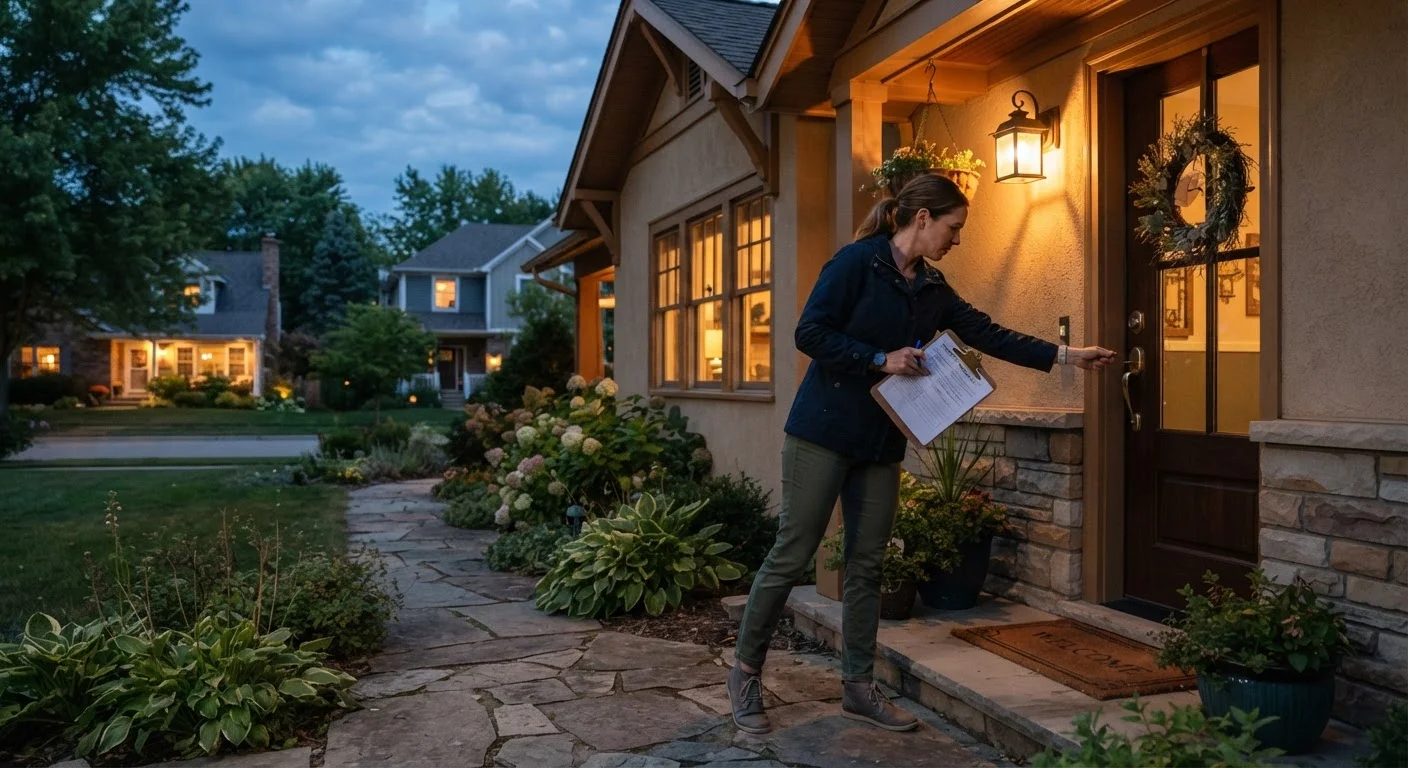
Homeowner with clipboard inspecting front door lock and exterior lighting during a home security audit

Key Takeaways

A home security audit doesn't require professional equipment — a clipboard and systematic approach are enough to get started.
Entry points, exterior lighting, and landscaping are among the most overlooked areas in DIY audits.
Identifying vulnerabilities is the essential first step before investing in any new security hardware.
Most audit findings can be addressed with relatively low-cost fixes like improved locks, motion lights, or trimmed hedges.
Regular audits — ideally once or twice a year — help homeowners and renters stay ahead of changing risks.
45–90 min

Summary

22 items · 45–90 minutes

Why Running Your Own Audit Matters

A home security audit is a deliberate, zone-by-zone review of your property to identify weaknesses an intruder could exploit. The goal isn't to make you feel unsafe in your own home — it's to give you a clear picture of what's already working and what needs attention.

You don't need a security background to do this well. What you need is a methodical approach and about an hour of uninterrupted time. Before spending money on cameras, sensors, or a monitoring subscription, it's worth understanding what your property actually looks like from the outside — because that's exactly the perspective worth examining first.

If you'd like context on what specific hardware does once you've identified gaps, see our overview of home security system components for a plain-language breakdown.

Entry Points

Test every exterior door for solid-core construction by knocking firmly — hollow-core doors offer minimal resistance. Must
Check that all deadbolts extend at least one inch and operate smoothly without wobble. Must
Inspect door frames for damage, rot, or gaps larger than 1/8 inch that could weaken resistance to forced entry. Must
Verify that strike plates are secured with screws at least 3 inches long, anchoring into the structural frame rather than just the door trim. Must
Check sliding glass doors for a secondary bar or pin that prevents the door from being lifted off its track. Should
Confirm that the garage entry door (if attached) has the same deadbolt quality as your front door. Must
Note any exterior doors that lack a peephole or sidelight — these limit your ability to identify visitors before opening. Nice to have

Windows

Open and close every accessible window to confirm locks engage fully and latches haven't become loose over time. Must
Check ground-floor and basement windows for secondary blocking pins or keyed locks in addition to the factory latch. Should
Look for windows obscured by dense shrubs or fencing that would allow unobserved access. Should
Assess whether window glass is standard single-pane, which can be broken silently — consider whether film reinforcement is warranted. Nice to have

Exterior Lighting

Walk the full perimeter after dark and mark every area that remains unlit or in deep shadow near an entry point. Must
Test all existing motion-activated lights by walking through their coverage zone and confirming activation range and speed. Must
Confirm that bulbs in exterior fixtures are functional and rated for outdoor use. Must
Identify whether a path from a public street to a side or rear door exists that is completely unlit. Should

Landscaping and Visibility

Identify any shrubs or trees near entry points whose height or density would conceal someone from street view. Should
Check whether low-hanging tree branches provide an unintended climbing path to upper-floor windows or roof access. Should
Note whether your address numbers are clearly visible from the street for emergency responder access. Must

Garage and Outbuildings

Confirm the garage door's auto-close feature is enabled if the opener supports it. Should
Check any detached garage, shed, or outbuilding for functioning padlocks on doors and hasps that are anchored with carriage bolts, not standard screws. Should
Confirm that ladders stored outside or in an unlocked area cannot be easily accessed and used to reach upper floors. Nice to have

Tools You'll Need Before You Start

This audit requires no specialized tools. Gather what's listed below, then walk every zone of your property in daylight. Plan a second pass after dark to evaluate lighting gaps — what's well-lit at noon can be completely unlit at 10 p.m.

Required

Clipboard or tablet with note-taking app

Record observations zone by zone so nothing is overlooked during the walkthrough.

Required

Flashlight or headlamp

Illuminate dark corners, attic hatches, and crawl spaces during inspection.

Required

Tape measure

Measure deadbolt throw length and gap widths at doors and windows.

Required

Screwdriver

Check that strike plates, hinge screws, and lock hardware are secure and not backing out.

Optional

Camera or smartphone

Photograph specific vulnerabilities for reference when planning fixes or consulting a locksmith.

How to Use Your Findings

Once you've completed the walkthrough, sort your notes into three categories: immediate fixes (things you can address today, like replacing a burned-out light or adding a door reinforcement plate), short-term upgrades (items that require a modest purchase or some planning), and longer-term considerations (system-level decisions such as adding monitored sensors or upgrading to a smart lock).

Repeat this audit at least once a year, or after any significant change — a new neighbor, a renovation, seasonal landscaping growth, or a change in your household's routine. Security gaps often emerge gradually, not all at once.

Homeowners looking to act on what they find can use our DIY security system setup walkthrough as a practical next step. If you rent and face lease restrictions on hardware, the renter's security playbook covers approaches that work without drilling or permanent changes.

Don't Skip the After-Dark Walkthrough

A daytime-only audit will consistently miss lighting gaps that matter most. Shadows that seem minor in sunlight can completely obscure a ground-floor window or side entry after sunset. Plan your exterior lighting check for a typical evening hour when your home would normally be occupied, and walk the full perimeter before drawing conclusions.

For homeowners considering connecting security devices to a broader smart home setup, it's worth reviewing the compatibility and friction considerations before committing to a platform.

Smart Home Living Editorial Team is the collective byline for our editorial team and contributor network. Articles published under this byline or an editorial pen name are researched, written, and reviewed according to our editorial standards for clarity, consistency, and independence before publication.

View all articles by Smart Home Living Editorial Team →
Disclaimer: The content provided on our blog site traverses numerous categories, offering readers valuable and practical information. Readers can use the editorial team’s research and data to gain more insights into their topics of interest. However, they are requested not to treat the articles as conclusive. The website team cannot be held responsible for differences in data or inaccuracies found across other platforms. Please also note that the site might also miss out on various schemes and offers available that the readers may find more beneficial than the ones we cover.