

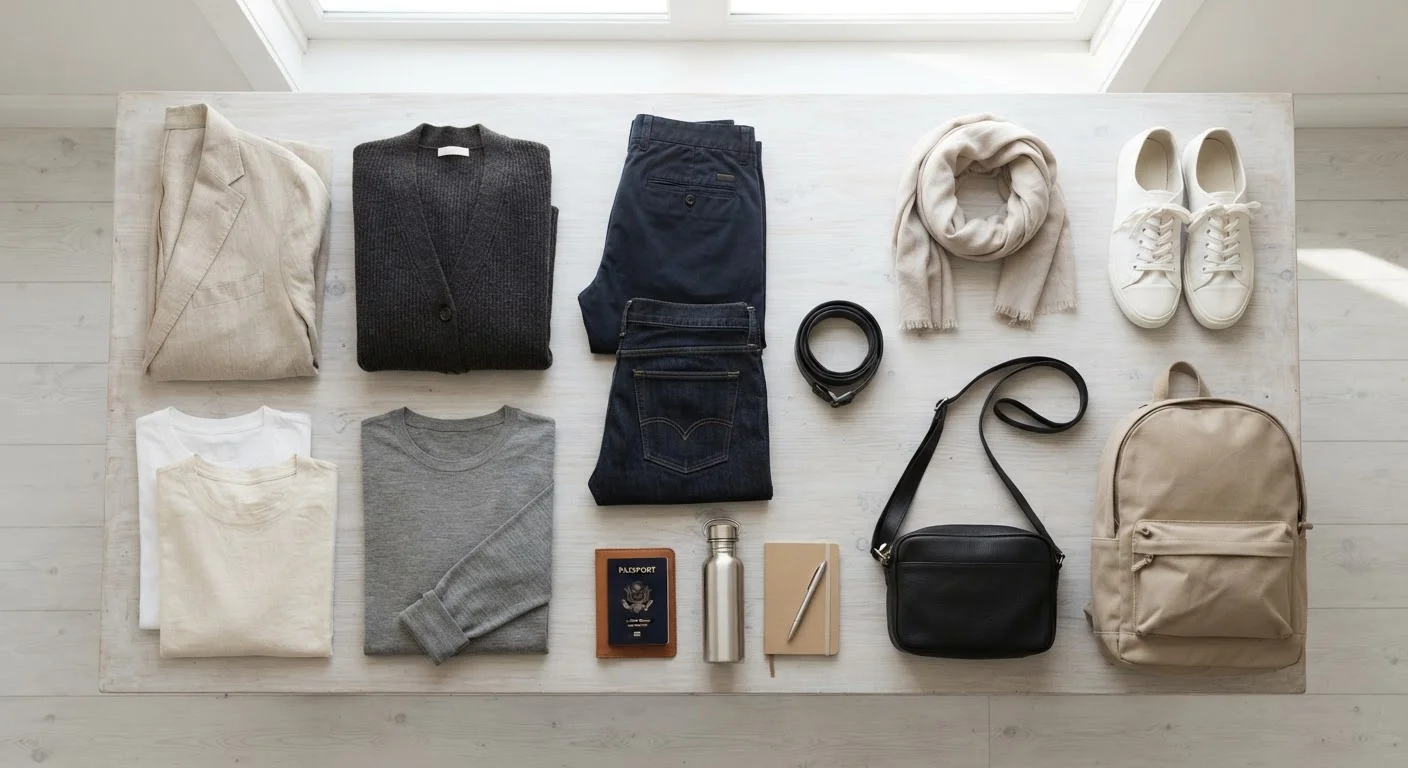
Key Takeaways
Why Most Travel Wardrobes Fail Before the Bag Is Zipped
The typical approach to packing for travel goes something like this: open the closet, pull out things you like, and stop when the bag is full. The result is usually a collection of individual outfits — not a system. You end up with pieces that each work once but don't combine, which means you either run out of outfits or run out of luggage space, often both.
A true capsule wardrobe solves this by treating clothing as a set of interchangeable components. The goal isn't to pack fewer clothes for the sake of minimalism — it's to pack fewer clothes that produce more outfit combinations, so you're covered for more days and more situations without the bulk. The math is simple: five tops and three bottoms that all work together produce fifteen base combinations. The same ten pieces chosen at random might produce three.
This approach also reduces decision fatigue on the road. When everything in your bag works with everything else, getting dressed takes seconds rather than minutes of deliberating over what goes with what.
The Combination Math Shortcut
A simple way to pressure-test your capsule: multiply your tops by your bottoms. If you have 5 tops and 3 bottoms, that's 15 base combinations before you add layers or accessories. Aim for at least 10 distinct combinations from your clothing items so repeat outfits feel intentional, not accidental.
Understanding the psychology behind overpacking is the first step toward changing it. The reasons most travelers overpack come down to predictable anxieties — and most can be resolved at the planning stage before anything goes in the bag.
What You Need Before You Start Selecting Pieces
Building a capsule wardrobe that actually works requires a bit of groundwork. You need to know what your trip actually demands — not a generalized guess, but a specific read on the activities, climate range, and social contexts you'll encounter. You also need to know what you already own, since the goal is almost always to build from existing clothes before buying anything new.
What you will need
If you're building a capsule for a longer trip — two weeks or more — it also helps to think through laundry access early. A capsule that assumes you'll hand-wash items mid-trip needs different fabric choices than one built for a week with no washing. For longer trips, the carry-on strategy for two-week trips covers this tradeoff in detail.
Packing cubes
Compress and organize capsule items by category, making it faster to locate pieces and keep the bag tidy throughout a trip.
Full-length mirror
Used during home try-on sessions to evaluate how planned combinations actually look together before departure.
Wrinkle-release spray
Refreshes items between wears, extending how long each piece stays presentable without laundering.
Lightweight travel laundry bag
Separates worn items from clean ones inside the bag, essential for multi-week trips where you'll rewear items.
How to Build Your Capsule: Step-by-Step
Define your trip's activity range
Before you touch a single garment, write down every type of activity your trip includes — casual walking, dining out, beach time, hiking, business meetings, or evening events. Be honest about what you'll actually do, not what you imagine. This list becomes your filter: every piece you consider must serve at least two activities on it.
If you're traveling with others, this is also the stage to coordinate who carries what. Splitting a shared bag can reduce per-person load significantly when done deliberately.
Choose a two- or three-color palette
Pick one or two neutral base colors (navy, black, grey, khaki, olive) and one optional accent color that pairs with both. Every garment in your capsule should work within this palette. This is the mechanical core of a capsule system — it's what makes pieces interchangeable rather than outfit-specific.
Avoid packing items that only work with one other item. A shirt that only matches one pair of pants isn't a capsule piece — it's a dedicated outfit that wastes space.
Select your core pieces by category
Use a structured breakdown by category rather than packing whatever feels right in the moment:
- Bottoms: 2–3 pieces (one versatile trouser or jean, one casual short or skirt if the climate calls for it)
- Tops: 4–5 pieces (mix of short and long sleeve within your palette)
- Layers: 1–2 pieces (one lightweight mid-layer, one outer layer if needed)
- Shoes: 2 pairs maximum — one for walking, one that handles smarter occasions
- Accessories: 2–3 items that shift the feel of an outfit (a scarf, simple jewelry, a belt)
This framework typically produces 10–14 garments — enough to cover a week-plus trip through rewearing and light washing. For a deeper look at why most people exceed this and how to reset the habit, see why packing light is harder than it looks.
Audit for fabric and wearability
Once you've assembled candidate pieces, check each one against three criteria: Does it resist wrinkles after being packed? Does it dry quickly if hand-washed? Does it feel comfortable after a long travel day? Fabrics like merino wool, nylon blends, and polyester-spandex mixes generally pass all three. Cotton is comfortable but slow to dry and prone to wrinkling — acceptable for some pieces, but not the whole capsule.
This step matters especially on trips longer than a week. The two-week carry-on approach depends heavily on selecting pieces you can wash and rewear mid-trip without them looking worn out.
Map out combinations on paper, then try them on
List every combination you plan to wear — not just tops and bottoms, but with which shoes and which layer. Then physically try each one. This is where abstract packing lists become real wardrobes. You may discover that two tops you planned to rotate don't both work with your one pair of evening shoes, or that your only warm layer doesn't fit over a specific shirt.
[important_callout]Eliminate any item that doesn't appear in at least three planned combinations. If a piece only works in one or two outfits, it isn't earning its weight in the bag.
Pack strategically and do a final weight check
Use packing cubes to separate categories — tops in one, bottoms in another, layers and accessories in a third. Roll softer items to minimize volume; fold structured pieces flat. Once packed, weigh the bag. Most carry-on airline limits fall between 15–22 lbs depending on the carrier — verify your specific airline's policy before departure, as rules vary and can change.
If the bag is over your target, return to step 3 and remove the lowest-combination item first. Never cut a piece that appears in five or more combinations to keep a piece that appears in two.
Once your capsule is built and tested at home, the trip planning process becomes significantly easier — fewer packing decisions means more mental bandwidth for the logistics that actually matter before departure.
Destination Context Changes Everything
A capsule built for a city break in Europe won't serve a hiking trip or a beach week equally well. Before selecting your core pieces, clarify the activity range your trip actually requires. See the trip-type packing guide for how to shape your selection by destination.