

Key Takeaways
Why Sharing a Bag Is Worth the Coordination
Traveling with a partner or family creates a logistical opportunity most people overlook: consolidating into fewer bags. One checked bag shared between two people instead of two separate bags can cut airline fees significantly — and that's before accounting for lighter loads through airports, trains, and hotel lobbies. As covered in The Hidden Costs of Overpacking, those fees and physical burdens add up faster than most travelers expect.
The coordination challenge is real, but it's manageable with a clear system established before anyone starts folding clothes. The travelers who pull this off consistently are the ones who plan the shared bag as a joint project, not an afterthought.
Best Practices for Organizing a Shared Bag
These approaches work across trip lengths and group sizes. Adapt them to your situation rather than following them rigidly.
Assign ownership zones using packing cubes
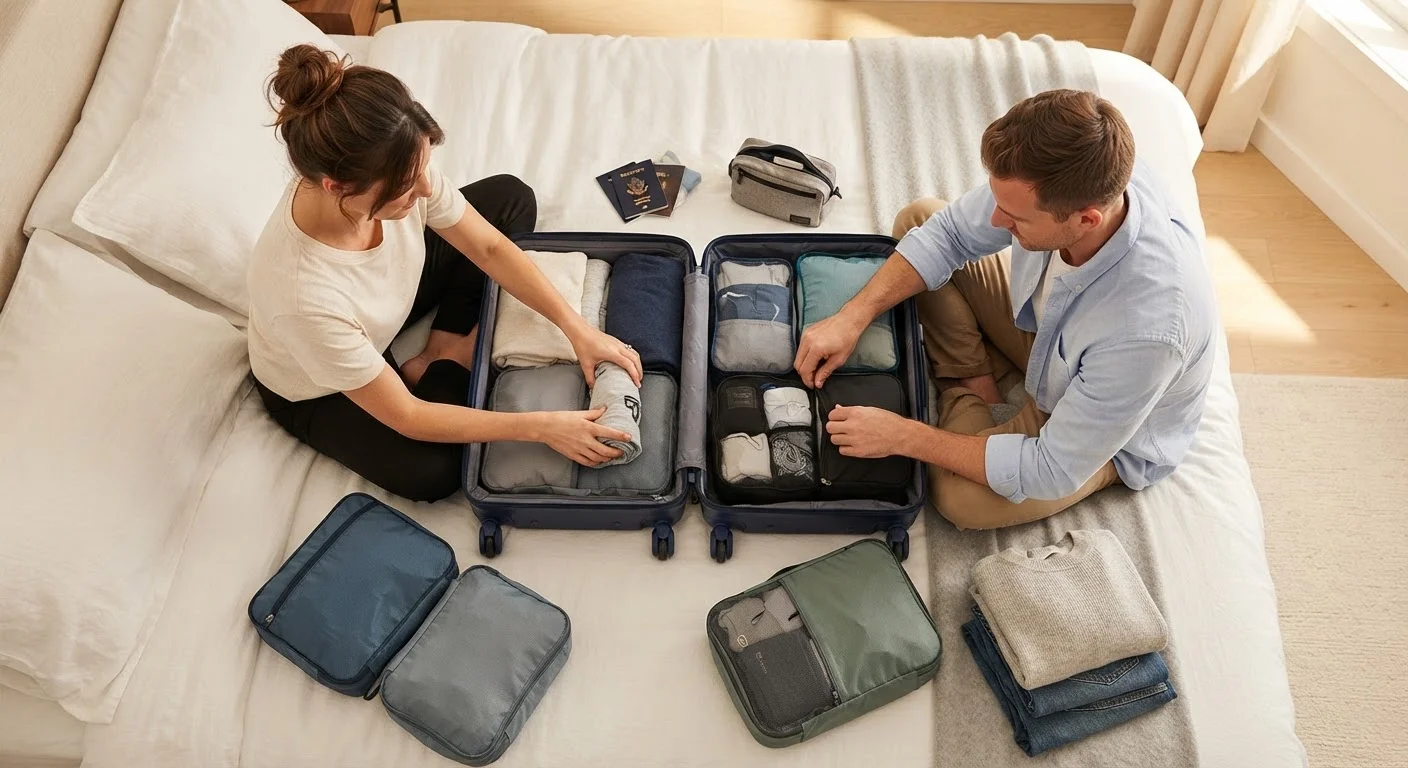
When two people share one bag without structure, finding anything requires unpacking half the contents. Packing cubes give each person a designated zone — one person's cube stays on the left side, the other's on the right. This speeds up repacking at hotels and removes the guesswork at security.
Consolidate toiletries into one shared kit
Toiletries are the most duplicated category in shared travel. Two shampoos, two conditioners, two moisturizers — the weight and volume add up quickly. Most products can be shared, and the TSA 3-1-1 liquid rule for carry-ons means consolidation is also a compliance strategy.
Pack heavier items toward the bag's wheels
Weight distribution affects how a bag handles in motion and how easy it is to lift overhead. Heavier items at the bottom (near the wheels when upright) lower the center of gravity and reduce strain on zippers and frames.
Balance the weight between travelers for carry days
A shared checked bag can weigh 40–50 pounds when fully packed. On days involving significant walking with luggage, that load falls entirely on one person. Distribute weight so that each traveler's carry-on or personal item compensates for who isn't pulling the main bag.
Use a pre-departure checklist reviewed by both travelers
Memory is unreliable under travel stress. A written checklist reviewed by both people catches duplicate items and forgotten essentials before you leave the house — not after you've cleared security. Similar coordination logic applies to trip planning responsibilities, as outlined in Splitting Trip Research Between Travelers.
What Each Person Should Always Carry Independently
Sharing a checked bag doesn't mean combining everything. There are items each traveler should always keep in their own personal item or carry-on, regardless of the shared-bag arrangement.
- Medications and health essentials — never pack these where a separated bag could leave someone without them mid-trip.
- Travel documents — passports, boarding passes, and any printed reservations stay on each person's body or in their own bag.
- One day's worth of clothing — if the shared bag is delayed or lost, each person should have enough to manage until it's recovered.
- Valuables and electronics — laptops, cameras, and jewelry travel in carry-ons, not checked luggage.
This division also protects against the friction of digging through one large bag at security checkpoints. For a deeper look at when checked luggage makes sense versus carry-on only, see Carry-On vs. Checked Luggage.
Keep Travel Documents on Your Person
Even when sharing a bag, each traveler should carry their own passport, ID, and boarding pass in a pocket or personal item — never in the shared checked bag. If the bag is delayed or separated at baggage claim, everyone still has what they need to move through the airport independently. A small document organizer worn under clothing adds another layer of security in busy transit hubs.
Start With a Joint Packing List
The most common failure mode in shared-bag travel is duplicated items — two full-size shampoo bottles, two sets of phone chargers, two travel umbrellas. Build a single master packing list that both people review and sign off on before anyone packs a thing.
Divide the list into three columns: shared items (one per trip, split between bags), personal items (each person handles their own), and one person's responsibility (assigned to a specific traveler). This structure eliminates both duplication and gaps.
For trips where clothing is the main packing challenge, a travel capsule wardrobe approach helps both travelers pack fewer pieces that work harder — making the shared bag easier to organize from the start. And if budget is part of your planning equation, the broader strategies in Stretching a Travel Budget include luggage decisions as one piece of keeping overall trip costs down.