

| Max liquid container size | 3.4 oz (100 ml) (TSA 3-1-1 rule) |
| Quart bags allowed per passenger | 1 (TSA 3-1-1 rule) |
| Medications subject to 3-1-1? | No — exempt, declare separately (tsa.gov) |
| Solid toiletries (e.g., shampoo bars) in quart bag? | Not required (TSA screening policy) |
| Carry-on size set by | Individual airlines, not TSA |
| Typical U.S. airline carry-on limit | ~22 x 14 x 9 inches (incl. wheels) (Common airline policy; verify with your carrier) |
The 3-1-1 Liquid Rule, Explained Plainly
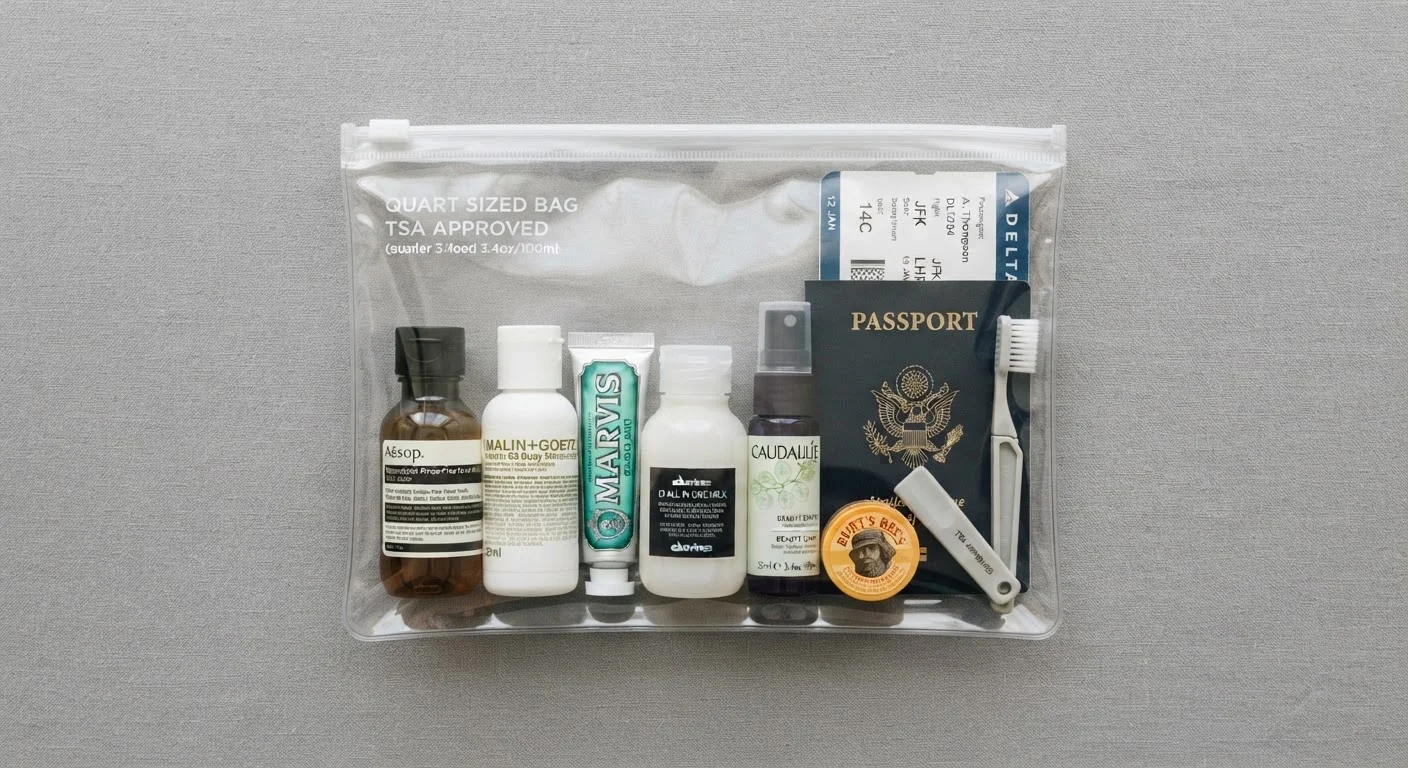
TSA's 3-1-1 rule applies to all liquids, gels, aerosols, creams, and pastes in your carry-on bag. Here's what it actually means:
- 3.4 oz (100 ml) or less per container — the container size matters, not how full it is
- 1 quart-sized, clear, zip-top bag — one bag per passenger
- 1 bag total — it must be removed from your carry-on and placed in a bin at screening
Common items that fall under this rule include shampoo, conditioner, toothpaste, mouthwash, lotion, sunscreen, mascara, lip gloss, and contact lens solution. If a container is larger than 3.4 oz — even if it's mostly empty — it won't pass through. Decanting into travel-sized bottles before you leave is the practical workaround.
Solid versions of toiletries (shampoo bars, solid deodorant, bar soap) are not subject to the liquid rule and don't need to go in your quart bag. That's worth knowing if you're trying to maximize space.
| Max liquid container size | 3.4 oz (100 ml) (TSA 3-1-1 rule) |
| Quart bags allowed per passenger | 1 (TSA 3-1-1 rule) |
| Medications subject to 3-1-1? | No — exempt, declare separately (tsa.gov) |
| Solid toiletries (e.g., shampoo bars) in quart bag? | Not required (TSA screening policy) |
| Carry-on size set by | Individual airlines, not TSA |
| Typical U.S. airline carry-on limit | ~22 x 14 x 9 inches (incl. wheels) (Common airline policy; verify with your carrier) |
Medication Exemptions: What's Actually Allowed
Medications — including prescription drugs, over-the-counter pills, liquid medicines, and medical supplies — are explicitly exempt from the 3-1-1 rule. You do not need to squeeze them into your quart bag, and they can exceed 3.4 oz in liquid form.
Key details to know:
- Liquid medications must be declared to the TSA officer at the checkpoint. Keep them accessible in a separate bag or pouch so you can pull them out quickly.
- You are not required by TSA to have a prescription label on your medication, but having one can help avoid delays if an officer has questions.
- Ice packs, gel packs, and freezer packs used to keep medications cool are also allowed in carry-ons — even if frozen solid — as long as they're accompanying medically necessary items.
- Insulin, syringes, lancets, and diabetes-related supplies are permitted without quantity limits.
- Medically required liquids like nutritional supplements or feeding supplies are also exempt.
TSA may still screen medications through X-ray or additional inspection. For anything sensitive — chemotherapy drugs, controlled substances, or unusual medical devices — consider carrying documentation from a prescribing physician, even though it's not required. Conditions and enforcement can vary by checkpoint, so verifying current policy at tsa.gov before travel is always the right move.
See our pre-trip checklist for a full rundown of what to organize before departure, including medications and documents.
What Counts as a Carry-On vs. a Personal Item
TSA doesn't set carry-on size limits — airlines do. This is a common source of confusion. TSA's job is security screening; bag size is enforced (or not) by the airline at the gate.
That said, most U.S. carriers allow a carry-on bag in the overhead bin and a personal item that fits under the seat in front of you. Typical size limits for carry-ons across major U.S. airlines fall around 22 x 14 x 9 inches, including handles and wheels. Personal item limits tend to run around 18 x 14 x 8 inches, though this varies.
What qualifies as a personal item? Generally: a standard backpack, laptop bag, purse, briefcase, or small tote. What doesn't qualify: a second full-sized bag or a bag clearly meant to substitute for a carry-on.
Before you pack, check your specific airline's size and weight policy — not just for carry-ons, but for the personal item too. Budget carriers in particular have become stricter about enforcement and may charge fees at the gate for oversized items. Our guide on carry-on vs. checked luggage walks through when each option actually makes sense for different trips.
For travelers trying to fit a full trip into carry-on space, packing for two weeks in a carry-on is a practical starting point. And if you've been hauling more than you need, the real costs of overpacking lays out why a lighter bag often pays off beyond just convenience.