

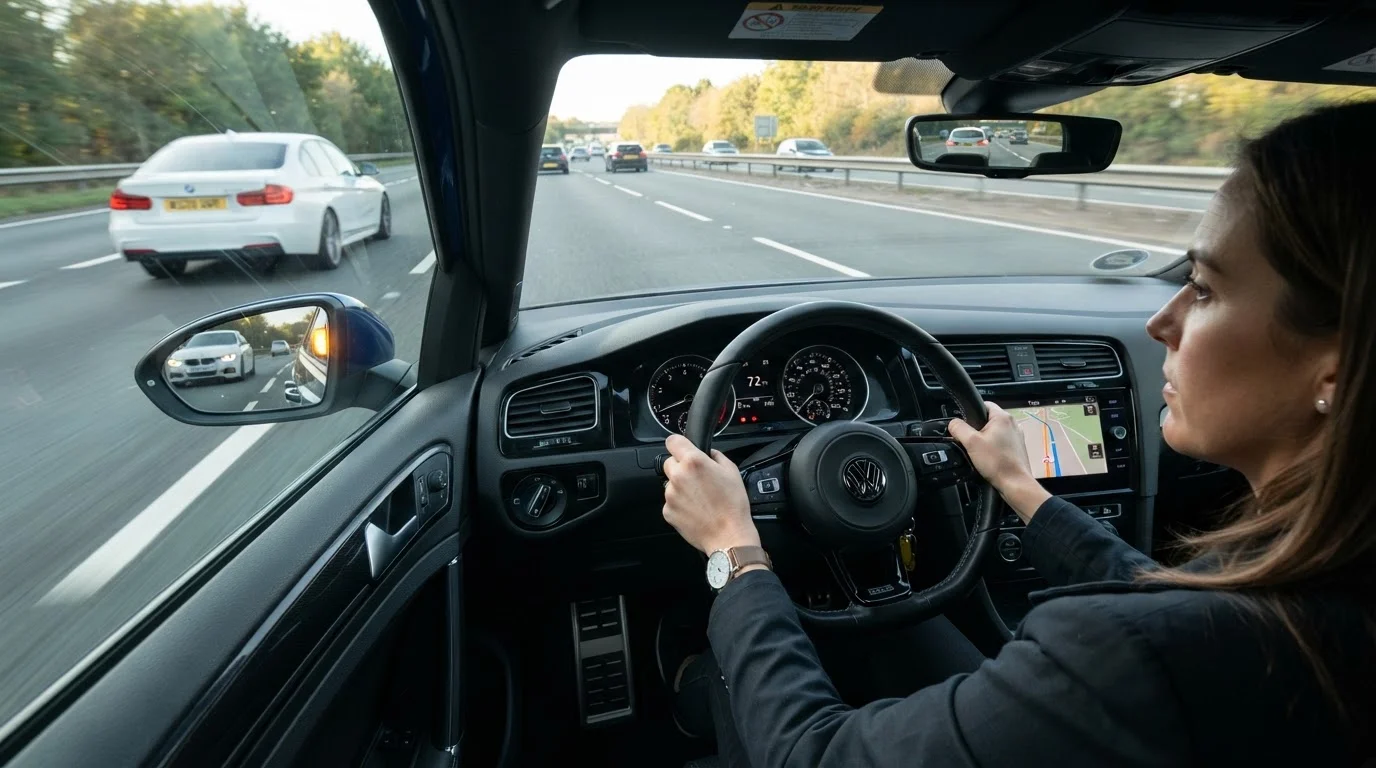
Key Takeaways
Option A
Blind Spot Monitoring (BSM)
The sensor-driven safety assist that watches where you can't.
Best for: Drivers who want an extra electronic alert layer during lane changes on highways and multi-lane roads.
Option B
Checking Your Mirrors
The foundational habit every licensed driver is trained to use.
Best for: All driving situations — mirrors provide real-time, context-rich visual awareness no sensor can fully replicate.
If you drive frequently on busy multi-lane highways
Both — use mirrors as primary, BSM as backup
Highway lane changes happen quickly. Mirrors give you context; BSM provides a safety net for vehicles entering your blind zone at speed.
If you drive without BSM and have an older vehicle
Checking Your Mirrors
Properly adjusted mirrors combined with a head-check habit are proven, reliable, and available on every vehicle ever made.
If you're parking or maneuvering in tight urban spaces
Checking Your Mirrors
BSM typically doesn't activate at low parking speeds, so manual mirror checks and physical head turns are essential in these situations.
If you drive in heavy rain, snow, or icy conditions
Checking Your Mirrors
BSM sensors can be impaired by ice, mud, or precipitation, making mirror checks and head turns the only reliable option in harsh weather.
How Each Method Actually Works
Blind spot monitoring uses radar or ultrasonic sensors, typically mounted in the rear bumper, to detect vehicles positioned alongside your car in adjacent lanes. When a vehicle enters the detection zone — usually alongside and slightly behind your vehicle — the system triggers a visual alert, often an amber icon in or near the side mirror. Some systems also add an audible tone if you activate a turn signal while a vehicle is detected.
Mirror checks, by contrast, rely entirely on you. Your side mirrors, when correctly adjusted, let you see the lanes beside and behind you. Your rearview mirror covers the lane directly behind. The catch is that even perfectly adjusted mirrors leave a zone — roughly where the rear door meets the back of your vehicle — that neither mirror covers completely. That's the true blind spot, and it's why a quick shoulder glance (sometimes called the head check) is taught alongside mirror use in driver's ed.
Understanding how road rules and signals work together is the broader context — BSM and mirror checks are both tools within a larger system of situational awareness.
What Blind Spot Monitoring Misses
BSM is genuinely useful, but it has specific, documented limitations every driver should know:
- Cyclists and motorcyclists: Narrow vehicles may fall below the detection threshold of some radar-based systems, particularly at higher relative speeds.
- Low-speed and parking situations: Most BSM systems are designed for highway-speed lane changes and do not activate below a certain speed threshold — often around 20–25 mph. In parking lots or slow urban traffic, the system may be off entirely.
- Sensor obstruction: Ice, mud, snow, or even adhesive residue covering the rear bumper sensors can disable or degrade BSM performance without warning.
- Vehicles approaching quickly from far back: Some systems have detection range limits. A fast-approaching vehicle may not trigger the alert early enough for a slow or hesitant response.
- Trailers and towing: Hitching a trailer often disrupts the sensor's detection field. Many vehicles require you to manually disable BSM when towing to prevent false alerts — or the system disables itself automatically.
| Criterion | Blind Spot Monitoring | Checking Your Mirrors |
|---|---|---|
| Primary method | Radar/ultrasonic sensors | Driver visual scan |
| Works at low/parking speeds | Generally no | Yes, always |
| Detects cyclists reliably | Inconsistent | Yes, with head check |
| Affected by weather/dirt | Yes — sensors can be blocked | Minimally (dirty mirror glass) |
| Works when towing | Often disabled or unreliable | Yes, with proper mirror setup |
| Requires driver action | No — passive alert system | Yes — active habit required |
| Covers true blind zone | Yes, within sensor range | Partially — head check needed |
| Judges closure rate | Some systems estimate speed | Requires driver experience |
The takeaway is that BSM is a supplemental alert system, not a comprehensive awareness tool. Just as your eyes adapt imperfectly to night driving, electronic sensors adapt imperfectly to edge cases.
What Mirror Checks Miss — and How to Close the Gap
Mirrors have a physics problem: they're flat reflective surfaces positioned at fixed angles. Even with the side mirrors pushed outward to minimize overlap with the rearview mirror — a common recommendation to reduce the true blind zone — a sliver of space beside your rear quarter panel remains uncovered.
The other limitation is human: mirrors only work when you actually use them. A proper scan cycle — rearview, left mirror, rearview, right mirror — should happen roughly every five to eight seconds in normal traffic, and immediately before any lane change or merge. Many drivers scan less frequently than this, especially on familiar routes.
Finally, mirrors tell you where vehicles are, but not how fast they're closing. Judging closure rate from a mirror reflection takes experience. A vehicle that looks stationary in your mirror may be approaching at a significant speed differential.
Closing these gaps means combining mirror checks with a deliberate shoulder glance before changing lanes. It also means keeping mirrors clean and properly adjusted — which sounds obvious but is a surprisingly common oversight, alongside other maintenance items drivers tend to overlook.
How to Properly Adjust Your Side Mirrors
Sit in your normal driving position, then adjust each side mirror outward until you can just barely see the edge of your own vehicle in the inner corner of the mirror. This wider angle reduces the traditional blind spot compared to angling mirrors inward toward your car's body. The rearview mirror should show the full rear window. Even with this setup, a quick shoulder glance before lane changes remains good practice.