

Key Takeaways
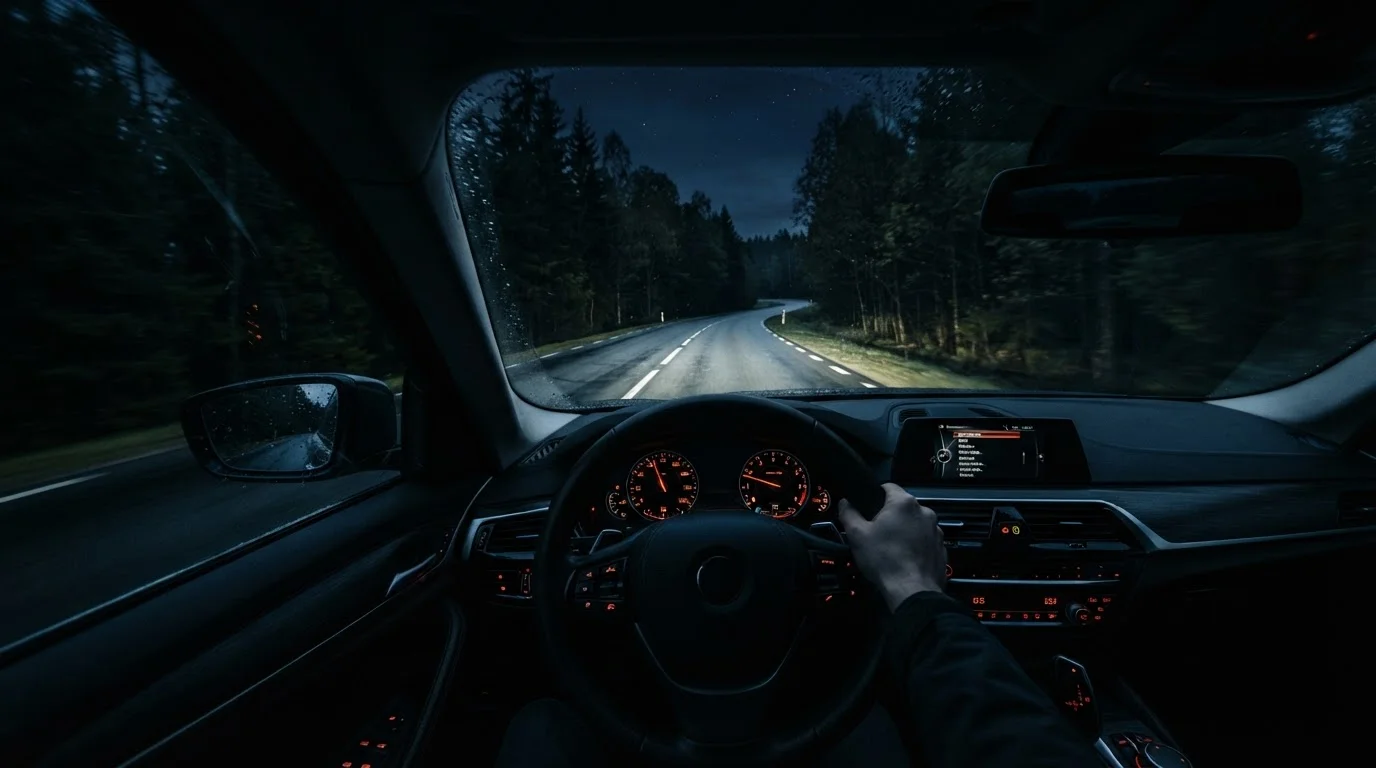
Night Vision While Driving
Night vision while driving refers to your eyes' ability to see clearly in low-light conditions on the road. Unlike daytime driving, your eyes must rely on rod cells rather than cone cells to detect shapes and movement — a slower, less precise process. This shift reduces your ability to judge distance, spot hazards, and perceive color accurately.
The transition from cone-based (photopic) to rod-based (scotopic) vision takes roughly 20–30 minutes of darkness exposure to fully complete — a process called dark adaptation.
Why Night Driving Is Statistically Riskier
About 25% of all driving happens after dark, yet nearly half of all traffic fatalities occur at night, according to data from the National Highway Traffic Safety Administration (NHTSA). That gap isn't a coincidence — it reflects real physiological limits that every driver faces once the sun goes down.
Lower light levels reduce visual acuity, narrow your field of view, and make it harder to gauge how fast objects are approaching. Hazards that would be obvious in daylight — a deer at the road's edge, a pothole, a pedestrian in dark clothing — can appear with very little warning. The stopping distance your headlights provide often falls short of the distance you'd need if something unexpected appears.
Understanding these limits is the first step toward compensating for them. Safe night driving isn't about driving with more confidence — it's about adjusting your speed, following distance, and attention to account for what you genuinely cannot see.
What Happens to Your Eyes in the Dark
Your eyes use two types of photoreceptors: cones, which work well in bright light and detect color and fine detail, and rods, which are more sensitive in low light but slower to respond and unable to distinguish color clearly. Night driving forces a shift from cone-dominant to rod-dominant vision.
This shift — called dark adaptation — takes time. When you walk out of a brightly lit house and get into a dark car, your eyes begin adjusting immediately, but full adaptation can take 20–30 minutes. During that window, your sensitivity is genuinely lower than it will be once adaptation completes. Exposure to a bright oncoming headlight can partially reset that adaptation, which is why glare from other drivers feels so disorienting.
Beyond the cones-and-rods shift, several other factors reduce night visibility:
- Pupil dilation limits: Older drivers' pupils dilate less, admitting less light to the retina.
- Night myopia: Some people's focal point shifts slightly in low light, causing blurring — even people with good daytime vision.
- Contrast sensitivity loss: Distinguishing objects from dark backgrounds becomes harder even with otherwise normal vision.
Many of these changes go unnoticed until an eye exam reveals them. New drivers, in particular, may not realize their night vision isn't as sharp as they assume.
~3x
Higher fatal crash rate at night vs. daytime
NHTSA data consistently shows nighttime fatal crash rates are roughly three times higher per mile traveled than daytime rates.
25%
Share of driving that occurs after dark
Despite only a quarter of driving happening at night, nighttime accounts for a disproportionate share of fatal traffic crashes.
50%+
Headlight output lost to clouded lenses
Studies from the AAA Foundation for Traffic Safety found heavily oxidized headlight lenses can reduce light output by more than half.
20–30 min
Time required for full dark adaptation
Ophthalmological research indicates rod cells require up to 30 minutes of low-light exposure to reach maximum sensitivity.
Practical Habits That Compensate for Night Vision Limits
You can't override your eye's biology, but you can adjust your driving to work within its constraints. A few high-impact habits make a significant difference:
Slow down and increase following distance
Your headlights illuminate roughly 160–250 feet ahead on low beams. At 60 mph, your vehicle travels approximately 88 feet per second — meaning you have about two seconds to react if something appears at the edge of your headlight range. Reducing speed gives you more time and shortens the gap between what you see and what you need to stop for.
Use high beams correctly
High beams roughly double your effective visibility range, but many drivers underuse them on empty rural roads and overuse them in traffic. Switch to low beams when another vehicle is within about 500 feet coming toward you, or when you're following a car closely. Blinding oncoming drivers is a safety hazard, not just an annoyance.
Maintain your equipment
A dirty windshield scatters light and amplifies glare dramatically. Clean both the inside and outside of your windshield regularly. Yellowed or clouded headlight lenses — common on vehicles more than a few years old — can reduce light output by more than 50%. Restoration or replacement restores meaningful visibility.
Manage fatigue
Drowsiness after dark is compounded by your body's natural circadian rhythm pushing toward sleep. If you're yawning repeatedly or struggling to focus, pull over. This is not a minor comfort issue — it's a safety decision. Combining night vision limits with fatigue multiplies risk in ways that are hard to overstate. This pairs directly with the mental disciplines covered in defensive driving habits that reduce crash risk across conditions.
Technology Helps — But Has Real Limits
Modern vehicles offer several driver-assistance features that can improve night safety. Adaptive headlights that pivot with steering, automatic high-beam control, and forward-collision warning systems with night detection all reduce risk at the margins. Some newer vehicles include infrared night-vision displays that extend your visible range beyond headlight range.
However, technology compensates for — it doesn't replace — attentiveness. Blind spot monitoring systems that work well in daylight may perform inconsistently in darkness or heavy rain. Forward-collision alerts have activation thresholds that may not catch every scenario. The safest approach treats these systems as additional support, not a substitute for reduced speed and full attention.
If your vehicle displays a warning light that might relate to a lighting or sensor system, don't ignore it. Dashboard warning lights can flag issues that directly affect your night visibility before they become dangerous.
The most consistent night-driving safety tool remains a driver who understands their own limits, adjusts speed and following distance accordingly, and stays alert to what their headlights cannot yet show them.
This article is for general educational purposes only. For vision concerns that affect your driving, consult a licensed optometrist or ophthalmologist.