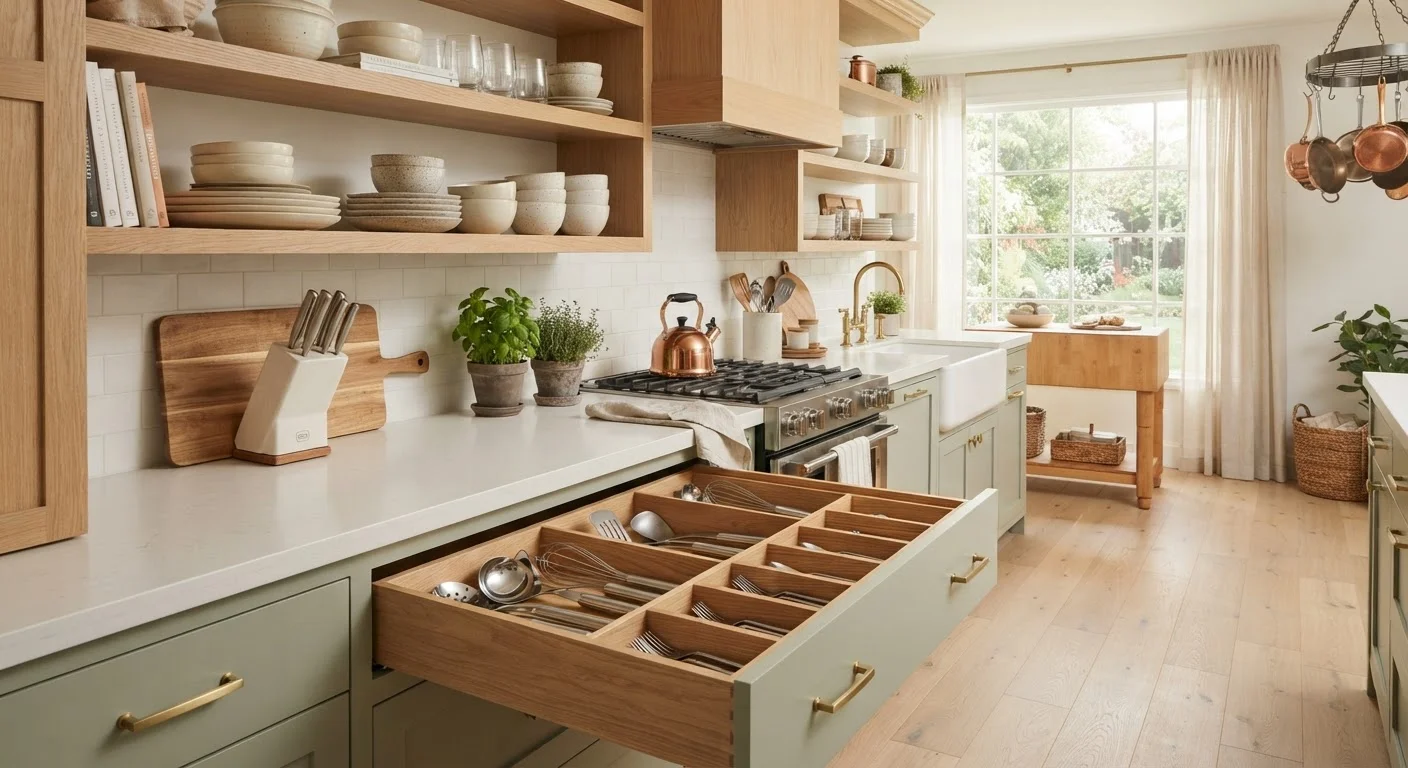
Auditing your kitchen zone by zone reveals hidden friction points that slow down everyday cooking.
Storing items near where you use them is the single most effective organization principle.
Decluttering duplicates and rarely used tools frees up space without any renovation.
Labeling and grouping similar items reduces decision fatigue during meal prep.
A quick monthly reset prevents a full audit from being necessary too often.
45–90 min
Summary
28 items · 45–90 minutes
Why a Kitchen Audit Pays Off
Most kitchen disorganization doesn't happen all at once — it accumulates slowly. A spatula ends up in the wrong drawer. Canned goods get buried behind newer groceries. Cutting boards lean against the cabinet next to the stove simply because that's where they landed after the last dishwasher unload. Over time, these small misplacements add up to real friction every time you cook.
A structured audit helps you see your kitchen as a system, not just a collection of stuff. By working through each zone methodically, you'll identify what's working, what's slowing you down, and what you can fix without buying a single new organizer. Understanding how your kitchen flows — the path from fridge to prep surface to stove — is a useful foundation before you start. Our article on the kitchen work triangle explains how layout shapes cooking efficiency.
Work through the checklist below one zone at a time. You don't have to do everything in a single session — tackling one area per day is perfectly effective.
Countertops & Surface Zones
Remove everything from countertops and assess which items are used at least three times a week — only those earn permanent surface space.Must
Identify your primary prep zone and ensure it's kept clear of appliances, mail, and miscellaneous items before each cooking session.Must
Relocate infrequently used countertop appliances to a cabinet or pantry shelf to reclaim workspace.Should
Check that your knife block or magnetic strip is within arm's reach of your main cutting board.Should
Drawers
Empty each drawer completely, discard any broken utensils, and return only tools you've used in the past three months.Must
Designate one drawer exclusively for everyday utensils — spatulas, ladles, tongs — and keep it closest to the stove.Must
Use drawer dividers or small containers to prevent loose utensils from shifting and piling up.Should
Move rarely used gadgets (melon ballers, egg separators, specialty zesters) to a single secondary drawer or bin.Nice to have
Cabinets & Shelving
Audit each cabinet shelf and remove items that belong in another room entirely (office supplies, pet items, mail).Must
Place daily-use dishes and glasses at eye level; move seldom-used serving pieces to higher or lower shelves.Must
Nest bowls and pots by size, storing lids vertically in a rack or a deep drawer to avoid lid avalanches.Should
Consider shelf risers to double usable vertical space inside standard-height cabinets.Nice to have
Pantry & Dry Storage
Check expiration dates on all dry goods and canned items, and discard or donate anything past its date.Must
Group pantry items by category — baking, grains, canned goods, snacks — so similar items are always together.Must
Apply a simple first-in, first-out (FIFO) rotation: newer purchases go behind older ones so nothing gets forgotten.Should
Label shelves or bins so that other household members can find and return items correctly.Should
Transfer frequently opened dry goods (flour, sugar, pasta) to sealed containers to improve freshness and visibility.Nice to have
Refrigerator & Freezer
Remove all items from the refrigerator, discard expired or spoiled food, and wipe down each shelf before restocking.Must
Assign consistent zones inside the fridge — dairy on one shelf, leftovers at eye level, produce in the crisper drawers.Must
Audit the freezer for items older than three months and plan meals this week to use them up rather than discarding.Should
Label freezer bags and containers with contents and the date they were stored.Should
Under the Sink & Cleaning Supplies
Remove everything from under the sink, discard empty bottles, and consolidate duplicates of the same cleaning product.Must
Store dish soap, sponges, and scrub brushes within reach of the sink; keep everything else in a caddy or bin.Should
Check that any stored trash bags, gloves, or paper towels are accessible without unpacking half the cabinet.Nice to have
Small Appliances & Specialty Equipment
List every small appliance you own and honestly assess which ones you've used in the past six weeks.Must
Store appliances used less than once a month in a lower cabinet or pantry — not on the counter.Should
Donate or pass along appliances that duplicate a function another tool already handles well.Should
Final Review & Maintenance Habits
Walk through each zone you've audited and verify that every item has a clearly defined home.Must
Schedule a 15-minute monthly reset to catch drift before it requires another full audit.Should
Review your kitchen layout with the cooking basics in mind — make sure prep zones support the techniques you use most.Nice to have
Tools You'll Need to Get Started
Before diving in, gather a few basic supplies so you're not hunting for things mid-audit. You don't need specialized organizers to begin — the goal of a first audit is assessment and decluttering, not purchasing.
Required
Large trash bags
Collect discarded, expired, or broken items as you clear out each zone.
Required
Donation box or bin
Separate usable but unwanted items for donation rather than throwing them away.
Required
Masking tape and a marker
Temporarily label shelves, bins, and containers as you re-assign storage zones.
Required
Notepad or phone notes app
Record what's missing, what needs replacing, and any storage gaps you find.
Optional
Drawer dividers or small bins
Separate utensils and loose pantry items once you've decided on a new layout.
Optional
Shelf risers
Create a second usable level inside cabinets that have wasted vertical space.
If you're working with a compact kitchen, our guide to maximizing storage in tight spaces offers targeted strategies for making the most of limited square footage. And if you share your kitchen with others, keeping a shared kitchen organized addresses how to maintain order when more than one person cooks or shops.
Once you've completed your audit, a well-organized kitchen becomes a genuine asset for weekly meal planning — you'll know exactly what you have and where it lives, which cuts prep time significantly.
Don't Buy Organizers Before You Audit
A common mistake is purchasing bins, baskets, and dividers before knowing what you actually have and where it will live. New organizers added to an unaudited kitchen often just contain the clutter rather than solve it. Complete the full audit and declutter first — then measure your actual spaces before buying anything.
Food & Kitchen Editorial Team is the collective byline for our editorial team and contributor network. Articles published under this byline or an editorial pen name are researched, written, and reviewed according to our editorial standards for clarity, consistency, and independence before publication.
Disclaimer: The content provided on our blog site traverses numerous categories, offering readers valuable and practical information. Readers can use the editorial team’s research and data to gain more insights into their topics of interest. However, they are requested not to treat the articles as conclusive. The website team cannot be held responsible for differences in data or inaccuracies found across other platforms. Please also note that the site might also miss out on various schemes and offers available that the readers may find more beneficial than the ones we cover.