

Key Takeaways
Our Verdict
Both the avalanche and snowball methods are legitimate, research-supported paths out of debt. The avalanche saves more money in interest, while the snowball tends to keep people motivated longer. The method you'll actually stick with is the one that works best for you.
| Best for | Recommended |
|---|---|
| Those who want to minimize total interest costs | Avalanche Method |
| Those who need early wins to stay motivated | Snowball Method |
| Those juggling many small debts across several accounts | Snowball Method |
| Those with high-rate debt like credit cards as their biggest balances | Avalanche Method |
How the Two Methods Are Structured
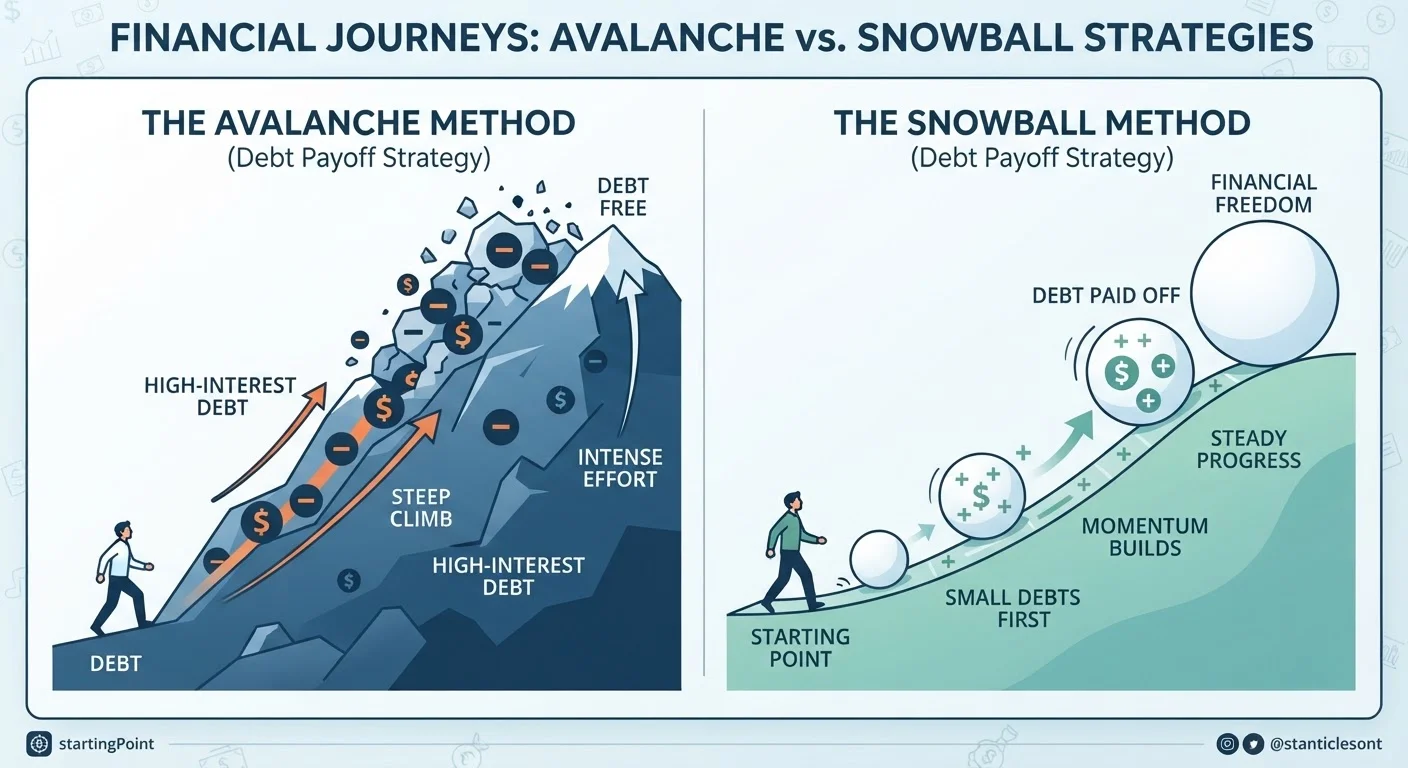
Both strategies share the same foundation: you make minimum payments on every debt you owe, then direct any extra money toward one target debt at a time. The difference is how you pick that target.
Avalanche method: You rank your debts by interest rate — the annual percentage rate, or APR — from highest to lowest. Your extra dollars go toward the highest-rate debt first. Once it's gone, you roll that payment into the next highest, and so on. This order is purely mathematical: eliminating the most expensive debt first means less interest accumulates across your entire payoff timeline.
Snowball method: You rank your debts by balance — smallest to largest — and attack the smallest one first regardless of its interest rate. When that balance hits zero, you roll the freed-up payment into the next smallest. Each eliminated account gives you a tangible sense of progress.
To understand the difference in practice, consider a simplified example. Suppose you have three debts: a $500 medical bill at 0% interest, a $3,000 credit card at 22% APR, and an $8,000 personal loan at 11% APR. The avalanche targets the credit card first; the snowball targets the medical bill first. The math favors the avalanche, but the psychology can favor the snowball — that medical bill can be gone in months, not years.
For a deeper look at how different debt types work, see how revolving and installment debts affect your credit profile.
Comparing the Two Approaches Side by Side
The table below outlines the key differences across several practical criteria.
| Avalanche Method | Snowball Method | |
|---|---|---|
| Payoff order | Highest interest rate first | Smallest balance first |
| Total interest paid | Lower — mathematically optimal | Potentially higher |
| Time to first payoff | Longer if top debt is large | Faster — smallest balances clear quickly |
| Psychological boost | Delayed — requires patience | Early — frequent wins |
| Best for | Disciplined, numbers-focused people | Motivation-driven, overwhelmed people |
| Complexity | Slightly more calculation upfront | Simple to understand and follow |
One nuance worth noting: the gap between what you pay in total interest under each method depends on your specific mix of balances and rates. In some cases the difference is hundreds of dollars; in others it's modest. Run the numbers for your own debts if you want to see your exact savings potential.
When the Avalanche Makes More Sense
The avalanche method is mathematically optimal whenever your highest-interest debts are also among your larger balances — the case for many people carrying significant credit card debt. High-rate balances compound quickly, meaning every month you wait costs you more in interest charges.
This approach suits people who are naturally disciplined or analytically motivated. If you can stay focused on a long-term goal even when progress feels slow — especially at the start, when that big high-rate balance may take a year or more to eliminate — the avalanche will save you the most money.
It also makes sense if you're already comfortable with a budget. Knowing exactly how much extra you can redirect each month, and committing to it, is essential. A solid budgeting practice gives you that number reliably.
When the Snowball Makes More Sense
Research into behavioral economics suggests that people are more likely to follow through on a debt payoff plan when they experience early success. The snowball method is designed around that insight. Paying off a small account completely — even if its interest rate is low — produces a concrete result: one fewer bill, one fewer monthly obligation.
This method tends to work well for people who have several accounts and feel overwhelmed by the sheer number of creditors. Reducing that count quickly can make the overall debt picture feel more manageable. It's also a good fit if past attempts at debt payoff have stalled out, because the quick wins can reignite momentum.
The tradeoff is real, though. If your smallest balance happens to carry a very low rate while your largest balance carries a high rate, you may end up paying considerably more in total interest. Before choosing the snowball, it's worth at least glancing at the avalanche numbers so you're making an informed decision.
Combine Both Methods If Needed
You don't have to commit rigidly to one approach forever. Some people start with the snowball to eliminate two or three small accounts, then switch to the avalanche once they feel stable. What matters most is that you keep making progress. Adjusting your strategy when your situation changes is a sign of good financial judgment, not failure.
Regardless of which method you choose, understanding what type of debt you're dealing with matters. Secured and unsecured debts carry different risks, which can influence which balances you prioritize.
Making Either Method Work in Practice
The strategy itself is only as effective as the budget supporting it. Before you can direct extra money anywhere, you need to know how much extra you actually have each month. List your income, subtract your fixed expenses and minimum debt payments, and identify what's left. Even a modest surplus — say, $50 or $75 a month — applied consistently makes a real difference over time.
A few practical steps to get started:
- List every debt you owe, including the balance, minimum payment, and interest rate.
- Choose your method — avalanche or snowball — and rank the debts accordingly.
- Set up automatic minimum payments on all debts so you never miss one.
- Direct any extra funds to the top-ranked debt each month until it's eliminated.
- When a debt is paid off, immediately roll that payment amount into the next target.
If tracking all of this feels daunting, a simple budgeting format — digital or paper can help you stay organized without overcomplicating things.
For a broader foundation on how credit and debt work together, this complete guide to credit and debt is a useful starting point.
This article is for general informational and educational purposes only and does not constitute personalized financial, tax, or legal advice. Your individual situation may differ — consider speaking with a qualified financial professional before making significant decisions about debt repayment.