

Key Takeaways
Our Verdict
Neither revolving credit nor installment loans is universally better for your credit profile. Revolving credit gives you flexibility but requires careful management of your utilization ratio. Installment loans build a track record of consistent, predictable payments. Most people benefit from having both types responsibly managed over time.
| Best for | Recommended |
|---|---|
| Those focused on managing day-to-day spending and building flexible credit | Revolving Credit (e.g., credit cards) |
| Those making a large purchase and wanting predictable monthly payments | Installment Loans (e.g., personal or auto loans) |
| Those actively trying to diversify their credit mix | A combination of both types |
The Basic Difference Between the Two
Before diving into how each affects your score, it helps to understand what separates these two credit types at a fundamental level.
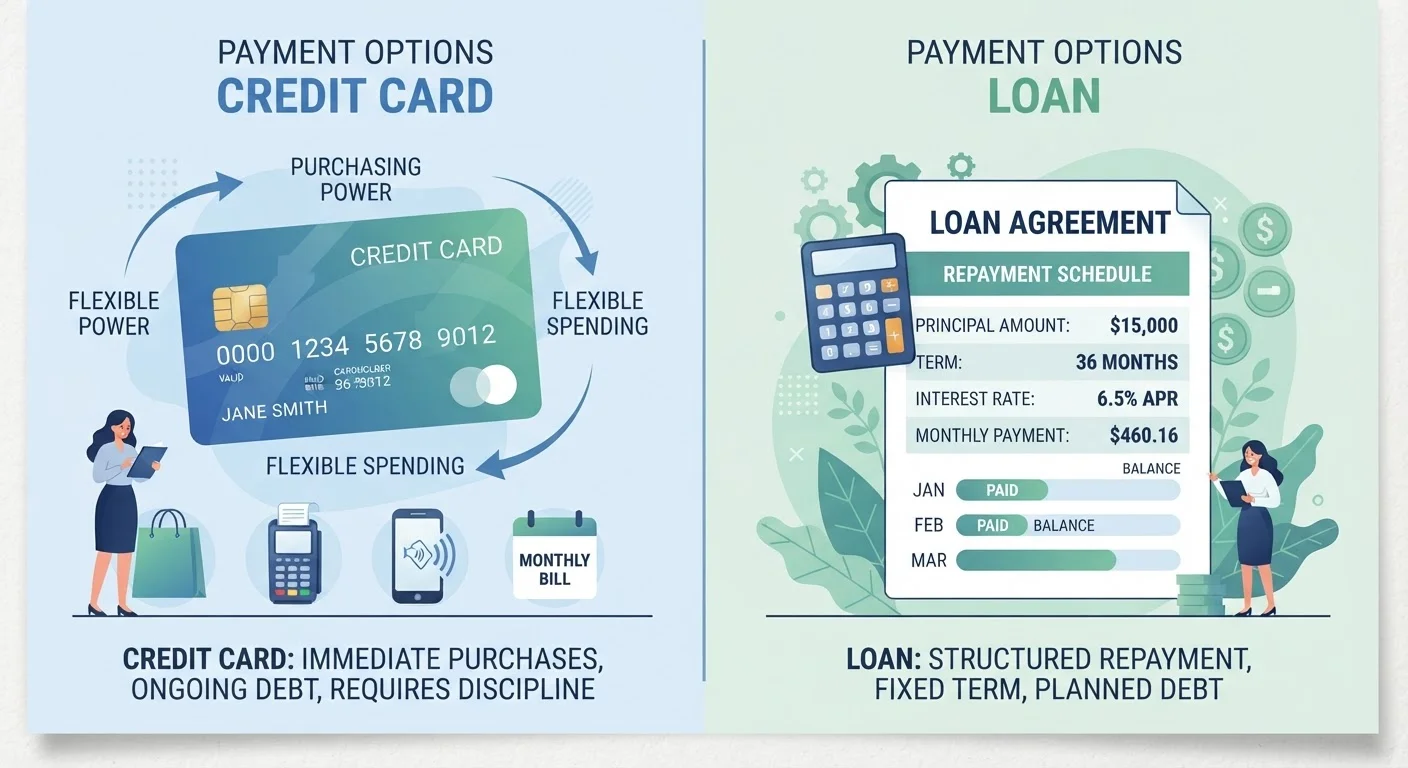
Revolving credit gives you a credit limit you can borrow against, repay, and borrow again — repeatedly. Credit cards are the most common example. Your balance fluctuates month to month based on how much you spend and pay off. You're not required to pay the full balance each month (though carrying a balance means paying interest).
Installment loans work differently. You borrow a fixed amount upfront and repay it in equal monthly payments — or installments — over a set period. Personal loans, auto loans, mortgages, and student loans all fall into this category. Once you pay off the loan, the account closes.
Both types show up on your credit report and influence your score, but the mechanisms are quite different.
How Revolving Credit Affects Your Score
With revolving credit, the biggest lever on your score is your credit utilization ratio — the percentage of your available revolving credit that you're currently using. If your total credit card limit is $10,000 and you're carrying $3,000 in balances, your utilization is 30%.
Scoring models treat high utilization as a risk signal, even if you pay on time. Most credit experts suggest keeping utilization below 30%, though lower is generally better. Learn more in our guide to credit utilization and how it moves your score.
The good news: because card balances are reported monthly, a high utilization number can improve relatively quickly once you pay balances down. It's one of the more responsive parts of your credit profile.
Opening a new credit card also adds to your total available credit, which can lower your utilization — but it also generates a hard inquiry and may temporarily reduce your average account age.
| Revolving Credit | Installment Loans | |
|---|---|---|
| Common examples | Credit cards, HELOCs | Personal, auto, student, mortgage loans |
| Balance structure | Fluctuates; reusable credit limit | Fixed amount, paid down over time |
| Key scoring factor | Credit utilization ratio | Payment history, account age |
| Score impact speed | Can change quickly with balance changes | Builds gradually over loan term |
| Account status after payoff | Remains open (unless closed) | Closes; stays on report up to 10 years |
| Flexibility | High — borrow and repay repeatedly | Low — fixed schedule, lump-sum disbursement |
How Installment Loans Affect Your Score
Installment loans don't carry a utilization ratio the way revolving accounts do. Instead, they contribute primarily through payment history and account age.
Every on-time monthly payment is a positive mark on your credit report. Over a multi-year loan term, that adds up to a long, consistent track record — something lenders like to see. Conversely, a missed payment on an installment loan hits your score hard, because it signals you couldn't meet a scheduled, predictable obligation.
One subtlety worth knowing: as you pay down an installment loan, the remaining balance relative to the original loan amount is reported. Scoring models track this, though it doesn't function the same as credit utilization. A nearly paid-off loan generally looks favorable.
When an installment loan is fully paid off, the account doesn't disappear from your report immediately — it can remain as a positive closed account for up to 10 years, continuing to contribute to your history. For context on how lenders interpret this data, see our overview of credit score ranges and what lenders see.
Credit Mix: Why Having Both Can Help
FICO and VantageScore — the two most widely used scoring models — both account for credit mix, meaning the variety of account types on your report. It typically makes up around 10% of a FICO score, which isn't enormous, but it can be the difference between two otherwise similar profiles.
Lenders view borrowers who've successfully managed different types of debt as lower risk. A person with only credit cards has demonstrated they can handle revolving credit; someone who's also handled an installment loan shows broader financial reliability.
This doesn't mean you should take on debt you don't need just to diversify. The benefit of credit mix is real but modest — it rarely makes sense to open an unnecessary loan to chase a small score bump. If you're planning a large purchase anyway (like a car or home improvement), understanding how the loan will interact with your profile is worthwhile preparation. Review our pre-application checklist before submitting any credit application.
It's also worth noting how these credit types differ from secured vs. unsecured debt — a separate but related distinction that affects your risk exposure, not just your score.
This article is for general informational purposes only and is not personalized financial advice. For guidance specific to your situation, consider speaking with a qualified financial professional.