

Key Takeaways
Why Pet Food Labels Are Regulated — and Still Confusing
In the United States, pet food labeling is governed by both the FDA and individual state regulations, with the Association of American Feed Control Officials (AAFCO) setting the nutritional standards manufacturers voluntarily follow. That framework means labels carry real, standardized information — but the format wasn't designed for easy consumer reading.
Packaging is also a marketing surface. Front-of-bag language like "premium," "natural," or "holistic" carries no enforceable regulatory definition under current rules. The information that actually matters lives on the back or side panel, in four specific areas: the ingredient list, the guaranteed analysis, the AAFCO nutritional adequacy statement, and the feeding guidelines.
Understanding what each section can and cannot tell you is the core skill. See our guide on separating genuine pet needs from marketing for a broader look at how packaging language works across pet products.
The Four Label Sections That Actually Matter
Walk through these four areas in order every time you evaluate a new food.
Check the AAFCO Nutritional Adequacy Statement
Find the statement that reads something like: "[Product name] is formulated to meet the nutritional levels established by the AAFCO [Dog/Cat] Food Nutrient Profiles for [life stage]." This tells you the food is intended to be complete and balanced — not just a treat or supplement.
Look specifically at the life stage listed: "all life stages" covers growth and reproduction, while "adult maintenance" applies only to typical adult animals. A food labeled for "all life stages" must meet the higher nutritional minimums set for growth, which can mean more calories — potentially problematic for sedentary adult pets.
Read the Ingredient List for Context, Not Rankings
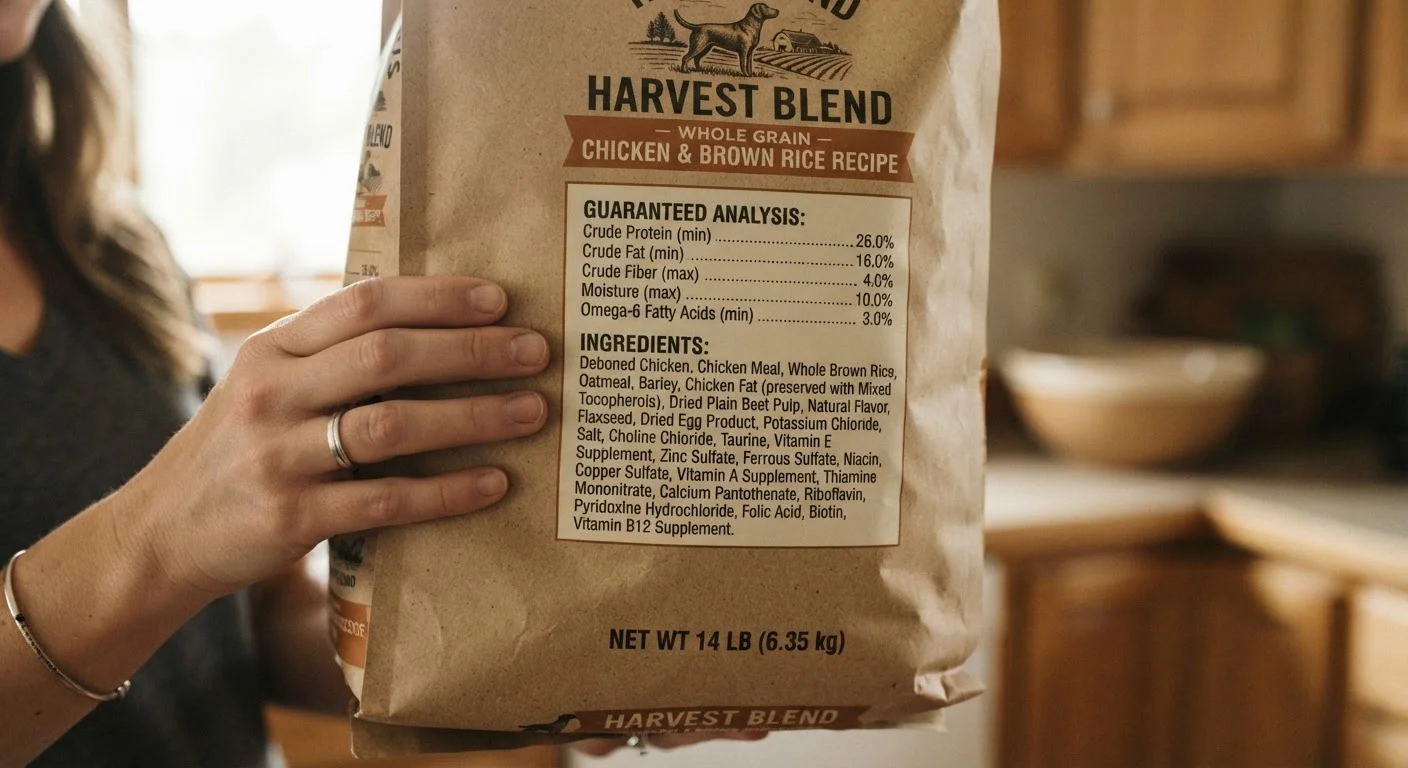
Ingredients are listed in descending order by pre-cooking weight. Whole meats like chicken or beef contain significant water weight, so they often appear first but may contribute less protein by dry weight than a concentrated meal (e.g., "chicken meal") listed lower.
Look for named protein sources (chicken, salmon, lamb) rather than generic terms ("poultry," "meat"). Scan for any ingredients your pet has a documented sensitivity to. Beyond that, a long ingredient list isn't inherently better or worse — it just reflects the formulation approach.
Interpret the Guaranteed Analysis Numbers Correctly
The guaranteed analysis panel lists minimums for crude protein and crude fat, and maximums for crude fiber and moisture. These are regulatory floors and ceilings, not precise measurements of what's in the bag.
To compare wet and dry food meaningfully, calculate dry-matter basis: subtract the moisture percentage from 100 to get the dry-matter percentage, then divide the nutrient percentage by that number and multiply by 100. For example, a wet food with 78% moisture and 8% protein has roughly 36% protein on a dry-matter basis.
Use Feeding Guidelines as a Starting Point Only
Feeding guidelines on the label are based on average animals at average activity levels. They're a useful starting point but rarely the right answer for your specific pet. Factors like spay/neuter status, activity level, health conditions, and whether you're supplementing with treats or toppers all affect actual caloric needs.
Use the guidelines to get in the right range, then adjust based on your pet's body condition over time. If you're unsure how to assess body condition, the body condition scoring method is a straightforward starting point.
Once you've worked through all four sections, cross-reference what you find with your pet's current life stage and any known health considerations. Our article on assessing your pet's body condition at home can help you determine whether the caloric density of a food aligns with your animal's actual needs.
Labels Don't Replace Veterinary Advice
Reading a label helps you make informed choices, but it cannot account for your individual pet's health conditions, allergies, or life stage needs. If your pet has a diagnosed condition or you're unsure which food is appropriate, consult your veterinarian before switching diets. General label literacy is a starting point, not a substitute for professional guidance.
Common Misconceptions and What They Cost You
One persistent myth is that the first ingredient determines the quality of a food. Ingredient splitting — listing related ingredients separately (e.g., "ground corn," "corn gluten meal," "corn bran") — can push a single source lower on the list while keeping its total contribution high. No single ingredient position tells the whole story.
Another misconception involves the guaranteed analysis. The protein percentage listed is a minimum, not a precise figure, and it includes protein from all sources, including plant-based ones. If your veterinarian has recommended a high-animal-protein diet for your pet, the ingredient list context matters as much as the number itself.
Moisture content also distorts comparisons between wet and dry food. A wet food showing 10% protein and a dry food showing 28% protein may deliver similar amounts on a dry-matter basis once water is removed from the equation. To compare across formats accurately, you'd need to calculate dry-matter percentages — a step worth taking if you're mixing food types. The deeper breakdown of guaranteed analysis figures covers this calculation in detail.
Finally, "grain-free" is a marketing category, not a nutritional recommendation. As of this writing, the FDA has been investigating a potential link between certain grain-free diets and dilated cardiomyopathy in dogs — the research is ongoing and inconclusive, but it's a reason to discuss the choice with your vet rather than defaulting to it based on packaging alone.