

Key Takeaways
Positive Reinforcement
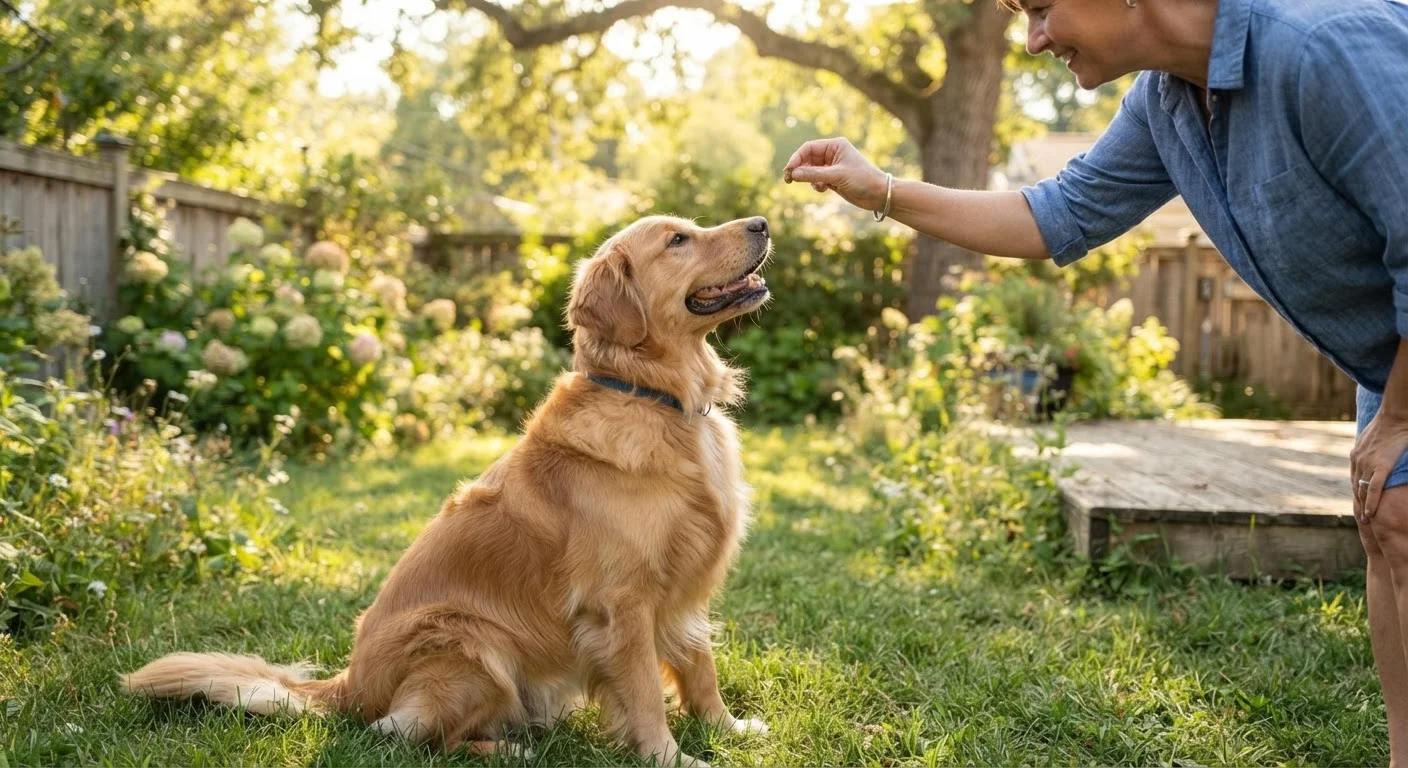
Positive reinforcement is a training method in which a desired behavior is followed immediately by something the dog finds rewarding — like a treat, praise, or play. This makes the dog more likely to repeat that behavior in the future. The principle comes from behavioral science and applies reliably across species, including dogs.
In operant conditioning terms, positive reinforcement adds a stimulus (the reward) after a behavior to increase the probability of that behavior recurring — distinct from negative reinforcement, which removes an unpleasant stimulus to achieve a similar effect.
How the Dog Brain Connects Behavior to Reward
When a dog sits on cue and receives a treat, something specific happens in its brain: neurons in the reward pathway release dopamine, a neurotransmitter associated with pleasure and motivation. This chemical signal tells the brain, in effect, that action produced something good — do it again. Over repeated pairings, the behavior becomes reliably associated with the reward, and the dog begins offering it more readily.
This process, known as operant conditioning, was described in detail by behavioral scientist B.F. Skinner in the mid-20th century. While Skinner's work was largely conducted on rats and pigeons, the principles translate directly to dogs because the underlying brain structures governing reward learning are highly conserved across mammals.
The key variable is timing. Research consistently shows that rewards delivered within one to two seconds of a behavior produce much stronger learning than delayed rewards. A treat given five seconds after a dog sits may actually reinforce whatever the dog was doing at the moment of delivery — standing up, sniffing the ground, or glancing away. This is why tools like clickers, which mark the exact moment of correct behavior, are widely used in professional training settings.
1–2 sec
Optimal reward delivery window after a behavior
Behavioral research consistently identifies this narrow window as critical for forming strong behavior-reward associations in dogs.
~72%
Dogs showing fear signs with aversive training methods
A study published in the journal Applied Animal Behaviour Science found that dogs trained with aversive methods displayed significantly more stress-related behaviors than those trained with reward-based methods.
Why Punishment Often Backfires
Punishment-based training — using physical corrections, harsh verbal reprimands, or aversive tools — can temporarily suppress an unwanted behavior. But it carries meaningful risks that reward-based methods generally avoid.
First, punishment tells a dog what not to do without communicating what to do instead. A dog scolded for jumping on guests learns that jumping caused something unpleasant, but it hasn't been given an alternative behavior to offer. Without guidance, dogs often cycle through other behaviors, some of which may also be unwanted.
Second, aversive methods are associated with elevated stress hormones and anxiety in dogs, according to research published in veterinary behavioral science literature. Dogs trained with punishment-heavy approaches show higher rates of fear-based reactions and are more likely to exhibit avoidance behaviors around their owners. This erodes the trust that effective training depends on. For a deeper look at how specific behaviors like jumping develop, see why dogs jump on guests — understanding the motivation behind a behavior is the first step toward changing it reliably.
What Counts as a Reward — and Why It Varies
Food is the most commonly used reinforcer in training because it is easy to deliver quickly, most dogs find it highly motivating, and the handler has direct control over it. But a reward is technically anything the dog finds reinforcing — that includes verbal praise, a favorite toy, access to a smell, or permission to greet another dog.
Matching the reward to the dog and the context matters. In a low-distraction environment, mild praise may be enough. In a busy park, a higher-value food treat may be necessary to compete with environmental stimulation. Professional trainers often speak of a dog's reinforcement hierarchy — understanding which rewards motivate a particular dog most in a given situation.
It's also worth noting that overreliance on food rewards has real trade-offs. Treat-based training every day can affect calorie intake and, in some cases, create a dog that only performs reliably when food is visible. Gradually transitioning to variable reward schedules — where rewards come sometimes, not always — helps behaviors become more durable and resistant to fading.
Putting the Science Into Practice
Understanding the science helps owners train more effectively because they can troubleshoot with logic rather than frustration. If a behavior isn't sticking, the most common culprits are delayed rewards, inconsistent responses from family members, or distractions that overwhelm the dog's ability to focus.
A practical approach involves three steps: mark the desired behavior the instant it occurs, reward immediately with something the dog values, and repeat consistently across different environments so the behavior generalizes. This mirrors what evidence-based trainers call a redirect, reward, repeat framework — a method well-suited to tackling common problem behaviors, which is explored further in practical strategies for curbing unwanted pet behaviors.
It's also worth separating fact from fiction before starting any training program. Several widely repeated beliefs about dog training — from ideas about dominance to assumptions about age limits — don't hold up to scrutiny. See our look at common pet training myths for a clearer picture of what the evidence actually supports.
The bottom line: positive reinforcement works because it aligns with how the dog's brain is built to learn. That's not a training philosophy — it's biology.