

Key Takeaways
Heat Pump
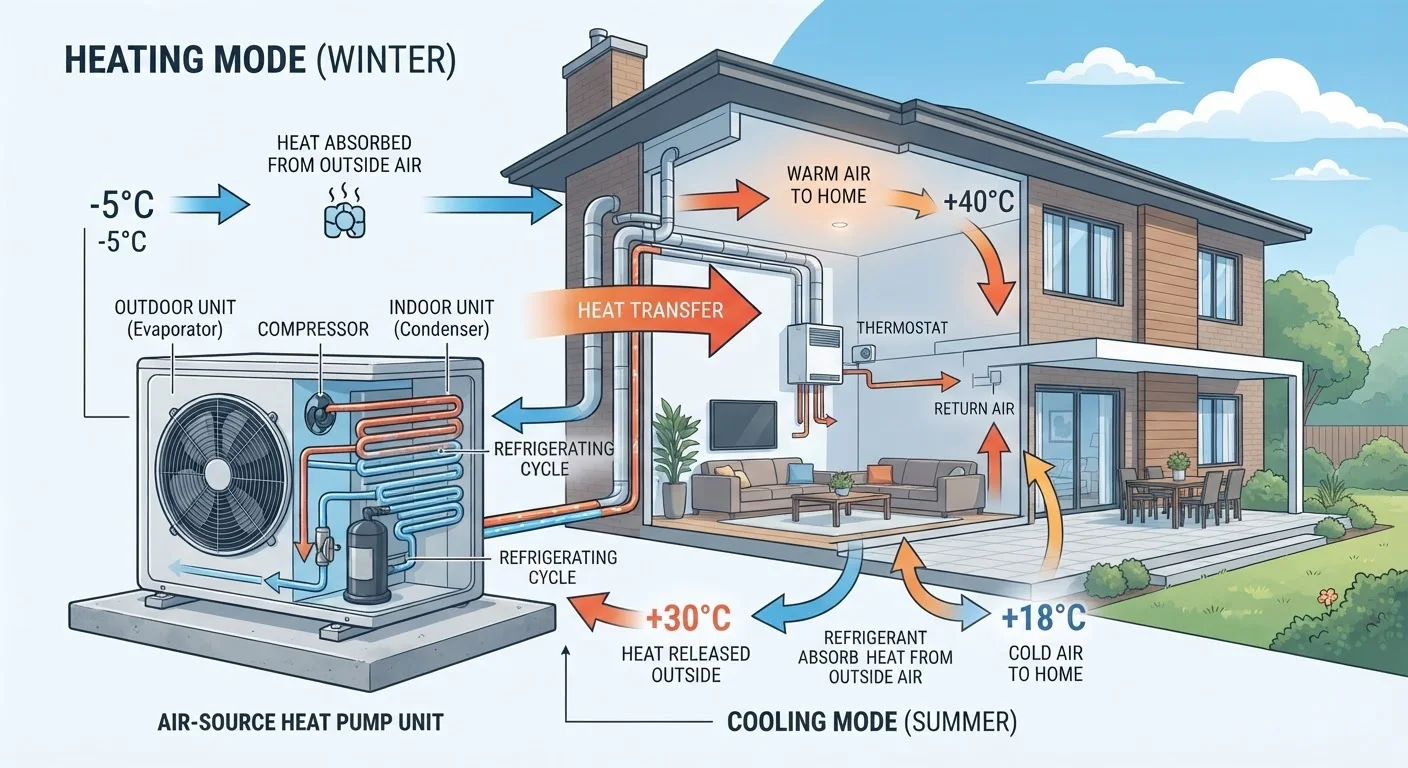
A heat pump is a home heating and cooling system that moves heat from one place to another rather than creating heat by burning fuel. In winter, it pulls heat energy from outdoor air (or ground) and transfers it inside your home. In summer, it reverses the process, pushing indoor heat outside to cool your living space. Because it moves existing energy instead of generating it, a heat pump can deliver more heating or cooling output per unit of electricity consumed than conventional systems.
The ratio of useful heat output to electrical energy input is called the Coefficient of Performance (COP). A typical air-source heat pump has a COP between 2 and 4, meaning it delivers 2–4 units of heat energy for every 1 unit of electricity used.
The Core Principle: Moving Heat, Not Making It
Every conventional furnace works by combustion — burning natural gas, oil, or propane to generate heat. A heat pump takes a fundamentally different approach. It exploits a physical principle: when a liquid refrigerant evaporates, it absorbs heat from its surroundings; when that refrigerant is compressed back into a liquid, it releases heat. By cycling refrigerant between an outdoor unit and an indoor unit, a heat pump harvests heat that already exists in the environment and delivers it where you need it.
Even on a cold winter day, outdoor air contains usable heat energy. A heat pump's outdoor coil acts as a collector, absorbing that energy into the refrigerant. A compressor then raises the refrigerant's temperature significantly, and the indoor coil releases that concentrated heat into your home's air. The process is the same physics that makes your refrigerator cold — just applied in reverse and at a much larger scale.
This distinction matters because it determines efficiency. Generating heat through combustion converts fuel energy into heat at roughly a 1-to-1 ratio at best. Moving heat electrically, a well-sized heat pump commonly delivers two to four units of heat for every unit of electricity it consumes — a meaningful difference for monthly energy costs. If you want to understand how complementary controls affect those savings, see our guide to programmable vs. smart thermostats.
Types of Heat Pumps and How They Differ
The most widely installed type in American homes is the air-source heat pump, which exchanges heat with outdoor air. These come in two main configurations:
- Ducted (central) systems: Connected to existing forced-air ductwork, distributing conditioned air throughout the house the same way a traditional HVAC system does.
- Ductless mini-splits: Individual indoor air-handling units mounted in specific rooms, connected by refrigerant lines to an outdoor compressor. These suit homes without existing ducts or allow zone-specific control.
Ground-source (geothermal) heat pumps exchange heat with the earth through buried loops of pipe. Because soil temperature stays relatively stable year-round — typically 45°F–75°F depending on region — ground-source systems maintain high efficiency even in extreme weather. Installation involves significant excavation or drilling, which raises upfront costs considerably compared to air-source models.
A newer category, water-source heat pumps, exchange heat with a body of water such as a pond or well. These are less common in residential applications but can be highly efficient where the water source is available.
2–4x
Heat energy delivered per unit of electricity
The U.S. Department of Energy notes that heat pumps can deliver two to four times more heat energy than the electrical energy they consume.
~40%
Share of U.S. home energy used for heating and cooling
According to the U.S. Energy Information Administration, space heating and cooling typically account for the largest portion of residential energy consumption.
3M+
Heat pump units shipped annually in the U.S.
Industry data reported by the Air-Conditioning, Heating, and Refrigeration Institute (AHRI) indicates heat pump shipments have surpassed gas furnace shipments in recent years.
What Heat Pumps Mean for Your Home's Energy Use
Switching from combustion-based heating to a heat pump changes the energy source your home depends on — from fuel to electricity. This has several practical implications worth understanding before making any decisions.
First, your heating costs become tied to local electricity rates rather than fuel prices. In areas where electricity is relatively inexpensive or where you generate solar power, this shift often favors the heat pump. In areas with very high electricity costs, the efficiency advantage may narrow. A qualified HVAC contractor or energy auditor can run a site-specific analysis.
Second, heat pumps produce lower-temperature air than gas furnaces. A furnace might push air at 130°F–140°F; a heat pump typically delivers air around 90°F–100°F. This is still warm enough to heat a well-insulated home comfortably, but homes with poor insulation or significant air leaks may notice a difference. Addressing insulation and air sealing first maximizes what a heat pump can do — a point worth keeping in mind alongside the common energy efficiency myths that sometimes lead homeowners astray.
Third, all heat pumps include some form of backup or supplemental heat — typically electric resistance strips — for conditions where the heat pump alone cannot meet demand. This backup mode is much less efficient, so the goal is always to minimize how often it activates.
Key Factors When Evaluating a Heat Pump
If you're considering a heat pump for your home, several technical specifications matter most:
- HSPF2 (Heating Seasonal Performance Factor)
- A standardized efficiency rating for heating mode. Higher values indicate better seasonal heating efficiency. The current federal minimum for split-system heat pumps in most U.S. regions is HSPF2 8.1 or above.
- SEER2 (Seasonal Energy Efficiency Ratio)
- Measures cooling efficiency over a typical season. Higher is more efficient. Federal minimums vary by climate region.
- Cold-climate rating
- Look for the rated heating capacity at 5°F or lower if you live in a northern climate. Some models maintain strong output well below 0°F; others drop off sharply.
Installation quality is equally important. An undersized or oversized unit, or a poorly designed refrigerant line set, can undercut efficiency regardless of what the equipment specifications promise. Always work with a licensed HVAC professional who performs a proper load calculation — often called a Manual J calculation — for your specific home.
This article is for general informational and educational purposes only. It does not constitute personalized energy, financial, or home improvement advice. Consult a licensed HVAC professional and, where applicable, an energy auditor before making decisions about heating and cooling systems for your home. Requirements, incentives, and performance outcomes vary by location and individual circumstances.