

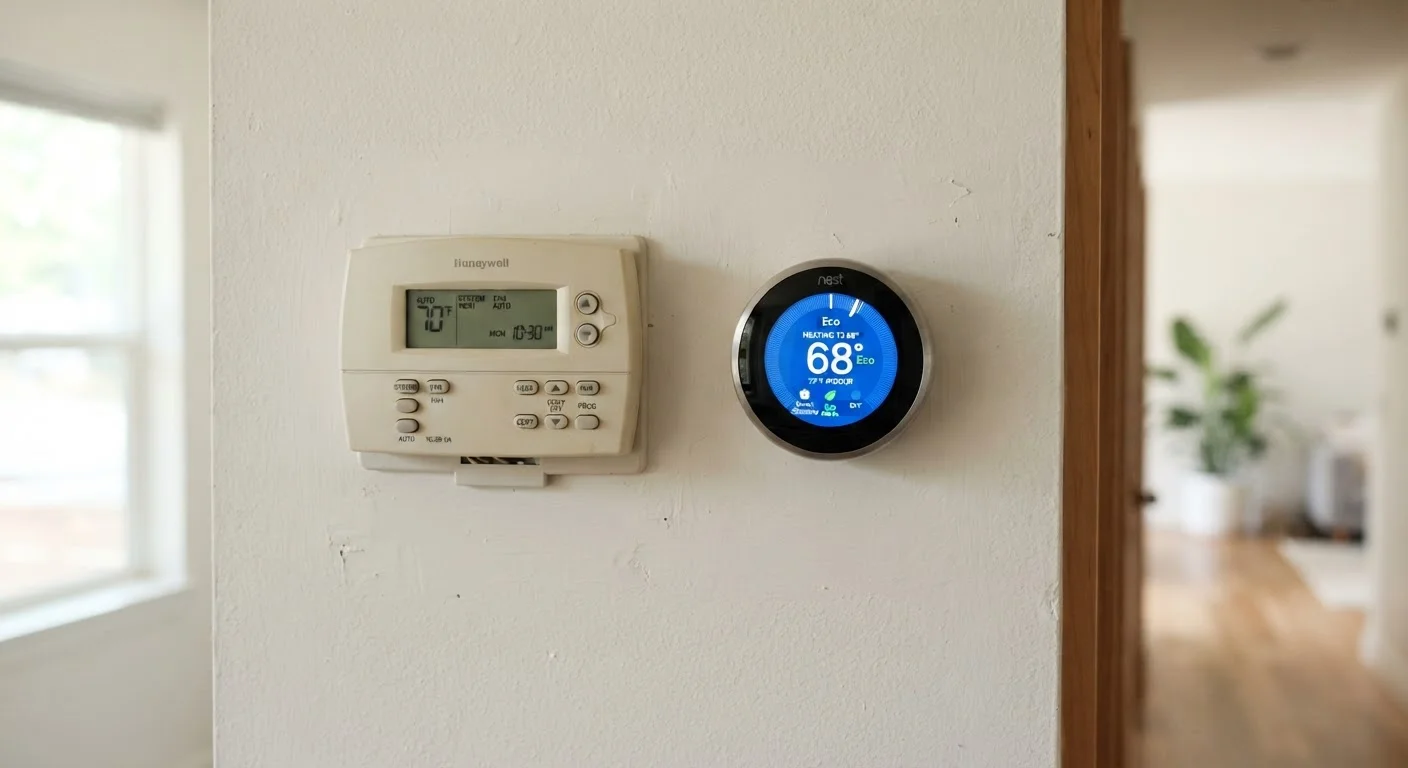
Key Takeaways
Our Verdict
Programmable thermostats are a proven, low-cost way to reduce energy waste when you maintain a predictable schedule. Smart thermostats offer greater flexibility, adaptive features, and remote access that can improve savings — particularly for households with variable routines. Neither type guarantees a specific outcome; the bigger driver of savings is consistent, correct use.
| Best for | Recommended |
|---|---|
| Households with consistent daily and weekly schedules | Programmable thermostat |
| Homeowners who travel frequently or have unpredictable routines | Smart thermostat |
| Renters or budget-conscious homeowners seeking a simple upgrade | Programmable thermostat |
| Those who want app control, utility integrations, and long-term data tracking | Smart thermostat |
How Each Thermostat Type Actually Works
A programmable thermostat lets you pre-set temperature schedules for different times of day and days of the week. Once programmed, it runs that schedule automatically — no manual adjustment needed. It does exactly what you tell it to, no more, no less.
A smart thermostat goes further by connecting to your home's Wi-Fi network. This enables remote control through a smartphone app, integration with voice assistants, and — on many models — a learning capability that observes your preferences over time and adjusts automatically. Some models also use geofencing (tracking when your phone leaves or approaches home) to switch modes without you lifting a finger.
Understanding this distinction matters because the energy-saving potential of each type flows directly from how it works — and how reliably you engage with it. For a broader look at realistic expectations, see common smart home myths worth knowing before upgrading.
Energy Savings: What the Evidence Suggests
The U.S. Department of Energy has long noted that adjusting your thermostat by 7–10°F for 8 hours a day can reduce annual heating and cooling costs by roughly 10%. Both programmable and smart thermostats are designed to achieve this kind of setback automatically.
The key difference is reliability of use. Studies and field data suggest that many homeowners who install programmable thermostats never fully program them — or override the schedule frequently — which erases potential savings. Smart thermostats partially address this by reducing the burden on the user through automation and remote adjustments.
That said, smart thermostats are not magic. If your home has poor insulation, drafty windows, or an aging HVAC system, no thermostat will compensate fully for those inefficiencies. For a broader view of where your energy dollars actually go, small home energy adjustments can have a meaningful cumulative impact alongside thermostat upgrades.
| Programmable Thermostat | Smart Thermostat | |
|---|---|---|
| Upfront cost | Generally lower | Generally higher |
| Scheduling method | Manual, fixed time blocks | Adaptive, app-controlled, or learning-based |
| Remote control | Not available | Yes, via smartphone app |
| Wi-Fi required | No | Yes |
| Learning capability | None | Available on select models |
| Compatibility complexity | Works with most systems | Varies; may need C-wire or specific HVAC type |
| Energy data reporting | None | Usage history and insights via app |
| Best use case | Predictable, regular schedules | Variable schedules or frequent travel |
Installation, Compatibility, and Setup Considerations
Programmable thermostats are generally straightforward to install and are compatible with most conventional forced-air heating and cooling systems. They don't require Wi-Fi, a C-wire (common wire), or a smartphone. Many homeowners can replace a basic thermostat themselves, though it's worth checking your wiring before starting — see what to know before touching thermostat wiring for a clear overview.
Smart thermostats have more variable compatibility requirements. Many require a C-wire to draw consistent power, which older homes may lack. They also need a stable Wi-Fi connection and a compatible HVAC system — heat pumps, multi-stage systems, and radiant heating may require specific models. If you're considering a smart thermostat, installing a smart thermostat yourself is often feasible with careful preparation.
Note: Always turn off power to your HVAC system at the breaker before handling thermostat wiring. If you're unsure about your system's wiring or compatibility, consult a licensed HVAC technician.
Cost, Longevity, and Practical Trade-Offs
Programmable thermostats typically cost less upfront than smart models and have fewer components that can fail — no wireless radio, no app dependency, no firmware updates required. This makes them a durable, low-maintenance option for homeowners who want a set-it-and-forget-it solution.
Smart thermostats carry a higher upfront cost and depend on ongoing software support from the manufacturer. However, many utility companies across the US offer rebates for smart thermostat installation, which can meaningfully offset the price difference — check with your local utility provider directly for current programs.
One often-overlooked factor: if your household's schedule is genuinely unpredictable — shift workers, frequent travel, irregular routines — a programmable thermostat may underperform because the fixed schedule won't match actual occupancy. A smart thermostat's geofencing or learning features can adapt more effectively in these situations. For a comparable trade-off discussion in another category, smart lighting vs. smart switches explores similar decision points.