

Key Takeaways
Start here
How International Packing Differs from Domestic Trips
Foundation
Documents and Entry Requirements
Gear up
Electronics, Power, and Connectivity
Edit down
What to Leave Behind (and Why)
Stay safe
Health, Medications, and TSA vs. Customs
Pull it together
Your Pre-Pack Mindset: Think in Layers, Not Items
How International Packing Differs from Domestic Trips
Packing for a domestic weekend is mostly a logistics exercise. Packing for international travel is a decision-making exercise first. The stakes are different: you can't run home for a forgotten item, replacement costs abroad can be steep, and customs rules add a layer of compliance that simply doesn't exist when driving to a neighboring state.
The core difference isn't quantity — it's preparation depth. You need to know your destination's power standards, entry rules, climate patterns, cultural norms around dress, and what you legally can and cannot bring across a border. None of that applies when you're packing for a road trip. For a broader domestic pre-trip framework, see our pre-trip checklist for American travelers — then use this guide to layer on what changes internationally.
Documents and Entry Requirements
Before you decide on a bag size, sort your documents. This is the only category where a mistake is genuinely trip-ending.
- Passport validity: Many countries require your passport to be valid for six months beyond your travel dates, not just your return date. Check this early.
- Visa requirements: Americans can enter many countries visa-free or with a visa on arrival, but not all. Verify requirements through the U.S. State Department or the destination country's official embassy website — never rely on a travel blog alone.
- Entry forms and digital pre-registration: An increasing number of countries require online pre-registration or electronic travel authorization (ETA) before arrival. Missing this can mean being denied boarding.
- Copies: Keep a digital scan of your passport, visa, and travel insurance in a secure cloud location. Carry one physical photocopy separately from the original.
Entry rules change. Always verify current requirements directly with official government sources before your departure date.
Visa on arrival
A travel authorization granted when you land at your destination, rather than applied for in advance. Not all nationalities qualify for all countries — always verify eligibility before traveling.
Dual-voltage device
An electronic device that can operate on both 110–120V (U.S. standard) and 220–240V (most of the world) without a converter. Check the power brick label to confirm.
Plug adapter
A small physical adapter that changes the shape of your plug to fit a foreign outlet. It does not change voltage — it only changes the plug shape.
Electronic Travel Authorization (ETA)
A digital pre-travel permission required by some countries before you can board your flight. It is distinct from a visa and typically applied for online in advance.
3-1-1 rule
The TSA rule requiring carry-on liquids to be in containers of 3.4 oz (100ml) or less, all fitting in one clear quart-sized bag, with one bag per passenger.
Travel medicine clinic
A healthcare facility specializing in vaccines and health advice for international travelers. Recommended for destinations with specific vaccination or health risks.
Electronics, Power, and Connectivity
The U.S. runs on 110–120V at 60Hz. Most of Europe, Asia, and South America run on 220–240V at 50Hz. Plugging a single-voltage device into the wrong outlet without a converter can destroy it immediately.
Here's how to sort your electronics before packing:
- Check the power brick label on each device. If it reads Input: 100–240V, it's dual-voltage and only needs a plug adapter for the correct outlet shape.
- If it reads a single voltage (e.g., 120V only), you need a voltage converter — not just an adapter.
- Research your destination's outlet type (Type C, G, I, and others) and pack the right adapter.
On connectivity: international SIM cards or local eSIM plans are generally more cost-effective than paying your carrier's international day rates. Decide before you leave whether you'll buy a local SIM on arrival or activate an international plan — and download offline maps for your destination regardless.
What to Leave Behind (and Why)
International flights frequently have stricter checked baggage weight limits than U.S. domestic flights — often 44 lbs (20 kg) for economy versus 50 lbs (23 kg) domestically. Budget carriers abroad may impose even tighter limits. Overpacking isn't just inconvenient; it can mean unexpected fees at a foreign check-in counter with no easy fix.
Common items first-timers pack that are almost never needed:
- Full-size toiletries (hotel toiletries or local pharmacies cover most needs; liquids also face 3-1-1 TSA rules)
- Multiple pairs of shoes beyond three (one casual, one walking, one for formal occasions if needed)
- Books and physical entertainment (phone storage and e-readers handle this more efficiently)
- Excessive 'backup' clothing for scenarios that won't happen
Our guide on why packing light is harder than it sounds breaks down the psychological patterns that drive overpacking — worth a read before your first list.
The One-Week Test Before You Finalize Your List
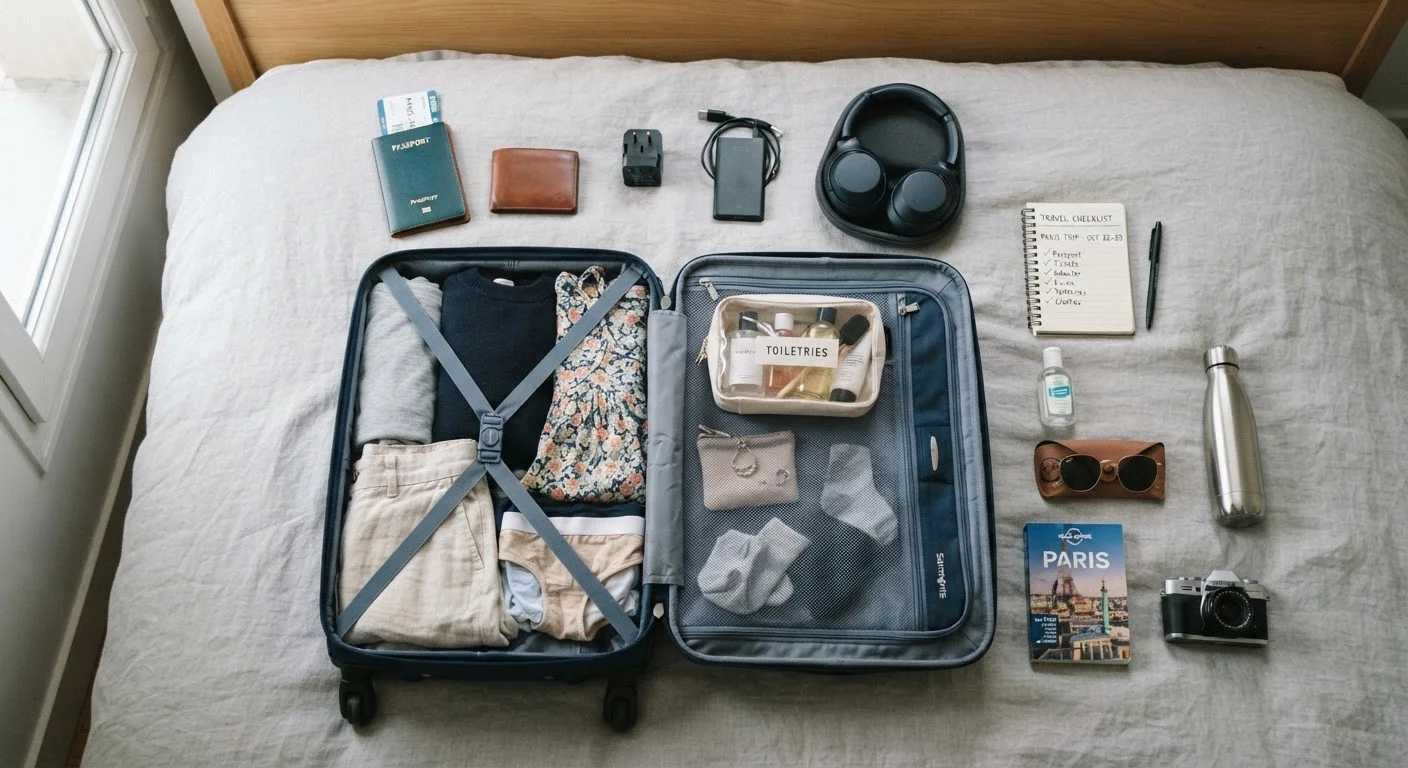
One week before your trip, lay every item you plan to pack on your bed. Then remove anything you haven't used in the past two weeks of normal life. Whatever survives is genuinely useful; everything else is a 'just in case' item taking up space. This single step tends to cut packing volume significantly without leaving travelers short on anything real.
Health, Medications, and TSA vs. Customs
TSA screening at U.S. airports and foreign customs are two distinct processes with different rules. TSA is focused on security threats. Customs is focused on what you're legally permitted to bring into another country — and that includes medications.
Steps to take before you travel:
- Check your destination country's customs authority website for any controlled or prohibited substances. Some common U.S. prescriptions (including certain ADHD medications and painkillers) are restricted or outright banned in specific countries.
- Carry prescription medications in their original pharmacy-labeled containers. Bring a letter from your prescribing doctor stating your diagnosis, medication name, dosage, and that it's medically necessary.
- Keep enough supply for your entire trip plus a buffer of a few extra days in case of delays.
- For vaccinations required or recommended for your destination, consult a travel medicine clinic or your primary care provider well in advance — some vaccines require multiple doses over weeks.
See our complete pre-trip checklist for a full rundown of health and document prep items to verify before departure.
This article is for general informational purposes only. Always consult official government sources, a licensed healthcare provider, and qualified travel insurance professionals for decisions specific to your health, legal, and financial situation.
Your Pre-Pack Mindset: Think in Layers, Not Items
The most efficient international packers don't think in individual items — they think in systems. A layering system for clothing means five to seven versatile pieces can cover ten or more combinations. Packing around your confirmed itinerary (not imaginary scenarios) cuts volume by a third or more.
A workable framework before your first list:
- Confirm your activities — what are you actually doing each day? Build only around those.
- Check the weather range — pack for the temperature spread, not individual days.
- Identify what's available locally — sunscreen, over-the-counter medication, and basic toiletries are sold almost everywhere. Don't pack what you can buy.
- Set a firm bag limit first — choose your bag, then fill it, not the reverse.
For destination-specific packing logic, our guide on trip-type packing strategies walks through how beach, city, and mountain trips each demand a different approach. And if you want to stress-test your list against common bad advice, common packing myths is a useful reality check before you zip up.