

Key Takeaways
Why Destination Type Is the Right Starting Point
Most travelers build their packing list by asking, How many days am I gone? That's the wrong first question. Seven nights in Miami and seven nights in the Rockies demand almost nothing in common beyond a toothbrush. Starting with destination type — not trip length — is the fastest way to avoid both overpacking and critical omissions.
Think of destination type as the filter that shapes every category on your list: clothing weight and volume, footwear count, tech and power needs, toiletry requirements, and bag style itself. Once you've locked in your trip type, the rest of the decisions follow a logical order rather than becoming a free-for-all the night before you fly.
If you're still working on understanding why overpacking happens, that's a useful foundation before applying any trip-type framework.
Best Practices by Trip Type
Each of the following trip categories has a distinct set of priorities. Use these as your starting framework, then adjust for personal needs and trip length.
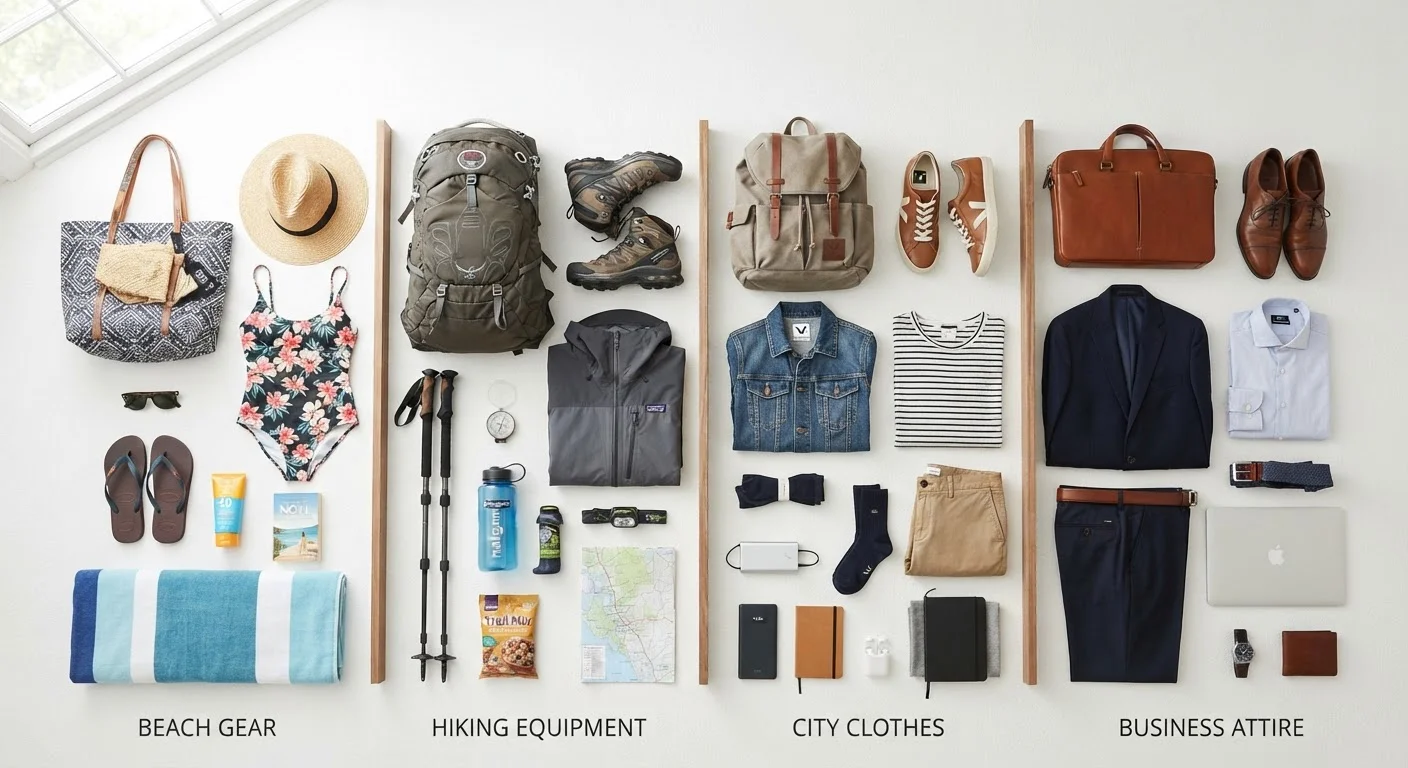
For beach and resort trips, anchor your list to sun and water needs first, then build outward.
Sun protection, swimwear, and sandals take up physical space and are the hardest to source affordably at a destination. Getting them right first ensures you don't crowd them out with excess clothing. Most resort destinations have on-site laundry or shops, reducing the pressure to pack every outfit.
For mountain and outdoor trips, prioritize layering systems over single heavy pieces.
Temperature swings at elevation are steep and unpredictable. A single heavy jacket takes up more space and versatility than a base layer, a mid-layer fleece, and a packable shell combined. The layering approach also lets you adapt without stopping to dig through your bag.
For city and cultural trips, build your clothing list around a single neutral color palette.
City trips involve the widest range of dress codes — casual sightseeing, restaurant dinners, museum visits, public transit. A cohesive palette means fewer pieces cover more combinations, and you don't need to carry dedicated outfits for each activity type.
For business trips, pack in reverse — start with formal requirements and fill gaps with casual pieces.
Business trips have non-negotiable dress requirements for specific events. Packing those first ensures they get the space and wrinkle-protection they need. Casual needs (off-hours wear, gym clothes) can usually be compressed or partially sourced from hotel amenities.
Apply a strict one-pair-of-shoes-per-function rule regardless of trip type.
Shoes are the heaviest, least compressible items in any bag. Most travelers bring more footwear than they actually rotate through. Limiting to one pair per function — walking, formal, activity-specific — forces deliberate choices and frees substantial weight and volume.
Audit your tech and power needs based on trip type before packing any electronics.
A beach trip may need nothing more than a phone and a waterproof case. A business trip might require a laptop, chargers, a portable battery, and international adapters. Packing the same tech load for every trip adds unnecessary weight — and risk of loss or damage.
Quick Actions You Can Take Before Your Next Trip
Once you know your trip type, the following actions take under an hour and meaningfully reduce packing stress — and weight.
When Your Itinerary Spans Multiple Trip Types
A common scenario: four days in Rome followed by three days hiking in Tuscany, or a conference that extends into a beach weekend. These hybrid itineraries are where packing goes sideways fastest.
The rule here is straightforward — build your list around the most demanding environment and trim for the rest. If you're hiking after a city stay, the hiking demands more specialized gear, so anchor to that and pack city-casual layers that double as camp-adjacent clothing. If it's business then beach, your formal needs are probably two or three outfits max; the beach portion is lighter and can absorb a smaller allotment.
A travel capsule wardrobe is especially useful in multi-type trips because it forces you to pick pieces with real overlap. And if you're traveling with someone else, splitting luggage by trip phase is worth considering — see how to divide and pack a shared bag efficiently for a practical approach.
For international itineraries that cross trip types, there are additional layers — customs rules, power adapters, documentation — covered in detail in what first-time international travelers need to know before packing.
Bag Choice Follows Trip Type Too
Your bag is not a neutral container — it either supports your trip type or fights it. A rolling suitcase is a liability on cobblestones or trail terrain. A large backpack is awkward in a business hotel lobby. Match the bag to the movement the trip demands.
Beach and resort trips generally favor a structured duffel or soft-shell roller — easy to pack loosely, no precision required. Mountain and outdoor trips favor a travel backpack with load-bearing straps, not a fashion pack. City trips are the most flexible but reward a bag that locks or zips securely. Business travel calls for a bag with a dedicated laptop sleeve and wrinkle-resistant garment capacity.
If you're trying to keep everything in one bag regardless of trip type, the one-bag travel philosophy has real appeal but real constraints — it's worth reading before committing. And if you're debating whether to check a bag at all, the carry-on vs. checked luggage tradeoff comes down to more than bag size.
Packing smarter also tends to be cheaper. Avoiding checked bag fees, reducing the chance of lost luggage, and moving faster through airports are all financial and logistical wins. For more on keeping costs down across the whole trip, see budget approaches that hold up across trip types.