

Key Takeaways
Our Verdict
Distracted and impaired driving are distinct problems that each erode safe driving through different mechanisms — one by redirecting your focus, the other by impairing the brain functions that enable focus in the first place. Neither is a lesser offense on the road; both are leading contributors to preventable crashes and fatalities in the U.S. Understanding how each works helps drivers make genuinely informed choices — and resist the rationalizations that make both behaviors so common.
| Best for | Recommended |
|---|---|
| Drivers who underestimate phone and in-car distractions | Understanding distracted driving risks |
| Drivers who misjudge their own impairment level after drinking | Understanding impaired driving risks |
| Drivers wanting to build safer overall habits | Defensive driving principles |
Two Different Threats to the Same Task
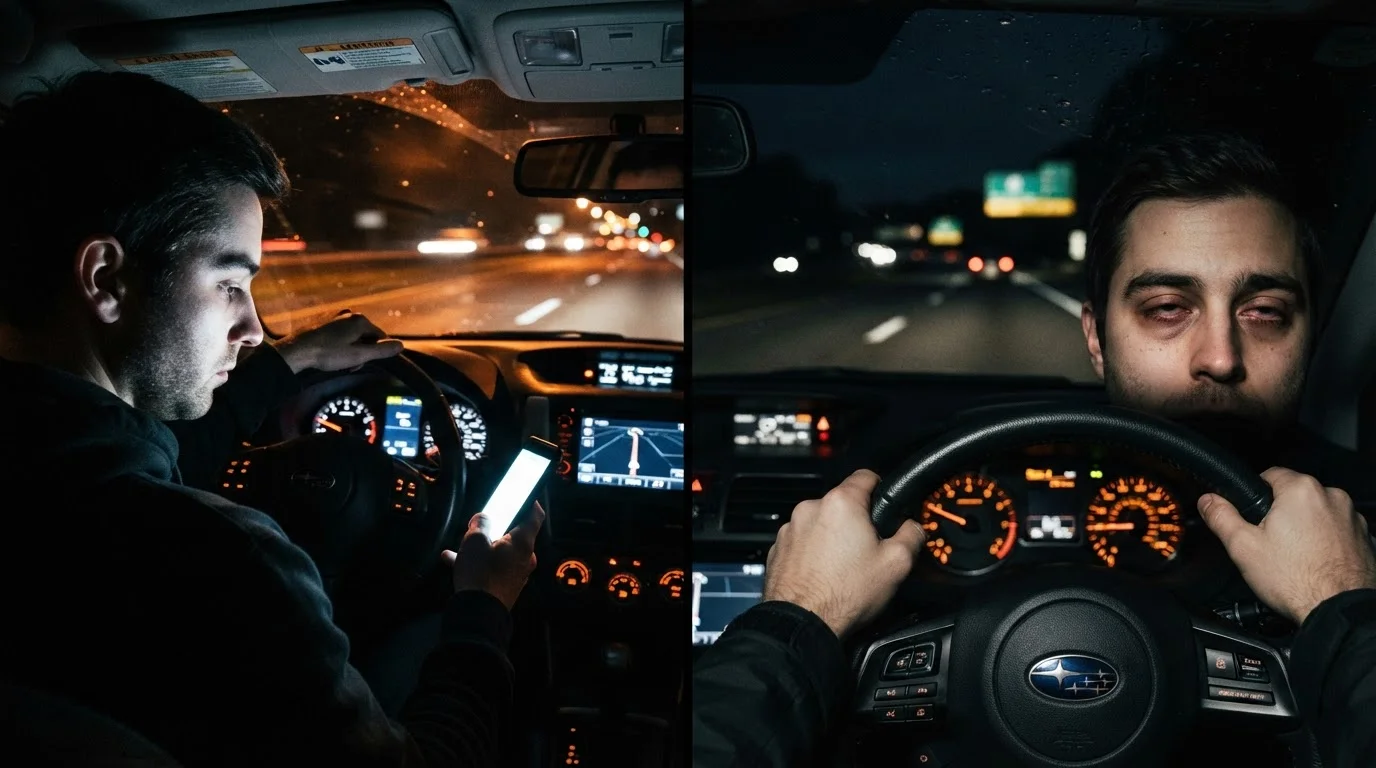
Safe driving depends on a continuous loop: perceive a hazard, process it, and respond. Distracted driving and impaired driving each break that loop — but at different points. Distracted driving interrupts input: your eyes leave the road, your hands leave the wheel, or your mind focuses on something other than traffic. Impaired driving corrupts processing: alcohol, cannabis, certain medications, and extreme fatigue all degrade the brain's ability to interpret what it sees and coordinate a response, even when the driver believes they're paying attention.
That distinction matters because it changes how each risk is experienced. A distracted driver often knows they're distracted — they made a choice to glance at a screen. An impaired driver frequently doesn't register how compromised they are, because the same systems that would flag the problem are themselves impaired. Both are dangerous. Neither is forgivable on public roads.
How Distracted Driving Affects Your Ability to React
Distraction comes in three forms: visual (eyes off road), manual (hands off wheel), and cognitive (mind off driving). Texting combines all three, which is why it's treated as the most dangerous form of distraction by safety researchers and law enforcement alike.
The National Highway Traffic Safety Administration (NHTSA) has reported that reading or sending a text takes a driver's eyes off the road for roughly five seconds. At 55 mph, that's approximately 100 yards of travel — the length of a football field — with essentially zero awareness of what's ahead. Even hands-free phone conversations create measurable cognitive blind spots, a phenomenon researchers call inattention blindness. You can learn more about that specific risk in our article on hands-free calling while driving.
Crucially, the distraction is often temporary and self-correcting — the driver can choose to put the phone down. That doesn't make it safe, but it does mean the risk can be eliminated with a behavioral choice.
| Distracted Driving | Impaired Driving | |
|---|---|---|
| Primary mechanism | Redirects attention away from road | Degrades brain's processing ability |
| Driver self-awareness | Usually aware they are distracted | Often unaware of how impaired they are |
| Common causes | Phone use, passengers, eating, controls | Alcohol, cannabis, medications, fatigue |
| Reaction time impact | Delayed during distraction window | Slowed continuously while impaired |
| Risk correction | Eliminated by behavioral choice in the moment | Requires planning before driving |
| Legal status | Banned in all 50 states (texting) | Criminal offense (DUI/DWI) in all states |
| Fatal crash contribution | Thousands of deaths annually (NHTSA) | Roughly one-third of all U.S. traffic fatalities |
How Impaired Driving Affects Your Ability to React
Chemical impairment from alcohol or other substances works differently. Alcohol, for instance, depresses the central nervous system progressively. Even at a blood alcohol concentration (BAC) well below the federal legal limit of .08 g/dL, drivers show measurably slower reaction times and reduced ability to track moving objects. At .08 BAC, NHTSA data indicate that the risk of a fatal crash is significantly higher than at zero BAC.
What makes impairment especially insidious is reduced self-awareness. Alcohol specifically impairs the judgment needed to assess one's own impairment — so drivers often rate their ability to drive as fine when it is objectively compromised. Cannabis impairment presents a different but equally real profile: it affects coordination and time perception, and its interaction with reaction time is harder to measure with roadside tests, though research consistently shows elevated crash risk.
Fatigue — while not chemical — mirrors impairment closely enough that many safety experts treat it in the same category. Driving after 20+ hours without sleep produces impairment comparable to a .08 BAC in some cognitive tests.
Where the Risks Actually Overlap
The two categories aren't always cleanly separated. A driver who is both tired and on a phone is experiencing compounded risk. An impaired driver who also reaches for their radio has layered two risk mechanisms on top of each other. Research consistently shows that risks don't merely add — they multiply in combination.
Both behaviors also share a common denominator: overconfidence. Most drivers who text believe they can do it safely. Most drivers who drink believe they're below the threshold of meaningful impairment. Both groups are statistically wrong at meaningful rates. For a deeper look at how these false beliefs form, see our piece on common myths about phone use and speeding.
Both also carry serious legal exposure. All 50 states ban texting while driving. Every state has a DUI/DWI framework with criminal penalties, license suspension, and insurance consequences that can follow a driver for years.
Building Habits That Eliminate Both Risks
The practical difference between the two risks shapes the solution. Distraction is a habit problem — it responds to behavioral rules like silencing your phone before starting the car and designating a passenger to handle navigation. Impairment requires planning before the situation arises: arranging a designated driver, using a rideshare app, or simply not starting the car after consuming alcohol or other substances.
Both risks are substantially reduced by the broader mental discipline of defensive driving — staying situationally aware, maintaining proper following distance, and anticipating the behavior of other drivers. Defensive habits also give you a margin of safety when other drivers around you are impaired or distracted, which is a real and common scenario.
If you want to understand how reduced reaction time interacts with stopping distance, our article on why tailgating is more dangerous than most drivers realize provides a useful grounding in the physics involved.