

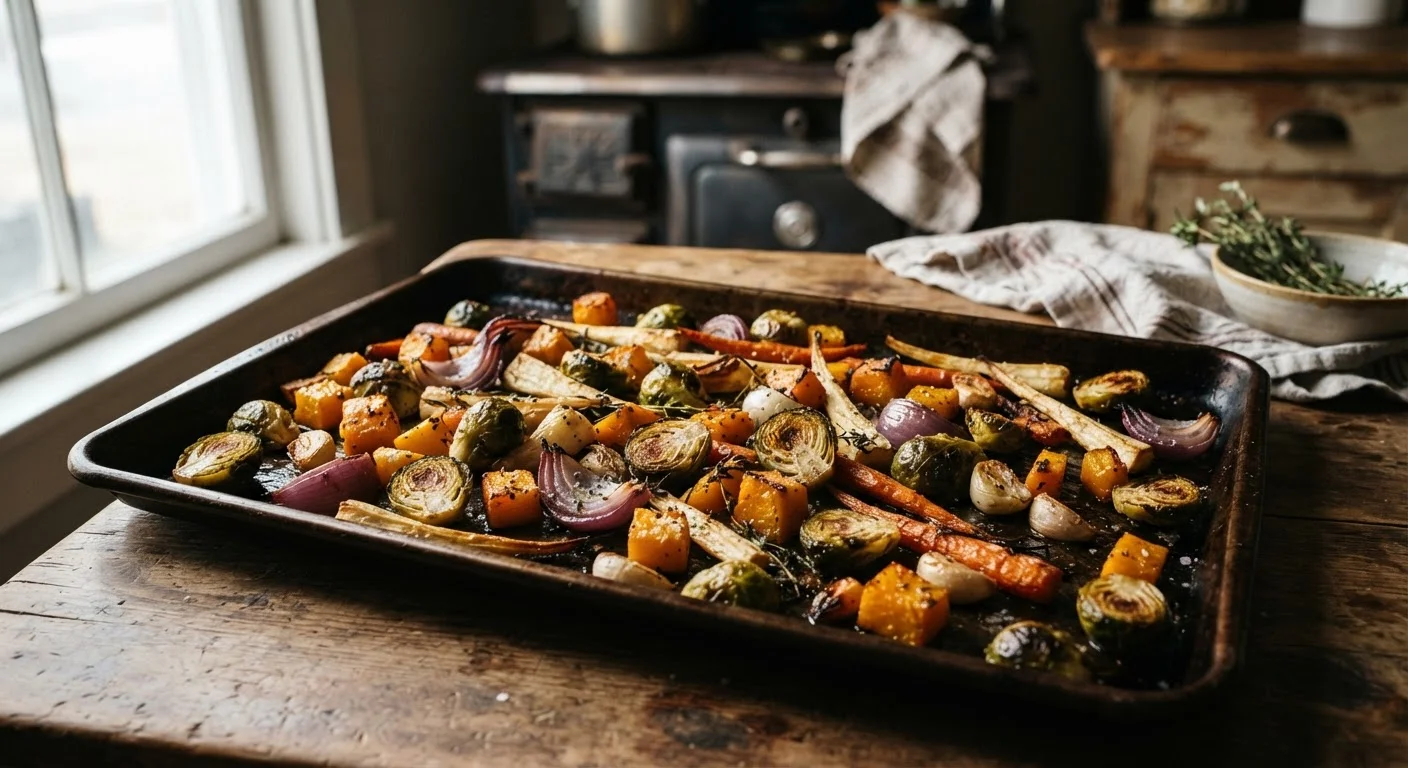
Key Takeaways
Why Vegetables Steam Instead of Caramelize
Roasted vegetables that turn out soft, pale, and watery aren't a seasoning problem — they're a heat and moisture problem. Understanding what's actually happening in the oven makes the fix straightforward.
Caramelization and the Maillard reaction (the browning of proteins and sugars under dry heat) require the surface of the food to be dry and the surrounding air to be hot enough to evaporate moisture quickly. When vegetables release water during cooking, that moisture needs somewhere to go. If it can't escape fast enough — because the pan is crowded, the oven isn't hot enough, or the vegetables weren't dried — it pools around the food and the vegetables effectively steam in their own liquid.
This is why roasting falls firmly in the dry-heat cooking category. For a deeper look at why that distinction matters, see Dry Heat vs. Moist Heat: A Map of Cooking Methods. The same principle that causes crowding problems in a skillet applies equally in the oven — more on that in Overcrowding the Pan: The Mistake That Kills a Good Sear.
Convection Mode Speeds Things Up
If your oven has a convection setting, use it. Convection fans circulate hot air and accelerate moisture evaporation, which means vegetables brown faster and more evenly. Reduce the temperature by about 25°F compared to conventional settings and start checking doneness a few minutes early.
What You'll Need Before You Start
Getting good results doesn't require special equipment, but a few basics make a real difference.
What you will need
Once you have these in order, the process itself takes only minutes of active effort — most of the work happens in the oven.
Rimmed sheet pan
Keeps vegetables contained while allowing hot air to circulate around each piece.
Wire rack (oven-safe)
Elevating vegetables on a rack inside the sheet pan allows heat to reach the bottom surface, improving browning on all sides.
Mixing bowl
Used to toss vegetables evenly in oil and seasoning before spreading on the pan.
Kitchen towel or paper towels
For thoroughly drying vegetables before oiling — essential for preventing steam.
Step-by-Step: Roasting for Caramelization
Follow these steps in order. Each one addresses a specific cause of steaming, so skipping one — even a seemingly minor step like patting vegetables dry — can undermine the whole result.
Preheat the oven fully to 425–450°F
Set your oven to 425°F (or 450°F for denser vegetables like beets or carrots) and allow it to fully preheat — at least 20 minutes. An oven that hasn't reached temperature will start cooking vegetables before it can evaporate moisture, leading to steaming from the first minute.
If you want to speed up browning further, place the sheet pan in the oven during preheat so it's hot when the vegetables land on it.
Cut vegetables to a consistent size
Aim for pieces roughly 1 to 1.5 inches in size. Uniform cuts mean every piece is done at the same time — smaller pieces overcook and burn before larger ones are tender. Dense vegetables like sweet potatoes need smaller cuts than quick-cooking ones like zucchini.
Dry the vegetables thoroughly
After washing and cutting, spread vegetables on a clean kitchen towel and pat them dry. Surface moisture is the enemy of caramelization — it must evaporate before browning can begin, and that costs time and heat.
Toss with oil in a bowl — don't pour oil directly on the pan
Add the dried vegetables to a mixing bowl, drizzle with enough oil to coat each piece lightly, and toss to distribute evenly. Every surface should have a thin, even coat of oil — this conducts heat to the vegetable surface and promotes even browning. Too little oil leads to dry, leathery spots; too much creates greasiness and can slow browning.
Season with salt and any other spices in the bowl, not on the pan, so seasoning adheres evenly.
Spread in a single layer with space between pieces
Arrange vegetables on the sheet pan so no two pieces are touching. A single layer with visible gaps is the goal. If there isn't enough room, use a second sheet pan rather than crowding. This is the most commonly skipped step and the most consequential one — crowded vegetables will steam no matter how hot the oven is.
Roast without disturbing, then flip once
Place the pan in the oven and resist the urge to stir or check frequently. Letting vegetables sit undisturbed allows a caramelized crust to develop on the contact surface. After roughly half the total cooking time, flip each piece once using a spatula to expose the other side to the pan heat.
Total roasting time varies: tender vegetables (asparagus, green beans) may need only 15–20 minutes at 425°F, while root vegetables (carrots, parsnips) can take 35–45 minutes.
Once you're comfortable with these fundamentals, the same logic applies to stovetop browning methods too. See Getting a Pan to the Right Temperature Before You Cook for a parallel guide to heat management on the stove.