

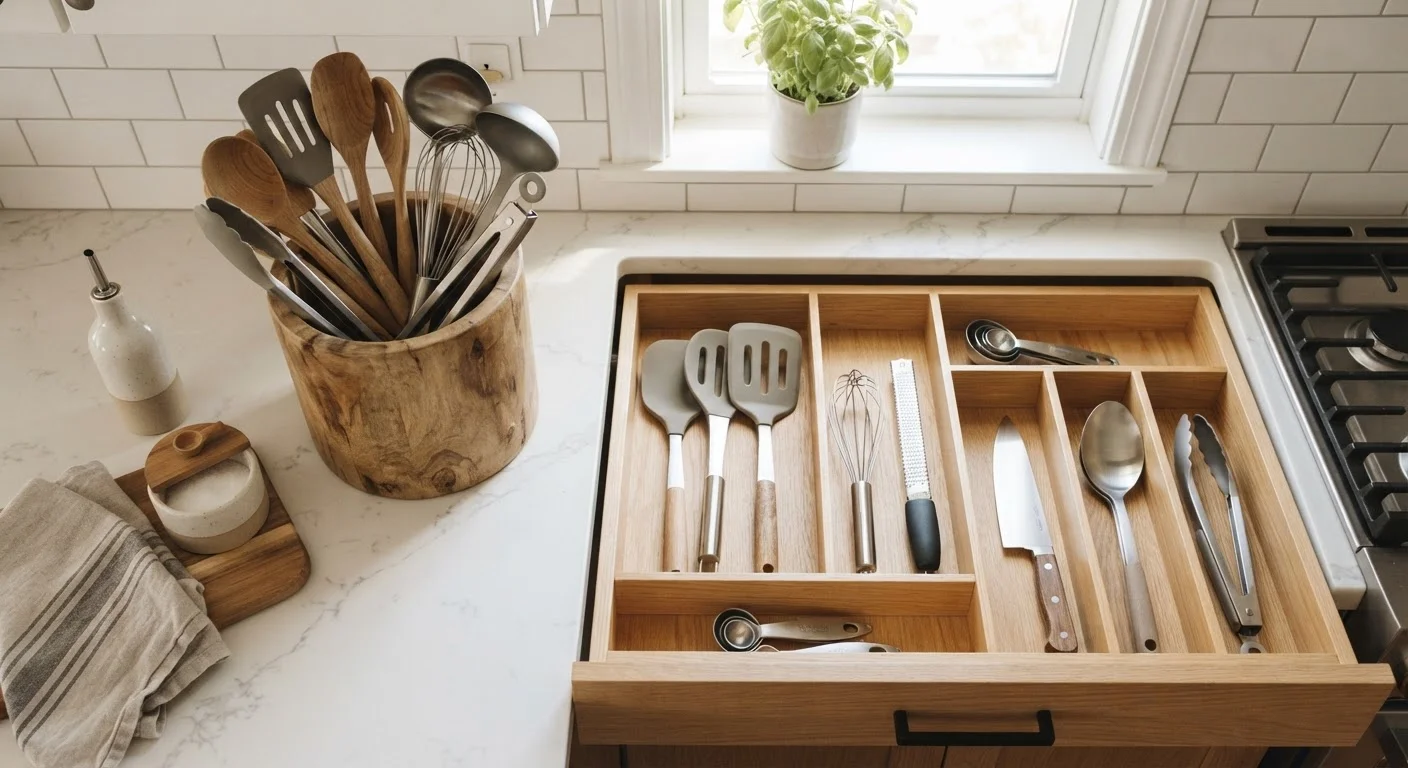
Key Takeaways
Option A
Drawer Dividers
The tidy, out-of-sight solution for flat tool storage.
Best for: Cooks who want counters completely clear and have at least one deep kitchen drawer available.
Option B
Utensil Crocks
The grab-and-go countertop approach for active, frequent cooks.
Best for: Cooks who reach for tools constantly while cooking and prefer instant visual access over drawer space.
If your counters are small or cluttered
Drawer Dividers
Moving tools off the counter immediately reclaims prep space, which matters most in compact or galley kitchens.
If you cook daily and reach for tools constantly
Utensil Crocks
Having spatulas, tongs, and spoons upright at arm's reach eliminates the stop-and-search interruption mid-cook.
If you share a kitchen with multiple people
Utensil Crocks
A visible crock system is easier for multiple users to maintain consistently without enforced categorization habits.
If you own tools of varying sizes and shapes
Drawer Dividers
Dividers can be configured to accommodate long, flat, or oddly shaped tools that tip or crowd inside a crock.
If you want a hybrid approach for a busy household
Utensil Crocks
Use a crock for the eight to ten tools you reach for daily, and dividers for the rest — crocks anchor the day-to-day system.
The Core Problem Both Solutions Try to Solve
Most kitchen utensil frustration comes from a single recurring moment: you need a tool right now, and you can't find it. It's buried under other spatulas, standing upright in a crowded crock, or lost in a junk drawer. Both drawer dividers and utensil crocks attempt to eliminate that friction — they just take opposite approaches to doing it.
Drawer dividers work by assigning each tool a defined horizontal slot, hidden from view inside a drawer. Utensil crocks work by standing tools upright in a container on the counter, immediately visible and accessible. Neither is objectively superior. The right one depends on how your kitchen is laid out, how often you cook, and what organizational habits you can realistically maintain.
Before choosing, it helps to do a quick count: how many utensils do you actually use in a typical week? If the answer is fewer than ten, either system can handle them comfortably. If it's significantly more, you may find yourself needing both. See our kitchen organization audit checklist for a structured way to assess what's actually earning its place in your drawers and on your counters.
How Each System Actually Performs Day to Day
Drawer dividers reward cooks who are disciplined about returning tools to a specific slot. When that habit holds, the drawer stays orderly and easy to navigate with a glance. The downside is that pulling open a drawer, scanning, and grabbing a tool adds a small but real interruption when you're actively cooking. For tools you use only a few times a week — a pastry brush, a basting spoon, a thermometer — that's a reasonable trade.
Utensil crocks shine during active cooking. Tongs, wooden spoons, and spatulas standing upright are reachable in one motion without breaking your focus. The trade-off is counter real estate and the tendency for crocks to gradually accumulate tools that don't belong there. A crock with fifteen items becomes nearly as frustrating as a junk drawer. Discipline still matters — it's just directed at limiting what goes in rather than where each item sits.
| Criterion | Drawer Dividers | Utensil Crocks |
|---|---|---|
| Counter space used | None | Moderate (footprint of crock) |
| Access speed while cooking | Slower (open drawer, scan, grab) | Faster (grab directly) |
| Drawer space required | At least one deep drawer | None |
| Works for odd-shaped tools | Yes, with right divider config | Limited — tall items tip |
| Multi-user household ease | Moderate — requires slot discipline | High — visual and intuitive |
| Clutter visibility | Hidden (drawer closed) | Visible on counter |
| Setup cost | Low to moderate | Low |
Kitchen size is a major factor. If your usable counter space is limited, a crock of any size competes with cutting boards, small appliances, and prep work. In that context, drawer dividers often win by default. If counter space isn't the constraint, a well-curated crock is genuinely faster for high-frequency cooks. This trade-off mirrors what you'll find in other storage decisions — our piece on open shelving trade-offs explores similar tension between visibility and clutter management.
Making Either System Actually Stick
The most common reason both systems fail isn't the organizer — it's overloading. Drawer dividers stop working when slots overflow with doubles, specialty tools, and items that belong elsewhere. Crocks stop working when every utensil you own ends up standing in them. Both systems require an initial edit: remove anything you haven't used in the past month and store it somewhere lower-access, or donate it.
For dividers, measure your drawer depth before purchasing inserts. A drawer shallower than two inches won't contain most ladles or large spoons flat without the handles jutting up. Adjustable or modular dividers give you more flexibility than fixed-slot trays, particularly if your tool collection changes seasonally.
For crocks, choose a size that limits capacity. A crock that holds eight to twelve tools is a feature, not a limitation — it prevents creep. Place it directly beside your primary cooking position, not near the sink or on the opposite counter.
If you share your kitchen with others, visibility tends to win. Systems that require remembering which slot holds which tool are harder to maintain across multiple users. Our guide on keeping a shared kitchen organized covers this dynamic in more depth. And if you're rethinking storage more broadly, spice storage approaches applies the same kind of trade-off thinking to another frequently chaotic kitchen zone.
The Hybrid Approach Is Common for Good Reason
Many organized kitchens use both systems simultaneously — a crock for the eight to ten tools reached for daily, and drawer dividers for everything else. This isn't indecision; it's practical prioritization. The crock handles speed and frequency; the drawer handles capacity and variety. If you're starting from scratch, begin with a crock for your most-used tools and add dividers only once you've identified which items genuinely belong in lower-access storage.