

Key Takeaways
Everything is immediately visible and accessible
You can see exactly where things are at a glance, which speeds up cooking prep and reduces the frustration of hunting through stacked cabinets. Frequently used items are genuinely faster to grab when there's no door in the way.
Makes small kitchens feel more open
Removing upper cabinet doors or replacing them with open shelves eliminates visual bulk along the walls. This can make a compact kitchen feel noticeably less closed-in without any structural changes.
Encourages intentional, curated storage habits
Because everything is on display, most people naturally keep only what they use regularly on open shelves and find better homes for the rest. This can reduce overall clutter when the habit takes hold.
Easier to rearrange and reconfigure
Without doors and hinges, adjusting shelf height or swapping shelf positions is straightforward. This makes it simpler to adapt storage as your kitchen tools and habits change over time.
Dust and grease build up quickly
Open shelves accumulate cooking grease, dust, and airborne residue much faster than items stored behind closed doors. In an active kitchen, dishes left unused for even a week may need rinsing before use.
Requires consistent daily tidying
A single out-of-place stack or mismatched item is immediately visible and disrupts the aesthetic. Maintaining open shelves at the level they're typically shown in design images is a real, recurring time commitment.
Reduces total usable storage capacity
Open shelves typically hold fewer items than deep closed cabinets because stacking and layering becomes messy-looking. Households with a lot of cookware, appliances, or pantry items often find they simply run out of space.
Items fade and wear more visibly
Prolonged exposure to light — especially direct sunlight — can fade dishware finishes and degrade certain materials over time. Items stored openly also tend to get handled more, which increases the rate of chips and breakage.
Can amplify the appearance of clutter
In a household where items don't always get put back in the right place, open shelving makes disorder more visible and harder to ignore than closed cabinets would. The visual noise can make a kitchen feel more chaotic, not less.
Our Verdict
Open kitchen shelving delivers real benefits — better visibility, a more spacious feel, and easier daily access — but those gains come with genuine maintenance demands. Dust and grease settle on displayed items quickly, and the visual tidiness seen in design photos requires deliberate, ongoing effort that not every household can sustain.
Open shelving suits organized, low-clutter households who cook regularly, own attractive dishware they use daily, and are willing to wipe down shelves and items at least once a week.
What Open Shelving Actually Means Day to Day
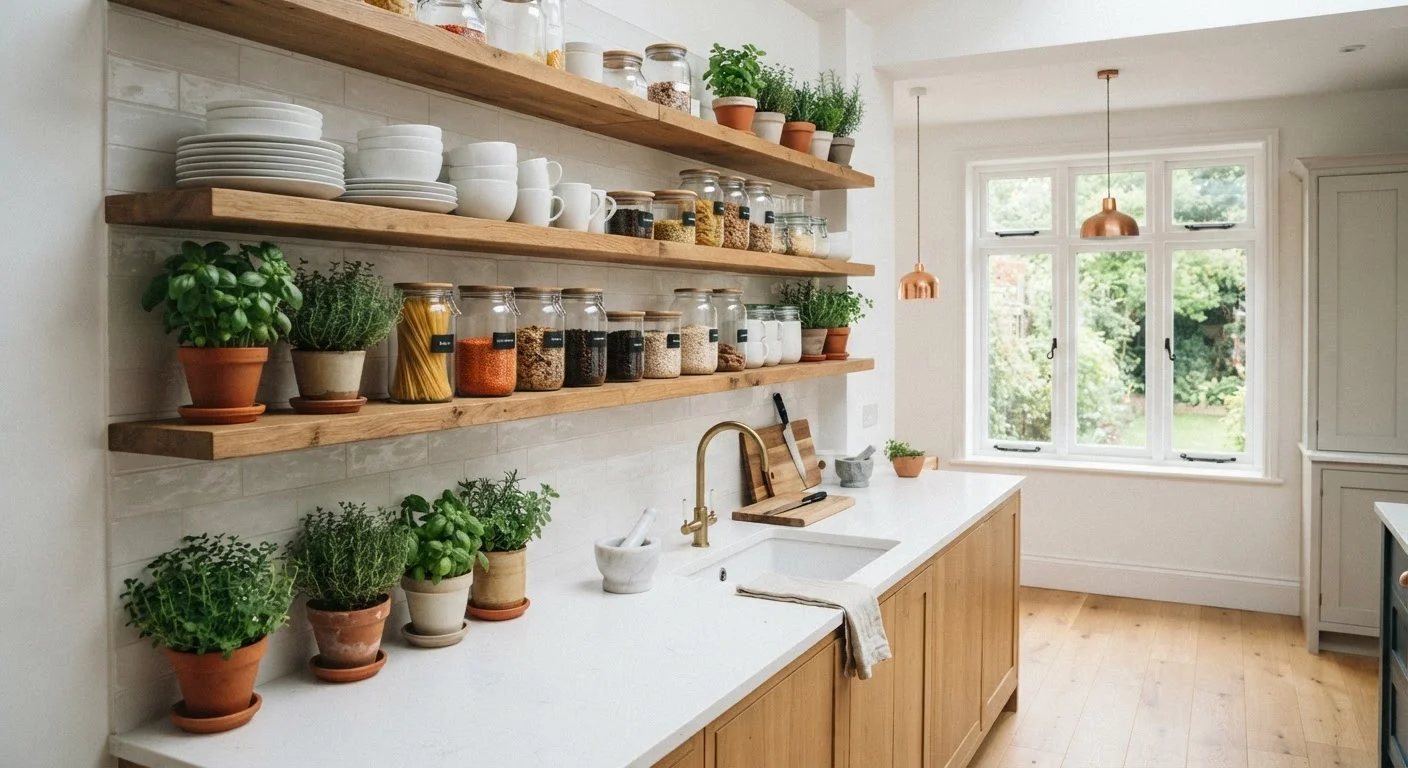
Open shelving replaces cabinet doors — or eliminates upper cabinets entirely — leaving your dishes, glasses, and pantry items fully visible. The appeal is obvious in kitchen design images: clean lines, a sense of airiness, and a display-ready aesthetic. But the kitchen in those photos is staged, not lived in.
In a real working kitchen, open shelves mean everything on them is exposed to steam, grease mist, and airborne cooking particles every time you use the stove. Items get touched more often and stay out of protective enclosures. Understanding that gap between the aspirational image and daily reality is the starting point for making an honest decision. If you've already noticed that your current kitchen creates stress even after a tidy-up, the root causes of kitchen clutter are worth understanding before adding an open storage format.
The Real Advantages
Everything is immediately visible and accessible
You can see exactly where things are at a glance, which speeds up cooking prep and reduces the frustration of hunting through stacked cabinets. Frequently used items are genuinely faster to grab when there's no door in the way.
Makes small kitchens feel more open
Removing upper cabinet doors or replacing them with open shelves eliminates visual bulk along the walls. This can make a compact kitchen feel noticeably less closed-in without any structural changes.
Encourages intentional, curated storage habits
Because everything is on display, most people naturally keep only what they use regularly on open shelves and find better homes for the rest. This can reduce overall clutter when the habit takes hold.
Easier to rearrange and reconfigure
Without doors and hinges, adjusting shelf height or swapping shelf positions is straightforward. This makes it simpler to adapt storage as your kitchen tools and habits change over time.
The functional benefits above are genuine — but they work best when your habits support them. Visibility is only useful if what's on the shelf is what you actually reach for daily. Easy access matters only when items are logically grouped. If you're evaluating your whole kitchen setup, a room-by-room kitchen audit can clarify which areas would benefit most from open versus closed storage before you commit to any changes.
The Real Disadvantages
Dust and grease build up quickly
Open shelves accumulate cooking grease, dust, and airborne residue much faster than items stored behind closed doors. In an active kitchen, dishes left unused for even a week may need rinsing before use.
Requires consistent daily tidying
A single out-of-place stack or mismatched item is immediately visible and disrupts the aesthetic. Maintaining open shelves at the level they're typically shown in design images is a real, recurring time commitment.
Reduces total usable storage capacity
Open shelves typically hold fewer items than deep closed cabinets because stacking and layering becomes messy-looking. Households with a lot of cookware, appliances, or pantry items often find they simply run out of space.
Items fade and wear more visibly
Prolonged exposure to light — especially direct sunlight — can fade dishware finishes and degrade certain materials over time. Items stored openly also tend to get handled more, which increases the rate of chips and breakage.
Can amplify the appearance of clutter
In a household where items don't always get put back in the right place, open shelving makes disorder more visible and harder to ignore than closed cabinets would. The visual noise can make a kitchen feel more chaotic, not less.
The maintenance burden is the most commonly underestimated factor. Grease from stovetop cooking travels further than most people realize, settling on surfaces several feet away. Shelves positioned near the range will need wiping down weekly in an active kitchen. In shared households where multiple people cook or shop for groceries, open shelves can become a rotating chaos of mismatched items — a challenge explored in more depth in organizing kitchens that multiple people use.
Open Shelves and Spice Storage
Spices are a specific case where open shelving often backfires. Heat, light, and humidity all degrade spice quality faster — and open shelves near the stove expose jars to all three. If you're considering open shelving for your spice collection specifically, it's worth reviewing spice storage approaches and their trade-offs before deciding on placement.
When Open Shelving Makes Sense — and When It Doesn't
Open shelving tends to work well in specific conditions: you own a cohesive set of everyday dishes you actually use, your kitchen isn't heavily used for frying or high-heat stovetop cooking, and at least one person in the household is naturally tidy. It also suits kitchens where closed cabinet space is simply insufficient and open shelves supplement rather than replace enclosed storage.
It works less well in small, enclosed kitchens where cooking aromas and steam concentrate. It can also backfire in kitchens that already struggle with clutter — removing cabinet doors doesn't solve an organization problem, it just makes it visible. If storage space is the real issue, strategies like using vertical space and door organizers covered in maximizing storage in tight spaces may address the need without the trade-offs of going fully open.
A hybrid approach — open shelves for frequently used items like everyday glasses and a favorite bowl, closed cabinets for everything else — is how many practical kitchens land on a workable middle ground.
~6 ft
Distance grease mist can travel from a stovetop
Kitchen ventilation guidelines commonly note that airborne grease particles from stovetop cooking can settle on surfaces several feet from the range, affecting open shelves throughout a small kitchen.
2–3×
More frequent cleaning versus closed cabinets
Home organization practitioners commonly note that open shelf items in active kitchens need wiping down two to three times more often than items stored behind closed cabinet doors.