

Key Takeaways
Our Verdict
Drawer inserts tend to suit frequent home cooks with accessible shallow drawers, while wall racks work best in cooler, low-light spots for smaller collections. Cabinet risers and lazy Susans offer the most flexible, low-investment entry points for most households. Those with large collections and an organized mindset may find a dedicated cabinet space the most sustainable long-term system.
| Best for | Recommended |
|---|---|
| Frequent cooks who want fast, visible access | Drawer inserts |
| Small collections in kitchens with limited cabinet space | Wall-mounted racks |
| Anyone seeking a low-cost upgrade to existing cabinets | Cabinet risers or lazy Susans |
| Cooks with 40+ spices who prioritize organization | Dedicated spice cabinet |
Why Spice Storage Deserves More Thought Than It Usually Gets
Most home cooks tuck spices wherever they fit—a cabinet shelf here, a windowsill there—and spend years digging through jars to find cumin. The problem isn't a lack of spices; it's a storage approach that doesn't match how you actually cook. A well-matched system means you grab what you need without interrupting your momentum at the stove.
The four main approaches—drawer inserts, wall-mounted racks, cabinet risers or lazy Susans, and dedicated spice cabinets—each solve real problems. But each comes with trade-offs worth understanding before you reorganize. For a broader look at how kitchen layout decisions ripple outward, see Open Shelving in the Kitchen: The Real Trade-Offs for useful context on visibility versus protection.
Comparing the Four Main Spice Storage Approaches
Each method has a distinct set of strengths and limitations. The comparison below covers the criteria that matter most in daily kitchen use.
| Drawer Inserts | Wall-Mounted Racks | Cabinet Risers / Lazy Susans | Dedicated Spice Cabinet | |
|---|---|---|---|---|
| Label visibility | Excellent — top-down view | Good — front-facing labels | Moderate — front labels only | Moderate — depends on layout |
| Space required | One shallow drawer | Wall space near prep area | Existing cabinet shelf | Full cabinet or cabinet section |
| Spice protection from light/heat | Good — enclosed drawer | Poor if near stove or window | Good — enclosed cabinet | Good — enclosed cabinet |
| Collection size fit | Up to ~30 jars | Up to ~20 jars | Up to ~30 jars | 30+ jars |
| Setup effort | Moderate — requires uniform jars | Low to moderate | Low — no installation needed | High — requires labeling system |
| Flexibility / portability | Low — drawer dependent | Low — wall mounted | High — fully movable | Moderate — cabinet tied |
Use this table as a starting framework, not a final answer. How you cook—and how often—will weight these criteria differently for your household.
Drawer Inserts: Best Visibility, Specific Requirements
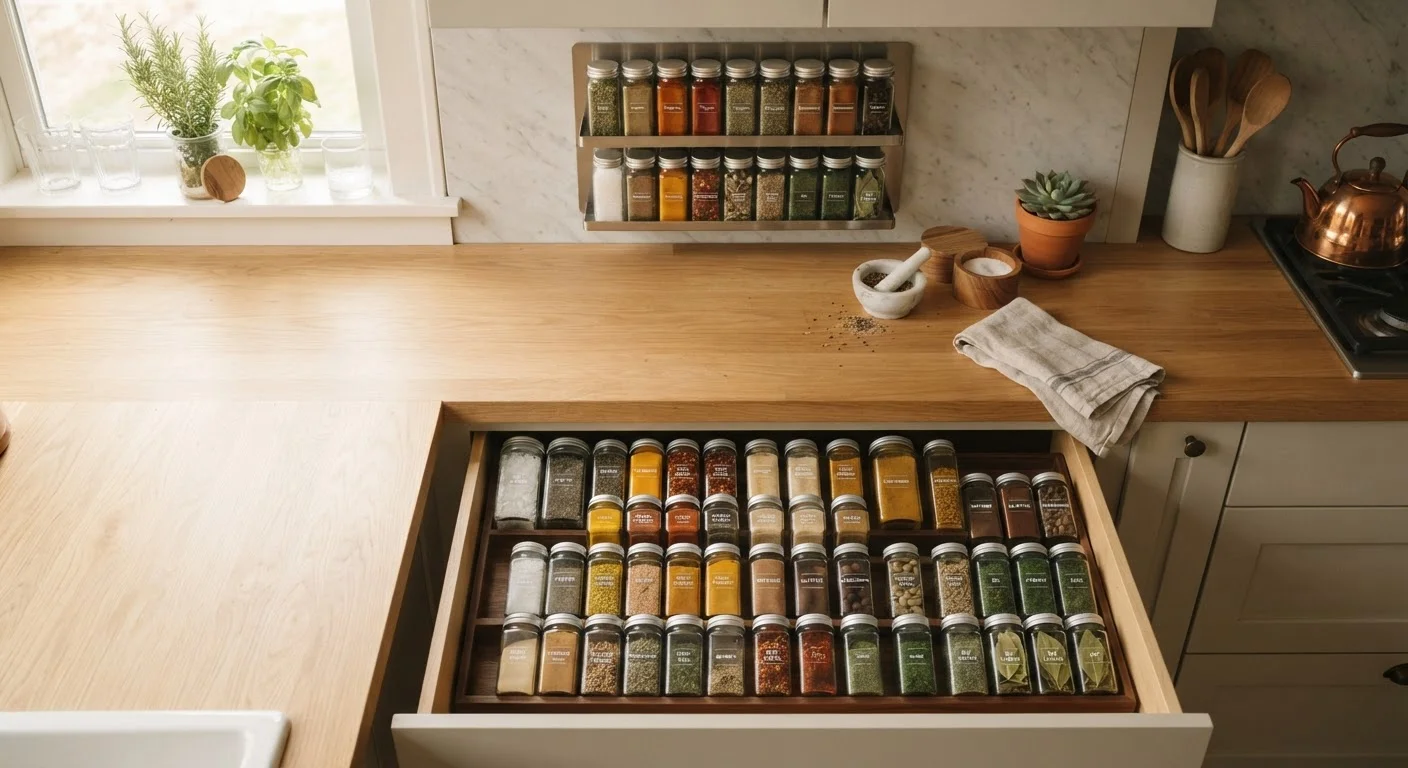
A spice drawer uses angled or flat inserts that let you look straight down at every label. For anyone who cooks frequently and uses a wide range of spices, this is the most efficient grab-and-go setup. The catch: you need a shallow drawer positioned close to your prep or cooking area. Deep drawers waste the advantage, and a drawer near the back of the kitchen defeats the convenience.
Standardizing your jars to a uniform height is practically a requirement here. A mix of tall and short bottles means some labels face down or get hidden. If you're already thinking about how drawer organization works across the kitchen more broadly, Drawer Dividers vs. Utensil Crocks covers the same organizational logic applied to utensils.
Wall-Mounted Racks: Space-Saving With a Catch
Wall racks—magnetic strips, tiered rails, or mounted shelving—keep spices off counters and out of cabinets entirely. They work especially well in small kitchens where every cabinet inch is spoken for. However, spices degrade faster when exposed to light and heat. A rack mounted above the stove or across from a south-facing window will shorten the shelf life of your spices noticeably. A cooler, dimmer wall near the prep area is a better location.
Wall racks also work best for collections of 20 jars or fewer. Beyond that, the visual clutter increases and finding specific jars slows down. If small kitchen constraints are shaping your decisions, Small Kitchen, Full Pantry offers practical strategies for getting more out of compact spaces without renovation.
Cabinet Risers and Lazy Susans: The Flexible Middle Ground
Tiered risers let you see the back row of a cabinet shelf without moving anything. A lazy Susan (a rotating turntable insert) gives 360-degree access in a corner or deep cabinet. Both are inexpensive, require no installation, and can move with you if you reconfigure. The limitation is that neither fully solves the label-visibility problem—you're still reading the front of jars rather than the top.
These work best when you want a meaningful upgrade without committing to a full reorganization. They're also a practical first step if you're uncertain about your preferred system. Terminology like "lazy Susan" and related kitchen storage concepts are explained in A Reference Guide to Common Kitchen Storage Terms.
Dedicated Spice Cabinets: High Capacity, High Maintenance
Assigning an entire cabinet—or a section of one—exclusively to spices suits cooks with large collections who cook across diverse cuisines. The protected environment (dark, consistent temperature) is good for spice longevity. The challenge is that without a clear system, a spice cabinet becomes a black hole. Alphabetical order, cuisine grouping, or frequency-of-use placement all work—the key is picking one approach and labeling everything consistently.
This method also demands periodic audits. Spices pushed to the back expire quietly. A good rule: check dates when you rotate in new jars, similar to FIFO (first in, first out) principles used in pantry management. For a full comparison of those organizing frameworks, Pantry Organization Methods, Compared covers how different systems fit different households.