

Key Takeaways
Our Verdict
Category grouping is the right starting point for most households—it's intuitive, low-cost, and easy to maintain. FIFO rotation adds real value for families who buy in bulk or deal with frequent food waste. The container method delivers the cleanest results but demands sustained effort, making it best suited for households willing to invest time in setup and upkeep. Mixing methods, such as grouping by category while rotating stock and using containers selectively for high-turnover staples, tends to offer the best practical balance.
| Best for | Recommended |
|---|---|
| Households new to pantry organization or on a budget | Category Grouping |
| Bulk buyers or those managing food waste | FIFO Rotation |
| Households that prioritize visual order and have time to maintain it | Container Method |
| Busy families or shared kitchens | Category Grouping + FIFO Rotation combined |
Why Your Pantry Organization Method Matters
A disorganized pantry costs you in two real ways: time spent digging for ingredients, and money lost to forgotten food that expires. Choosing a consistent organizational method—and sticking to it—addresses both problems without requiring a kitchen renovation or a large budget.
The three most common approaches American home cooks use are category grouping, FIFO (first in, first out) rotation, and the container method. Each has real trade-offs depending on how your household shops, cooks, and shares the kitchen. If you're not sure where your current setup stands, a kitchen organization audit can help you identify what's working before you overhaul anything.
Category Grouping: Simple and Scalable
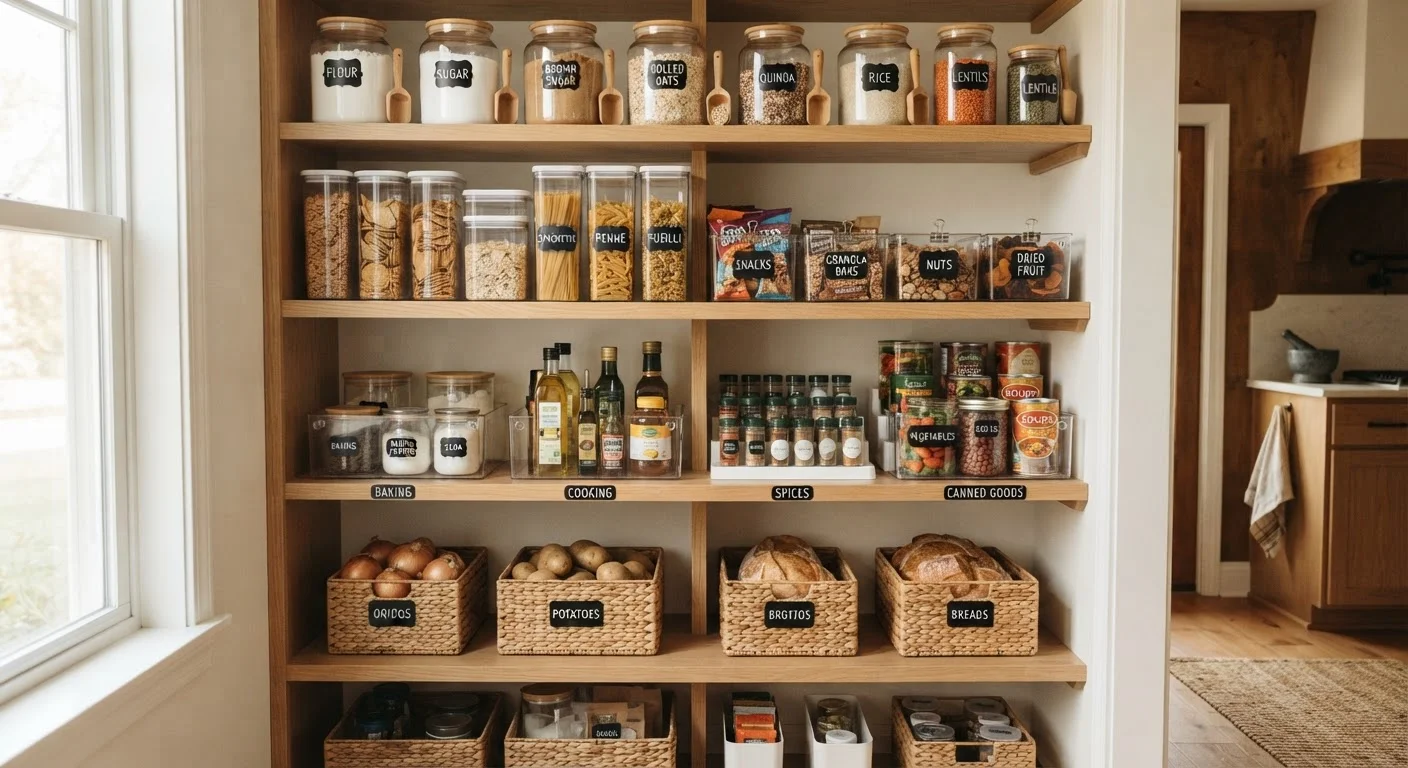
Category grouping means placing items together by type—baking supplies in one zone, canned goods in another, grains and pasta in a third. It's the most intuitive method because it mirrors how most people already think when they cook: Where are the pastas? not When did I buy this?
Strengths: Low setup cost, easy to explain to other household members, works in any pantry size. Once zones are established, restocking is straightforward and shopping lists are easier to build.
Weaknesses: It doesn't address expiration management. Items at the back of a category zone still get forgotten. Without a rotation habit layered on top, older items tend to linger.
Category grouping pairs naturally with cooking from what you already have, since knowing exactly where each type of ingredient lives makes a quick pantry audit fast before you shop.
FIFO Rotation: A Food-Safety Discipline
FIFO (first in, first out) is a stock-rotation method borrowed from commercial kitchens: new purchases go behind older stock so that older items always get used first. It's especially valuable for canned goods, dry staples bought in bulk, and anything with a meaningful shelf life.
Strengths: Directly reduces food waste. Keeps expiration dates relevant because older stock cycles through before newer stock. Works well for bulk shoppers and large households.
Weaknesses: Requires consistent restocking discipline—every grocery run means moving things around, not just placing new items in front. It can feel tedious for households with irregular shopping schedules.
Layer FIFO Into Any System
You don't have to commit fully to FIFO to benefit from it. Even with a basic category grouping setup, make a habit of placing new purchases behind existing stock when you unpack groceries. This small habit takes seconds and meaningfully reduces the odds of finding an expired can at the back of a shelf months later.
To understand which pantry labels actually indicate safety versus quality, see our guide to expiration dates and pantry food safety. Knowing the difference helps you apply FIFO more confidently.
The Container Method: Visual Order With a Higher Bar
The container method involves decanting pantry staples—flour, rice, oats, pasta, lentils—from their original packaging into uniform, labeled storage containers. The result is the tidy, cohesive look common in home organization content, but the reality involves meaningful upfront investment in containers and ongoing discipline to maintain.
Strengths: Clear visibility of quantities at a glance. Reduces packaging clutter. Works especially well for frequently used staples where you want to see how much you have left.
Weaknesses: Time-intensive setup and ongoing maintenance (refilling, relabeling). Containers have an upfront cost. Mixing product types or batches can create confusion around expiration dates unless you track them carefully. Not every pantry item transfers well—oddly shaped packaging, products you rarely use, or bulk buys all complicate the system.
If you're working with limited pantry space, the container method can actually be adapted effectively—our guide to maximizing storage in tight spaces covers how to use vertical space and door storage alongside containers to get more from a compact setup.
Side-by-Side Comparison
Here's how the three methods stack up across the criteria most relevant to everyday home cooks:
| Category Grouping | FIFO Rotation | Container Method | |
|---|---|---|---|
| Setup effort | Low | Medium | High |
| Ongoing maintenance | Low | Medium | High |
| Upfront cost | Minimal | Minimal | Moderate to high |
| Reduces food waste | Indirectly | Directly | Partially |
| Works for shared kitchens | Very well | Well | Requires coordination |
| Visual clarity | Moderate | Moderate | High |
| Best pantry size fit | Any size | Any size | Medium to large |
| Expiration management | Weak | Strong | Requires labeling |
Note that these ratings reflect general patterns—your specific pantry layout, household size, and shopping habits will shift the balance. For households where multiple people stock and use the pantry, a simpler, more visible system like category grouping is often easier to sustain. See our article on keeping a kitchen organized when multiple people use it for practical tips on shared-kitchen dynamics.
Choosing What Fits Your Household
The most effective pantry system is the one your household will actually maintain. A few questions that help narrow it down:
- Do you bulk-shop? FIFO rotation is nearly essential to prevent waste.
- Do multiple people restock the pantry? Category grouping is easiest for shared maintenance.
- Do you prioritize visual clarity? The container method delivers, but requires upfront commitment.
- Are you starting from scratch or refining an existing setup? Category grouping is the lowest-friction starting point.
Many households find that combining methods works best—for example, organizing by category as the base structure, applying FIFO within each zone, and using containers selectively for the five or six staples you go through fastest. For unfamiliar terms you encounter while setting up your system, the reference guide to kitchen storage terms covers concepts like FIFO, lazy Susans, and pull-out shelves in plain language.