

Key Takeaways
Option A
Zero-Based Budgeting
The detailed, deliberate planning system.
Best for: People who want complete visibility over every dollar and are comfortable planning on paper or digitally each month.
Option B
Envelope Budgeting
The tactile, spending-category system.
Best for: People who overspend in specific categories and want a physical or visual boundary that stops them in real time.
If you want full control over a complex monthly budget
Zero-Based Budgeting
Zero-based budgeting lets you allocate income across dozens of categories — including savings, debt payments, and irregular expenses — in one detailed plan.
If you consistently overspend in specific categories like groceries or dining out
Envelope Budgeting
Physical or digital envelopes create an immediate, visible boundary. When the envelope is empty, the spending stops — no math required.
If you prefer digital tools and rarely use cash
Zero-Based Budgeting
Zero-based budgeting translates easily to spreadsheets and budgeting apps, while envelope budgeting requires extra workarounds to function without cash.
If you're new to budgeting and want a simple starting point
Envelope Budgeting
Labeled envelopes are intuitive — allocate cash, spend from the right envelope, stop when it's gone. There's minimal setup and no spreadsheet knowledge required.
If your income or expenses vary significantly each month
Zero-Based Budgeting
You rebuild the budget from scratch each month, which makes it easier to adapt allocations when income or bills fluctuate.
How Each Method Actually Works
Both zero-based budgeting and envelope budgeting share a core principle: every dollar of income gets assigned a job before you spend it. But the mechanics are different enough that one may suit your life far better than the other.
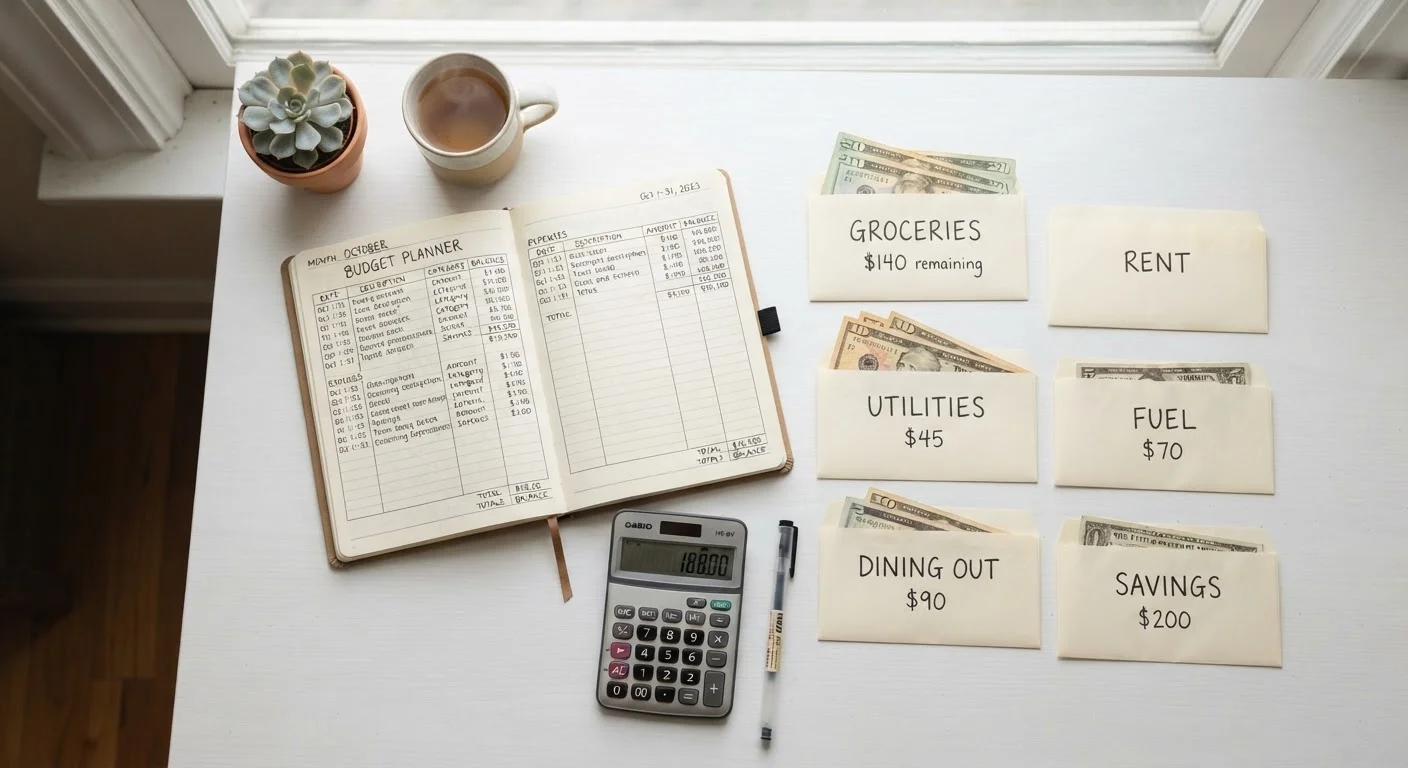
Zero-based budgeting means your income minus your planned expenses equals zero at the end of each planning session. You list every anticipated expense — rent, groceries, utilities, minimum debt payments, savings goals, subscriptions — and keep adjusting until the numbers balance. Nothing is left unassigned. You do this fresh at the start of every month, which is why it's called zero-based: you start from zero each time rather than copying last month's plan. For a deeper look at how to sort your spending into categories, see this reference guide to budget buckets.
Envelope budgeting works by dividing physical cash (or a digital equivalent) into labeled envelopes — one per spending category. Groceries get $400, gas gets $150, dining out gets $100, and so on. When an envelope runs out, spending in that category stops until the next budget period. The boundary is built into the system; there's no calculation needed at the point of purchase. Cash budgeting in a digital world explores how to adapt this approach when you rarely carry cash.
Key Differences Side by Side
Understanding where the two systems diverge helps you decide which fits your situation. The comparison below covers the most practical dimensions.
| Criterion | Zero-Based Budgeting | Envelope Budgeting |
|---|---|---|
| Core mechanism | Income minus all expenses equals zero | Cash divided into labeled spending envelopes |
| Setup time | 30–60 minutes per month | 20–30 minutes per pay period |
| Spending enforcement | Self-reported; requires tracking | Hard stop when envelope is empty |
| Best format | Spreadsheet or budgeting app | Physical cash or digital envelope app |
| Flexibility month to month | High — rebuilt fresh each month | Moderate — categories can be adjusted |
| Works with variable income | Yes, with careful estimation | Harder — requires knowing income upfront |
| Risk of accidental overspend | Higher — relies on self-discipline | Lower — physical limit built in |
One distinction worth noting: zero-based budgeting is a planning tool, while envelope budgeting is primarily a spending control tool. The two serve overlapping but distinct purposes, which is why some people use both simultaneously — planning their full budget with a zero-based approach, then using envelopes for the categories where they're most likely to overspend.
Trade-Offs to Consider Before You Choose
Zero-based budgeting takes more time upfront. Sitting down each month to build a full income-minus-expenses plan requires discipline and a clear picture of what the month ahead holds. If your income is irregular — say, you're self-employed or work hourly with shifting schedules — estimating income accurately enough to plan around it can be genuinely difficult.
Envelope budgeting solves the overspending problem in a very direct way, but it creates friction with modern financial life. Most Americans pay bills electronically, use debit or credit cards, and rarely carry much cash. Using digital envelope systems (apps that mimic the concept) requires extra setup and some mental translation between the physical metaphor and your actual bank account.
Combining Both Methods Is a Valid Approach
Some budgers use zero-based planning for their full monthly picture — rent, savings, debt payments — and then apply envelope-style limits only to variable categories like groceries, dining, and entertainment. This hybrid approach captures the clarity of zero-based budgeting while adding the spending guardrails that envelopes provide. There's no rule that says you have to pick just one.
Neither system is a complete financial plan on its own. Both methods handle day-to-day spending well, but you'll still need separate thinking for longer-term goals. Tools like sinking funds and emergency funds — explained in this comparison of sinking funds vs. emergency funds — work alongside either budgeting method to handle irregular expenses and unexpected costs.
If you want to explore other frameworks before committing, zero-based budgeting compared to the 50/30/20 rule offers another useful comparison. And for a broader foundation, budgeting from the ground up covers all the core concepts in one place.
This article is for general informational purposes only and does not constitute personalized financial advice. Consider speaking with a qualified financial professional about your specific situation.