

Key Takeaways
Our Verdict
No single insulation material wins across every scenario. The right choice depends on where you're insulating, your climate zone, your budget, and whether you're working in a new build or an existing home. In most cases, a combination of types — such as rigid board on the exterior and fiberglass batts in wall cavities — delivers the best thermal performance.
| Best for | Recommended |
|---|---|
| Homeowners insulating open attic floors on a budget | Fiberglass batts or blown cellulose |
| Those sealing hard-to-reach gaps and vented crawl spaces | Spray foam (closed-cell) |
| Eco-conscious homeowners prioritizing recycled content | Cellulose |
| Insulating below-grade walls or exterior sheathing | Rigid board (foam board) |
Why Insulation Type Matters More Than You Might Think
Most homeowners know insulation belongs in the attic. Fewer realize that choosing the wrong material for a specific location can leave significant energy savings on the table — or create moisture problems that cost far more to fix. If you're new to home efficiency improvements, the practical first-timer's overview is a helpful starting point before diving into material specifics.
The core metric across all insulation types is R-value — a measure of thermal resistance. A higher R-value means the material slows heat transfer more effectively. But R-value alone doesn't tell the whole story. Installation quality, moisture behavior, air-sealing ability, and fit for the application all determine real-world performance.
It's also worth noting that insulation and air sealing are related but distinct strategies. Our article on air sealing vs. insulation explains why doing one without the other often leaves gaps in your efficiency plan.
The Four Main Types at a Glance
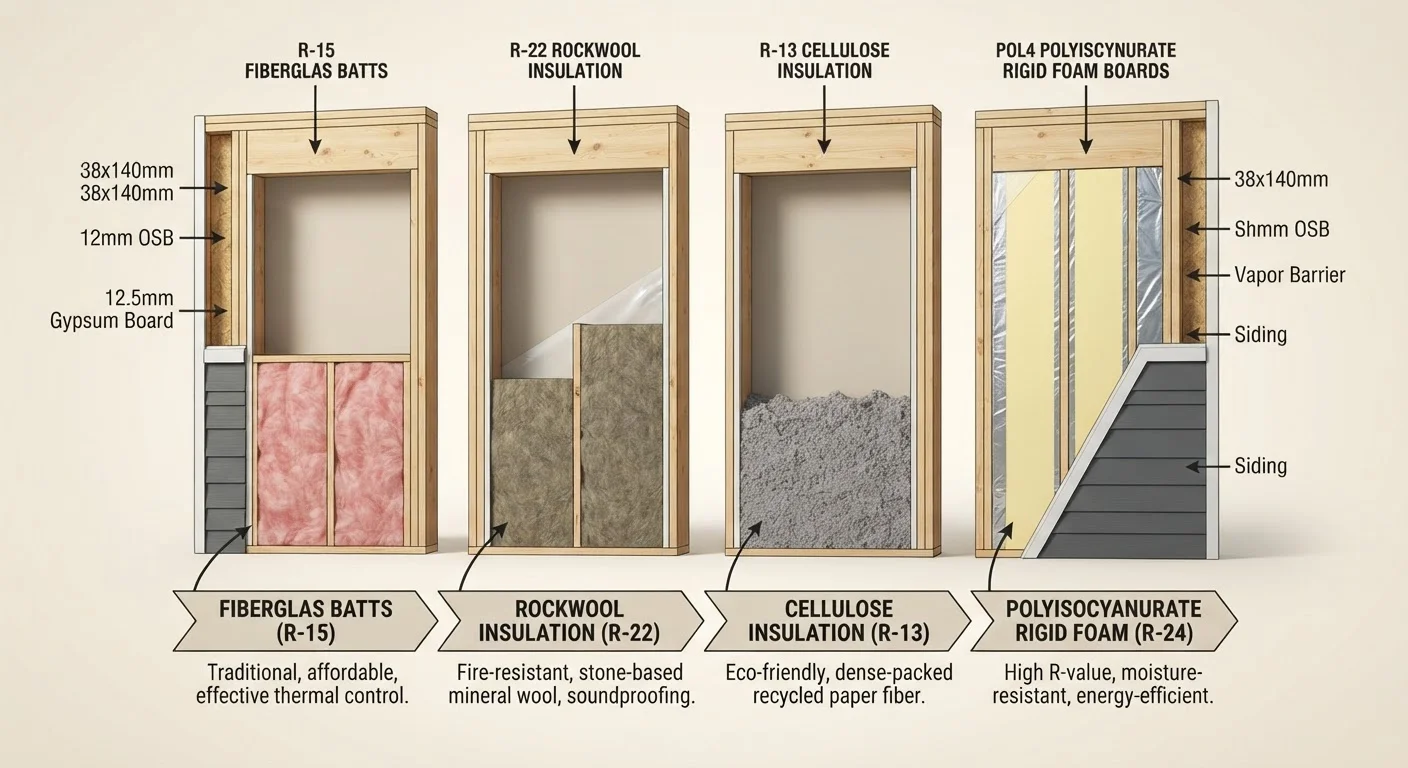
Here's how fiberglass, spray foam, cellulose, and rigid board stack up across the criteria that matter most to homeowners.
| Fiberglass | Spray Foam | Cellulose | Rigid Board | |
|---|---|---|---|---|
| R-value per inch | R-2.2 to R-2.7 | R-3.7 to R-7 (type varies) | R-3.2 to R-3.8 | R-3.8 to R-6.5 |
| Acts as air barrier | No | Yes (closed-cell) | No | Partial (taped seams) |
| Moisture resistance | Low | High (closed-cell) | Moderate | High |
| Typical installation | DIY-possible (batts) | Licensed applicator required | Pro equipment needed | DIY-possible (cutting boards) |
| Relative cost | Lower | Higher | Moderate | Moderate to higher |
| Common applications | Attics, wall cavities | Rim joists, crawl spaces | Attics, existing walls | Exterior sheathing, basements |
| Recycled content | Some (varies by product) | None | High (recycled paper) | None |
Each material is explored in more detail below, including where it works best and what limitations to keep in mind.
Fiberglass: The Familiar Standard
Fiberglass insulation — available as batts (pre-cut blankets) or loose-fill — is the most widely installed type in U.S. homes. Batts are designed to fit standard stud and joist spacing, making them a practical DIY option for unfinished attic floors and open wall cavities. Loose-fill fiberglass is blown in by machine and suits irregularly shaped spaces or topping off existing attic insulation.
Typical R-value: R-2.2 to R-2.7 per inch (batts); slightly higher per inch for some blown products.
Where it works well: Attic floors, floor joists over crawl spaces, open wall cavities before drywall is installed.
Limitations: Fiberglass does not block air movement on its own — it only slows conductive heat transfer. In drafty areas, its effective performance drops noticeably. Proper fit is critical; gaps and compression both reduce R-value. Handling requires gloves, eye protection, and a dust mask.
Spray Foam: High Performance, Higher Cost
Spray polyurethane foam (SPF) comes in two formulations: open-cell (lower density, lower R-value, vapor-permeable) and closed-cell (denser, higher R-value, acts as a vapor barrier and air barrier). Closed-cell foam reaches roughly R-6 to R-7 per inch — the highest of any common insulation type.
Where it works well: Rim joists, vented crawl spaces being converted to conditioned spaces, attic roof decks (unvented assemblies), and sealing around penetrations. Closed-cell is also used in below-grade applications where moisture resistance matters.
Limitations: Spray foam is the most expensive option per square foot and must be installed by a licensed applicator. Improper mixing ratios during installation can cause long-term off-gassing issues. Some formulations require a thermal barrier (typically drywall) when left exposed indoors due to fire codes. Always verify local code requirements before proceeding.
Get an Energy Audit Before Choosing
Before committing to any insulation type or location, consider scheduling a professional home energy audit. Auditors use tools like blower door tests and thermal imaging to pinpoint exactly where your home is losing conditioned air and heat — information that makes insulation decisions far more targeted and cost-effective. Learn more in our guide to home energy audits.
Cellulose: The Recycled-Content Option
Cellulose insulation is made primarily from recycled paper — typically newspaper — treated with fire retardants. It's installed as loose-fill blown into attic floors or dense-packed into wall cavities. Dense-pack cellulose can fill irregular spaces effectively and, when properly installed, reduces air movement within the cavity more than fiberglass batts.
Typical R-value: Around R-3.2 to R-3.8 per inch.
Where it works well: Attic floors (blown loose-fill), existing wall cavities accessed through small holes (dense-pack), and floors over unconditioned spaces.
Limitations: Cellulose absorbs moisture more readily than foam-based products, so it's less suited to areas with chronic moisture exposure. Settling over time can modestly reduce R-value in horizontal applications. Professional installation equipment is required for dense-pack applications. For a broader look at where insulation fits within your home's efficiency systems, see our whole-home energy efficiency guide.
Rigid Board: The Thin-Profile Solution
Rigid foam insulation panels — including expanded polystyrene (EPS), extruded polystyrene (XPS), and polyisocyanurate (polyiso) — deliver relatively high R-values in a thin, rigid format. This makes them useful in places where space is limited or where continuous insulation is needed without thermal bridging through studs.
Typical R-value: R-3.8 (EPS) to R-6.5 (polyiso) per inch, depending on product.
Where it works well: Exterior wall sheathing, below-grade basement walls, under slab applications, and the interior side of basement walls. Rigid board is also commonly used in low-slope roofing assemblies.
Limitations: Most rigid foam panels require a fire-rated thermal barrier (such as drywall) when installed on interior surfaces — check local building codes. Polyiso's R-value can drop in very cold temperatures, which is worth accounting for in northern climate zones. Seams between panels should be taped or foamed to limit air infiltration. A home energy audit can help you identify which areas of your home would benefit most from this type of insulation before you invest.
Note: Insulation work involving electrical wiring, gas lines, structural elements, or work in finished living spaces should be evaluated by a licensed contractor. Many jurisdictions require permits for insulation improvements — verify requirements with your local building department before starting any project.