

Key Takeaways
No monthly fees or long-term contracts required
Once purchased and installed, a local alarm has no recurring cost. For budget-conscious households, this makes the total cost of ownership significantly lower over time.
Immediate audible deterrent on site
A loud siren can startle and discourage an intruder before any breach is completed. It also alerts neighbors or passersby who may call for help.
Simple setup, often portable and renter-friendly
Many local alarm units require no professional installation and can be moved when you relocate — an important advantage for renters or frequent movers.
No dependency on internet or cellular connectivity
Standalone alarms function independently of network outages or service disruptions, which can be a reliability advantage in rural or low-connectivity areas.
Response depends entirely on nearby bystanders
If no one hears the alarm — or hears it but doesn't act — the event goes unreported. In low-density areas or at night, this is a significant limitation.
No automatic emergency dispatch capability
A local alarm cannot contact police, fire, or medical services on its own. A human must make that call, introducing delays or gaps in response.
Recurring monthly or annual monitoring fees
Professional monitoring involves an ongoing subscription cost that, over several years, can substantially exceed the upfront hardware expense.
False alarm dispatches can lead to fines
Many municipalities issue fines or fees after repeated false emergency dispatches. Sensor sensitivity and proper setup become more consequential with a monitored system.
Our Verdict
Local alarms are a practical, low-cost layer of deterrence that work best when neighbors are close and attentive. Monitored systems provide a reliable response chain that doesn't depend on proximity or luck, but that reliability comes with a recurring cost. Neither option is a guarantee of safety — both work best as part of a broader, thoughtful approach to home security.
Monitored systems tend to suit homeowners who travel frequently, live in lower-density areas, or want a documented emergency response chain; local alarms are a reasonable fit for renters, budget-conscious households, or those supplementing an existing monitored setup.
What Sets These Two Approaches Apart
At their core, local alarms and monitored alert systems represent two fundamentally different philosophies about what a security system is supposed to do. Understanding that difference is the starting point for making a sound decision.
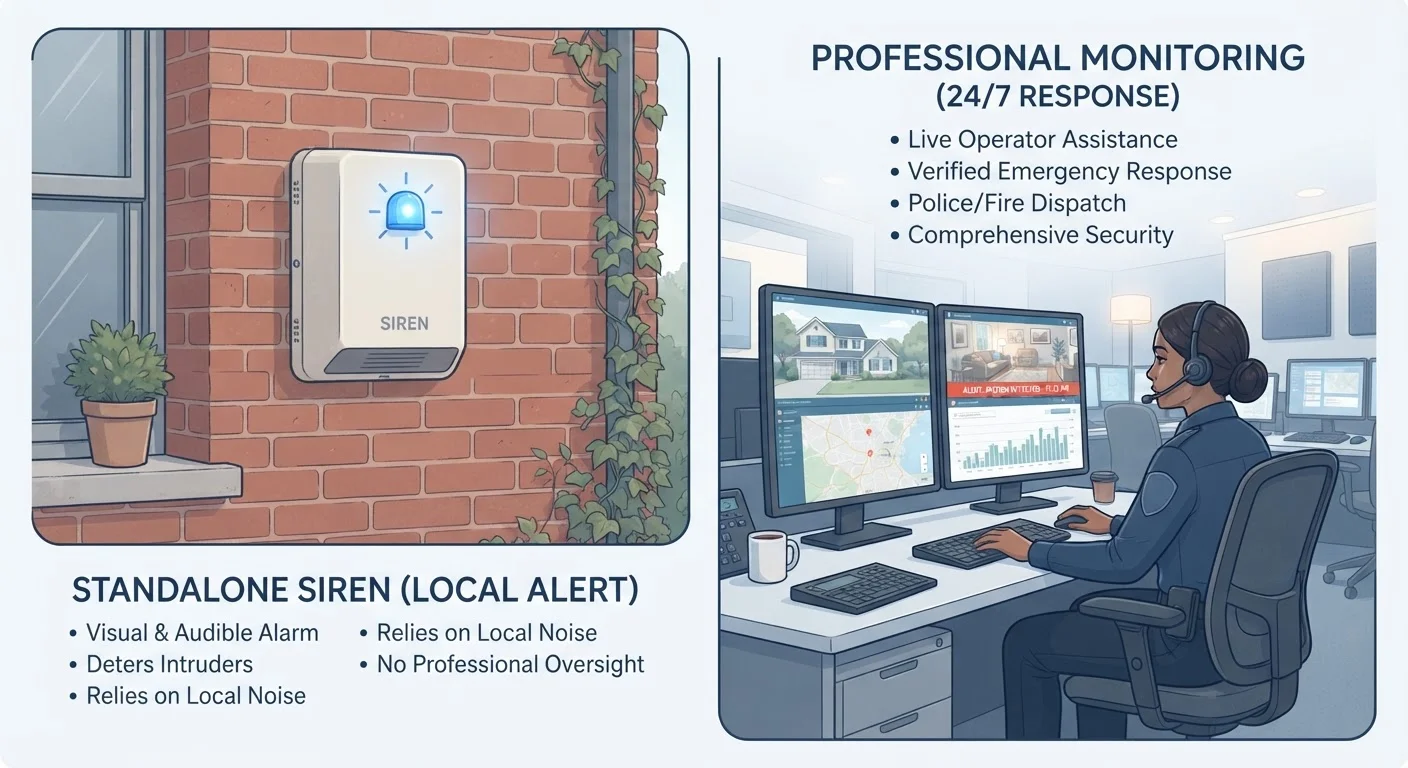
A local alarm — sometimes called a standalone or self-contained alarm — triggers an audible siren, a flashing light, or both when a sensor is tripped. That's the full response. No signal leaves your property. No dispatch center is notified. The alarm's effectiveness depends entirely on who is around to hear it and act on it.
A monitored system connects your sensors to a 24/7 central monitoring station (operated either by a professional company or, in some self-monitored setups, routed to your own smartphone). When an alert triggers, a trained operator — or an automated system — attempts to verify the event and, if warranted, contacts emergency services on your behalf. For a deeper look at how sensors, hubs, and sirens work together as a system, see Home Security Systems Explained.
The Case for Local Alarms
Local alarms have real, practical strengths that are easy to undervalue.
No monthly fees or long-term contracts required
Once purchased and installed, a local alarm has no recurring cost. For budget-conscious households, this makes the total cost of ownership significantly lower over time.
Immediate audible deterrent on site
A loud siren can startle and discourage an intruder before any breach is completed. It also alerts neighbors or passersby who may call for help.
Simple setup, often portable and renter-friendly
Many local alarm units require no professional installation and can be moved when you relocate — an important advantage for renters or frequent movers.
No dependency on internet or cellular connectivity
Standalone alarms function independently of network outages or service disruptions, which can be a reliability advantage in rural or low-connectivity areas.
A loud siren does two things simultaneously: it startles an intruder and signals neighbors or passersby to pay attention. In densely populated neighborhoods or apartment buildings, that acoustic deterrent can be surprisingly effective. Local alarms also sidestep one of the more frustrating realities of monitored systems — false alarm fees. Many municipalities charge homeowners or fine emergency services departments when repeated false alerts waste response resources.
For renters who can't hardwire anything, or for households that simply can't absorb a monthly monitoring fee, local alarms provide a meaningful layer of protection without a long-term financial commitment.
The Case for Monitored Alerts
Professional monitoring addresses the single biggest weakness of a local alarm: what happens when nobody hears it.
Response depends entirely on nearby bystanders
If no one hears the alarm — or hears it but doesn't act — the event goes unreported. In low-density areas or at night, this is a significant limitation.
No automatic emergency dispatch capability
A local alarm cannot contact police, fire, or medical services on its own. A human must make that call, introducing delays or gaps in response.
Recurring monthly or annual monitoring fees
Professional monitoring involves an ongoing subscription cost that, over several years, can substantially exceed the upfront hardware expense.
False alarm dispatches can lead to fines
Many municipalities issue fines or fees after repeated false emergency dispatches. Sensor sensitivity and proper setup become more consequential with a monitored system.
If you're asleep, away on a trip, or in a part of the house where a siren is muffled, a local alarm may make considerable noise and accomplish very little. A monitored system bypasses that dependency entirely. The moment a verified alert is confirmed, the monitoring station can contact police, fire, or medical services — whether you're reachable or not.
Monitored systems also typically generate event logs and, in some configurations, video verification, which can be valuable for insurance claims or police reports. Many homeowners' insurance policies offer modest premium discounts for professionally monitored systems, though the amount varies widely by insurer and location. It's worth asking your insurance provider directly rather than assuming a specific savings figure.
For a detailed comparison of what changes — beyond the monthly bill — when you choose professional over self-monitoring, see Professionally Monitored vs. Self-Monitored Security.
Self-Monitoring Is a Middle-Ground Option
Some systems route alerts directly to the homeowner's smartphone rather than a professional dispatch center. This eliminates the monthly fee while still providing remote notification — but it places the responsibility for calling emergency services squarely on you. If you're unreachable or slow to respond, the outcome may be similar to having no monitoring at all. Self-monitoring works best for people who are reliably reachable and quick to act on alerts.
Key Factors That Should Influence Your Choice
No single factor should dominate this decision. Consider the following together:
- Neighborhood density: A local alarm is more useful when neighbors are close enough to hear it and likely to call for help.
- How often you travel: Frequent travelers lose most of a local alarm's deterrent value the moment they leave town.
- Budget flexibility: Monitoring contracts typically run month-to-month or annually; factor that into a multi-year cost comparison.
- Local false alarm policies: Some municipalities issue fines after a set number of false police dispatches. Know your local ordinances before choosing a system that contacts emergency services automatically.
- Rental or ownership status: Renters face installation restrictions that may favor portable, wireless local alarms.
For homeowners weighing installation complexity as well, Wired vs. Wireless Home Security covers how your home's layout affects your options.
~38 seconds
Average time for a burglary to occur
The FBI's crime data has historically indicated that most residential break-ins are completed very quickly, underscoring the value of immediate deterrents rather than delayed response.
Up to 60%
Of break-ins deterred by visible alarms
Research compiled by the University of North Carolina at Charlotte found that visible security measures, including alarms, influenced burglar decision-making in the majority of surveyed cases.
Common Misconceptions Worth Addressing
Both local and monitored systems are sometimes credited with more protection than they reliably deliver. A sign in the yard, a siren on the wall, or a monitoring sticker on the window can act as visual deterrents — but none of them are foolproof, and treating them as such creates a false sense of security. Home Security Myths That Give Homeowners a False Sense of Safety separates the practices that hold up from the ones that don't.
It's also worth noting that some homeowners don't have to choose between the two approaches. A local siren on an exterior door combined with monitored interior motion sensors, for example, can provide layered coverage suited to specific vulnerabilities. The goal isn't the most expensive system — it's the most appropriately matched one. For a complete framework on evaluating your setup, Everything Homeowners Need to Know About Home Security Systems offers a thorough reference.