

Key Takeaways
Start here
Why Knife Skills Matter More Than Your Knife
Next
The Correct Grip and Stance
Core skills
The Four Cuts You Actually Use
Stay safe
Keeping Your Knife Sharp and Safe
Apply it
Putting It All Together
Why Knife Skills Matter More Than Your Knife
Most home cooks spend more time thinking about which knife to own than how to use the one they have. That's the wrong starting point. A basic 8-inch chef's knife, properly held and maintained, handles roughly 80% of everyday prep work — from slicing onions to breaking down chicken breasts.
What actually slows people down is uncertainty: unsure where to put their fingers, how much pressure to apply, or whether that cut is a dice or a mince. Those hesitations add up across every meal. Learning even a handful of deliberate techniques transforms chopping from a chore into something routine and fast.
If you're also rethinking how your kitchen is set up, organizing your workspace around how you actually cook can make knife work feel even more natural.
Pinch grip
A way of holding a knife where you pinch the blade between your thumb and index finger rather than wrapping all fingers around the handle. It gives you more control and stability while cutting.
Claw hand
The position of the non-knife hand while cutting — fingers curled so knuckles face the blade and fingertips are tucked safely away. The blade rides along the knuckles to guide each cut.
Dice
Cutting food into uniform cube-shaped pieces. Consistent sizing helps ingredients cook evenly so nothing burns while something else stays raw.
Mince
Cutting food into very fine, small pieces by rocking a knife repeatedly over a rough chop. Commonly used for garlic, ginger, and fresh herbs.
Chiffonade
A technique for leafy greens and herbs where you stack and roll the leaves, then slice across the roll to produce thin, even ribbons.
Honing
Using a honing steel to realign the tiny bent edge of a knife blade. It keeps an already-sharp knife performing well between full sharpenings.
The Correct Grip and Stance
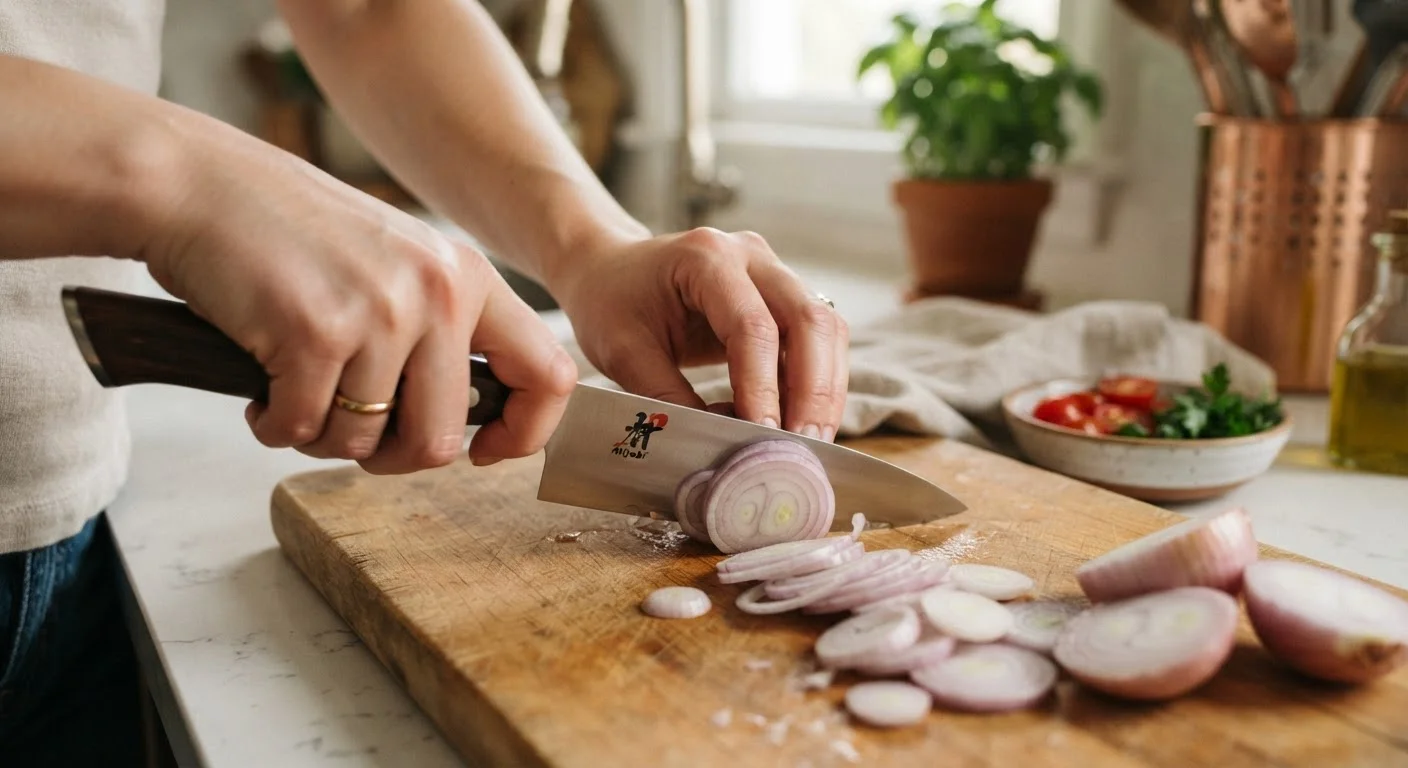
The pinch grip is the foundation of safe, controlled cutting. Pinch the blade itself — not just the handle — between your thumb and the side of your bent index finger, then wrap your remaining three fingers around the handle. This keeps the knife stable and gives you far more precision than a handle-only grip.
Your non-knife hand guides the food. Curl your fingers into a claw shape, with your knuckles angled slightly forward and your fingertips tucked back. The flat side of the blade rests lightly against your knuckles as you cut, which naturally limits how deep each stroke goes. This is the single habit that prevents most home-cook finger injuries.
Your body position matters too. Stand square to your cutting board, feet about shoulder-width apart, board at a height where your elbows are slightly bent when your hands rest flat. A board that is too low forces you to hunch; too high and you lose leverage. Place a damp kitchen towel under the board to keep it from sliding.
The Four Cuts You Actually Use
You do not need to master every classic French knife cut. These four cover nearly every recipe a home cook will encounter:
- Slice: A single straight or rocking cut through food. Use this for proteins, bread, mushrooms, and most vegetables. Keep strokes smooth and let the knife's weight do the work.
- Dice: Produces uniform cubes. First slice the ingredient into planks, then cut planks into strips, then cut strips crosswise into cubes. Consistent sizing matters because it affects how evenly food cooks — not just how it looks.
- Mince: Very fine, irregular pieces used for garlic, ginger, and herbs. Rough-chop first, then rock the knife back and forth over the pile, keeping the tip of the blade anchored on the board.
- Chiffonade: For leafy herbs and greens. Stack the leaves, roll them tightly lengthwise, then slice across the roll into thin ribbons. It's faster than tearing and keeps delicate herbs from bruising.
Once these feel automatic, you'll notice that mise en place — prepping everything before you cook — becomes genuinely practical rather than aspirational.
Keeping Your Knife Sharp and Safe
A dull knife is the most common source of kitchen cuts. When an edge won't bite into food, cooks apply extra force — and that extra force is what causes slips. A sharp knife requires far less pressure, giving you more control on every stroke.
Hone Before You Cook
Run your knife along a honing steel before each cooking session — it takes about ten seconds and noticeably improves cutting performance. Think of honing as maintenance between sharpenings, not a replacement for them. Most home cooks who do this find they need to fully sharpen their knives far less often.
Two tools maintain a knife edge at home: a honing steel and a sharpener. They do different jobs. Honing realigns the microscopic edge that bends slightly with use — run the blade down the steel at roughly a 20-degree angle before each session. Sharpening removes metal to create a new edge and is needed only a few times per year for most home cooks.
For storage, keep knives on a magnetic strip or in a knife block. Loose in a drawer, blades knock against other utensils and dull quickly — and reaching in blindly is a hazard. Wash by hand and dry immediately; dishwashers accelerate corrosion and can warp handles over time.
Putting It All Together
Knife skills compound. Once your grip is automatic, you stop thinking about it and start thinking about the food. Once your cuts are consistent, ingredients cook evenly and meals taste better. These aren't advanced techniques — they're the baseline that experienced home cooks rely on at the stove without thinking.
The fastest way to improve is simply to cook regularly and pay attention. Dice an onion every time a recipe calls for one instead of reaching for pre-cut. Mince your own garlic instead of using jarred. Those small repetitions build real muscle memory within a few weeks.
From there, pairing sharp knife work with a solid prep routine — like the one outlined in our before-you-cook checklist — closes the gap between cooking feeling stressful and cooking feeling manageable.