

Key Takeaways
Option A
Clumping Cat Litter
The scoopable, waste-isolating standard.
Best for: Cat owners who want quick daily scooping and clear visibility into how much their cat is urinating.
Option B
Non-Clumping Cat Litter
The absorbent, full-change alternative.
Best for: Households with kittens, cats with sensitivities, or owners who prefer less frequent scooping in exchange for full box changes.
If you want a fast, low-effort daily scooping routine
Clumping Cat Litter
Clumping litter lets you remove all soiled material in seconds without disturbing clean granules, making daily maintenance significantly quicker.
If you have a kitten under four months old
Non-Clumping Cat Litter
Young kittens may ingest litter while grooming; non-clumping formulas carry far lower risk of intestinal blockage in that scenario.
If odor control is your top priority
Clumping Cat Litter
Removing the entire urine clump daily eliminates the primary odor source rather than leaving it to break down inside the box.
If your cat has respiratory sensitivities or dust allergies
Non-Clumping Cat Litter
Many non-clumping options — particularly paper or wood-based formulas — produce significantly less airborne dust than traditional clumping clay.
If you want to monitor your cat's urinary health closely
Clumping Cat Litter
Distinct clumps make it easy to spot changes in urine frequency or volume, which are often early health warning signs.
How Each Type Actually Works
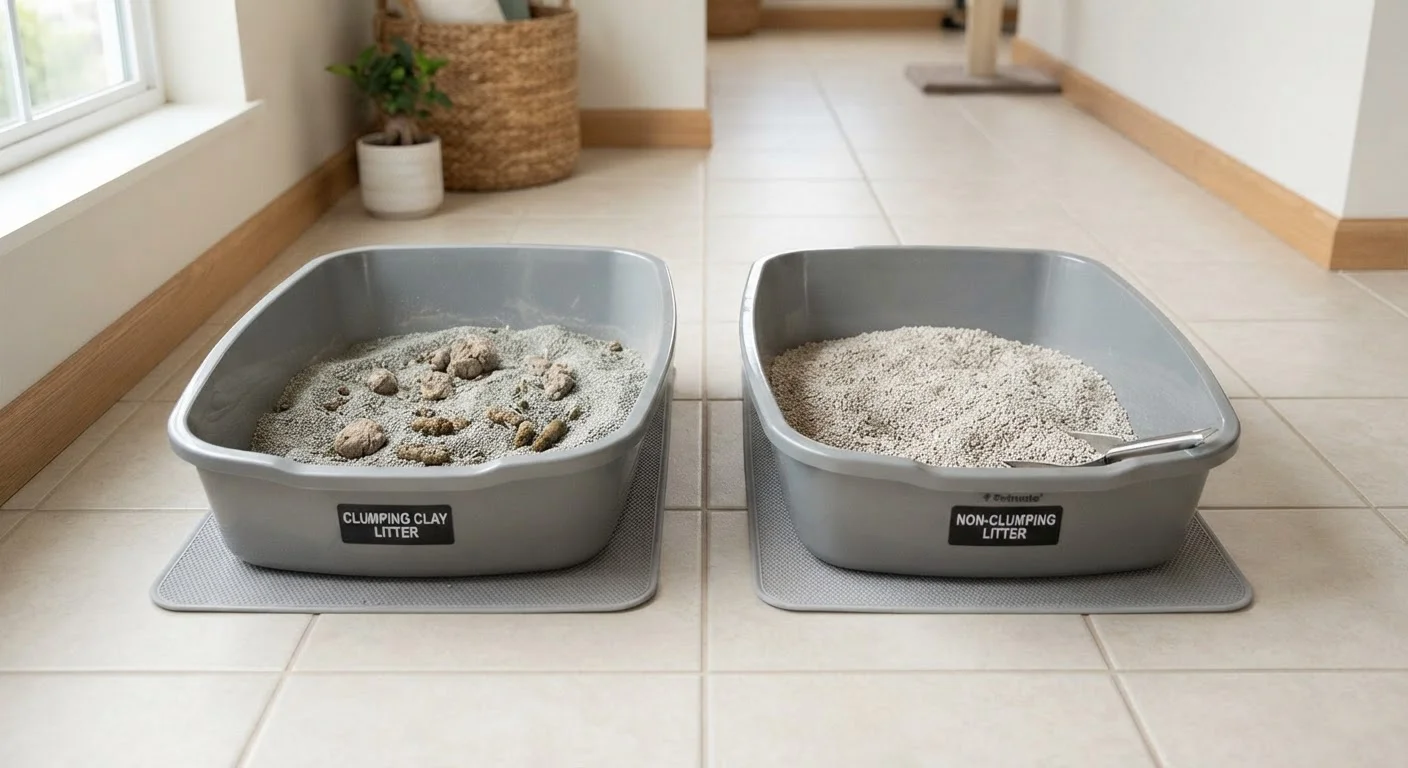
The core difference between clumping and non-clumping litter comes down to chemistry. Clumping litters — most commonly made from sodium bentonite clay — react with liquid on contact, binding granules together into firm, discrete clumps that can be lifted out intact. The clean litter surrounding those clumps remains usable.
Non-clumping litters absorb moisture without binding together. The granules soak up urine and distribute it through the litter bed, but they do not form a removable mass. Solid waste can still be scooped, but the urine stays in the box until a full litter change is done.
This single mechanical difference drives nearly every practical distinction between the two: how often you scoop, how often you do a full box change, how well odor is controlled, and what your overall time and litter cost look like week to week. For a broader look at all litter materials and how they compare, see our overview of clumping, crystal, paper, and clay litters.
| Criterion | Clumping Litter | Non-Clumping Litter |
|---|---|---|
| How waste is removed | Scooped out as firm clumps | Solids scooped; urine stays in box |
| Scooping frequency | Daily recommended | Solids as needed; no urine scooping |
| Full box change interval | Every 2–4 weeks (single cat) | Every 1–2 weeks (single cat) |
| Odor control | Strong — waste removed daily | Moderate — urine builds up over time |
| Safe for kittens under 4 months | Generally not recommended | Generally safer option |
| Dust levels (clay-based) | Often higher | Varies; paper/wood types are lower |
| Health monitoring | Easy — clumps visible and countable | Difficult — urine absorbed and hidden |
| Typical cost per month | Moderate — less litter used overall | Can be higher due to full changes |
Daily Cleanup: What Each Routine Actually Looks Like
With clumping litter, the standard approach is daily scooping. You remove urine clumps and feces, top off with fresh litter, and do a full box scrub and replacement roughly every two to four weeks depending on the number of cats. Because all soiled material leaves the box each day, odor is easier to manage with a lighter hand.
With non-clumping litter, solid waste is scooped as needed, but urine accumulates in the litter bed. This means the entire box contents need to be discarded and replaced more frequently — typically every one to two weeks for a single-cat household. Skipping that window allows ammonia to build up rapidly, which can deter cats from using the box reliably. Our guide on litter box habits and when to retrain explains how odor and cleanliness affect your cat's willingness to use the box at all.
For multi-cat homes, clumping litter typically holds up better between full changes simply because waste is removed rather than stored. Non-clumping in a multi-cat box may need changing every few days.
Health and Safety Considerations
One of the most important practical distinctions involves young cats. Kittens under approximately four months tend to explore their environment by tasting it — including their litter. Swallowed clumping clay can form obstructions in small digestive tracts, which is why most veterinary guidance steers owners toward non-clumping litter until kittens are old enough to reliably avoid eating it.
For adult cats, clumping litter is generally considered safe with normal use. However, cats that eat litter compulsively — a behavior sometimes linked to nutritional deficiencies or underlying health issues — should be evaluated by a veterinarian regardless of litter type.
Dust is another variable. Traditional clay-based clumping litters can be notably dusty, which poses problems for cats with asthma or chronic respiratory conditions, as well as for owners with dust sensitivities. Non-clumping alternatives made from paper, wood, or corn tend to produce less fine particulate. If your cat has respiratory concerns, material matters as much as clumping behavior.
Finally, clumping litter offers a practical health monitoring advantage: because urine becomes a discrete, visible clump, it is easy to notice changes in frequency or volume. Unusually small, frequent clumps or sudden absence of clumps can signal urinary tract issues that warrant veterinary attention. See our article on what the litter box can tell you about your cat's health for a full breakdown of what to watch for.
A Note on Flushable Litter Claims
Some clumping and non-clumping litters are marketed as flushable. However, many municipal water treatment systems are not equipped to filter out the parasites — particularly Toxoplasma gondii — that can be present in cat feces. Several state environmental agencies in the U.S. advise against flushing cat waste for this reason. Bagging and disposing of litter in household trash is generally the recommended approach, though you should check guidance from your local utility or water authority.
Which One Should You Choose?
Neither litter type is objectively better — they suit different routines and different cats. If you want the most time-efficient daily maintenance and strong odor control, clumping litter generally delivers that with less effort. If you have a young kitten, a cat with dust-related health concerns, or simply prefer a less frequent but complete swap-out approach, non-clumping litter is a sound choice.
Your cat's preference also deserves real weight here. Cats can be particular about texture and scent, and a litter a cat dislikes may go unused — which creates a worse problem than whatever the litter was supposed to solve. If you switch litter types, transition gradually by mixing the new formula into the old over seven to ten days.
For full context on how litter choice fits into your cat's overall indoor environment, our guide to setting up a safe indoor space for cats covers litter box placement, box count, and setup in relation to your cat's broader needs.