

Key Takeaways
Why the Environment Matters as Much as Food and Vet Care
Indoor cats live longer on average than outdoor cats, but living indoors only benefits a cat if the environment inside actually meets their behavioral and psychological needs. A cat confined to a bare apartment without outlets for natural instincts — climbing, scratching, hiding, hunting — will show it through stress behaviors: destructive scratching, litter box avoidance, aggression, or withdrawal.
Environmental enrichment isn't about buying the most expensive cat tree or the trendiest toy subscription. It's about understanding what cats are hardwired to do and making sure your home gives them the space and tools to do it. This guide covers the structural elements that matter most, so you can prioritize where to put your time and money. For a broader list of what to gather before a cat arrives, see the new pet owner's gear checklist.
Vertical Space: The Most Underrated Need
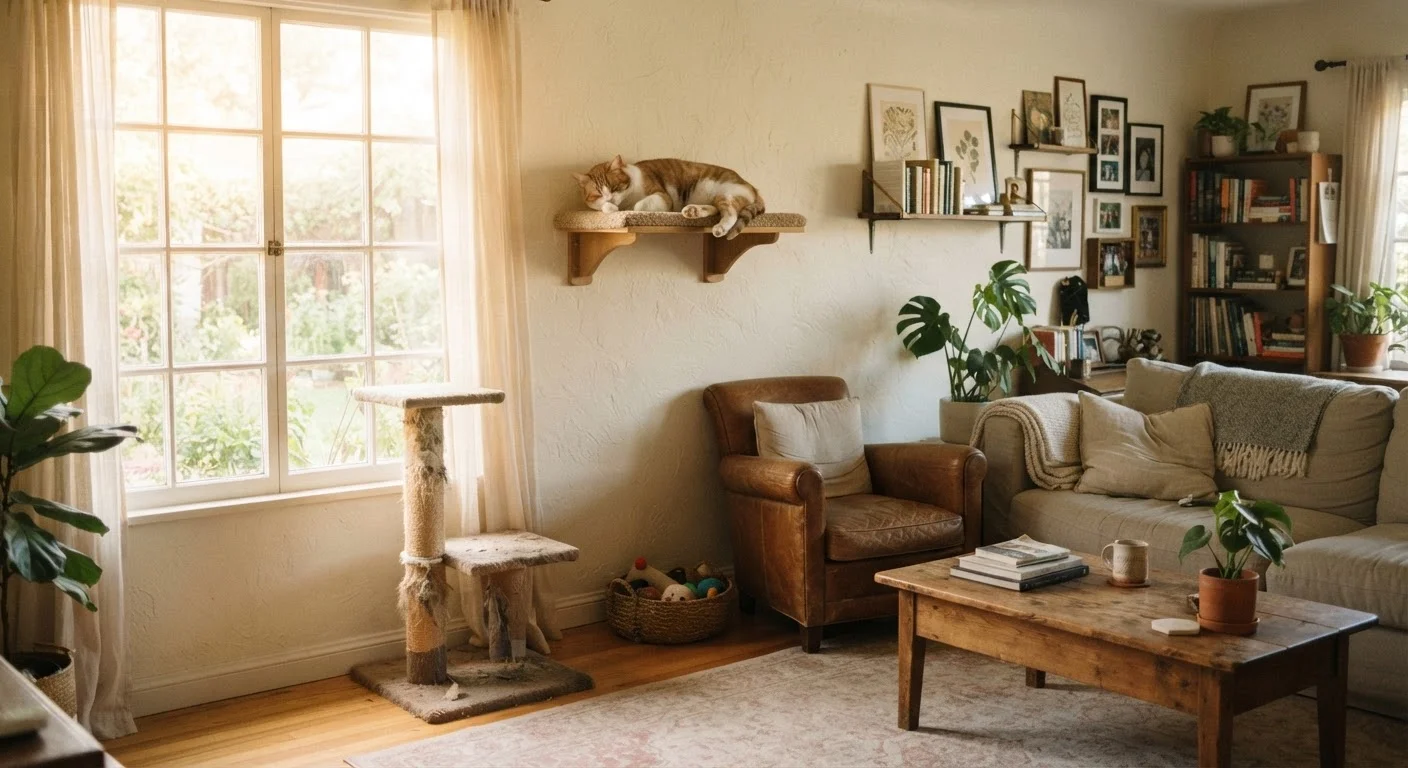
In the wild, cats use height to survey territory, escape threats, and feel in control of their surroundings. In a home, height functions the same way — a cat on a high perch feels safer and less stressed than one stuck at floor level. This is especially important in multi-cat or multi-pet households where ground-level resources feel contested.
Practical options include wall-mounted shelves stepped at varying heights, a sturdy floor-to-ceiling cat tree near a window, or cleared shelf space on a bookcase. The key requirements: stability (wobble sends cats elsewhere), reachable steps for older or less agile cats, and placement near windows so the perch doubles as a wildlife-watching station.
When introducing a new cat, set up a single 'base camp' room first — one with food, water, a litter box, a hiding spot, and a perch — before giving access to the whole home. This prevents overwhelm and helps the cat build confidence before expanding its territory.
Cats establish territory gradually. Too much space too fast can trigger anxiety and avoidance behaviors that are harder to reverse once established.
Rotate enrichment items — toys, puzzle feeders, cardboard boxes — on a two-to-three week cycle rather than leaving everything out permanently. Novelty drives engagement; familiar items lose their stimulation value quickly.
Cats habituate rapidly to static environments. Rotation mimics the changing stimuli of an outdoor territory and sustains exploratory behavior without requiring constant new purchases.
You don't need to cover every wall. One well-placed climbing route — ideally from floor to a perch at least five feet high — makes a meaningful difference for most cats.
Scratching Surfaces: Protecting Your Home and Your Cat
Scratching is not bad behavior. It removes the outer sheath of a cat's claws, stretches muscles along the spine and shoulders, and deposits scent-gland secretions as territorial marking. Cats that can't scratch appropriately are cats that will scratch your furniture — because the drive doesn't go away.
Offer both vertical and horizontal scratching surfaces, since cats have preferences that vary by individual. Sisal rope and corrugated cardboard are the two most commonly accepted materials. Posts should be tall enough that the cat can stretch fully upright — undersized posts are frequently ignored. Placement matters: put scratchers near entry points, sleeping areas, and wherever the cat already scratches. Once a preferred location is established, gradual redirection to the appropriate surface works better than punishment. For broader behavioral context, the guide to training cats explains redirection techniques that get consistent results.
Litter Box Placement and Setup
The general veterinary guideline is one litter box per cat, plus one extra. A single-cat household should have two boxes; a two-cat household, three. This prevents one cat from monopolizing access and gives every cat an option if one box is soiled.
Location matters as much as quantity. Cats prefer quiet, low-traffic spots with at least one clear exit route — a box wedged in a corner behind a door is a setup for avoidance. Avoid placing boxes near food and water. In multi-story homes, provide at least one box on each level.
Box size is frequently underestimated: the box should be roughly 1.5 times the length of the cat. Many commercially available boxes are too small for large breeds. Unscented litter, scooped at least once daily, is the baseline most cats accept. For help choosing a litter type, see cat litter types at a glance. Changes in litter box use are often an early health signal — what the litter box can tell you about your cat's health explains what to watch for.
Hiding Spots, Rest Areas, and Feeling Safe
A cat that can't hide when it feels threatened is a cat under constant low-grade stress. Hiding isn't dysfunction — it's a healthy coping mechanism. Every indoor cat needs at least one enclosed or semi-enclosed space: a covered bed, a box with a cut-out entrance, a shelf with a back wall. These serve as decompression zones during loud events, when strangers visit, or simply when the cat wants to be off the social grid.
Rest areas should be distributed throughout the home, not clustered in one room. Cats sleep 12–16 hours a day and cycle through multiple spots. Elevated resting places are preferred over floor-level beds by many cats, though older cats with joint issues may need lower, cushioned options. For guidance on why cats reject certain beds and what features they actually use, see pet beds that actually get used.
Hazards to Remove Before Your Cat Moves In
Indoor living reduces many risks, but introduces others specific to the home. Common household hazards for cats include:
- Toxic plants: Lilies (all species) are acutely toxic to cats and can cause kidney failure even in small amounts. Other common offenders include pothos, philodendron, and sago palm. The ASPCA maintains a searchable toxic plant database.
- Loose cords and strings: Linear foreign bodies — strings, rubber bands, tinsel — can cause life-threatening intestinal obstruction if ingested. Secure or remove them.
- Cleaning products and medications: Store all chemicals in closed cabinets. Many essential oils are also toxic to cats.
- Unsecured windows and balconies: Cats can and do fall from heights. Window screens should be secure; balconies should be fully enclosed if cats have access.
- Small gaps behind appliances: Cats seek enclosed warm spaces. Check behind dryers, refrigerators, and dishwashers.
Addressing these before a cat arrives is far easier than cat-proofing reactively. A safe space is the foundation everything else builds on — enrichment only works when a cat already feels secure enough to engage with it. For a complete overview of pet health basics, including preventive care, our hub covers the core practices every owner needs.